South Africa
SAHRC warns Gauteng water crisis requires accountability beyond government plans
The commission's inquiry found Gauteng's water failures stem from ageing infrastructure and poor municipal performance, not a shortage of water.
3 min read
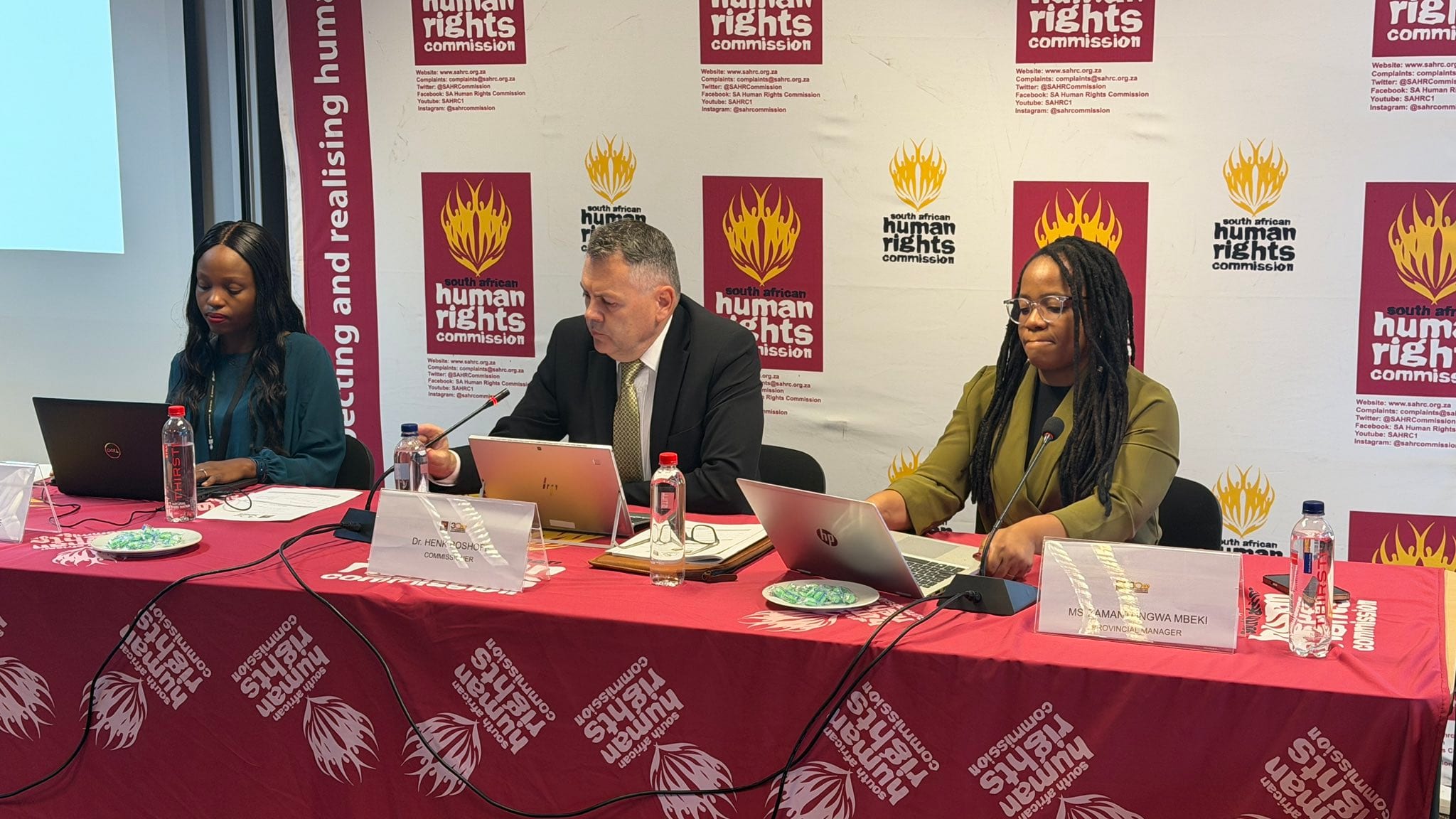
The South African Human Rights Commission (SAHRC) has called for urgent, measurable action to address Gauteng's persistent water and sanitation failures, warning that government coordination structures cannot replace effective infrastructure maintenance and accountability.
In a statement on Monday, Commissioner Henk Boshoff highlighted findings from its Inquiry Report into the State of Water and Sanitation Service Delivery in Gauteng, which was signed on 29 October 2026.
The inquiry, held from 19 to 21 May 2026, examined recurring water interruptions, infrastructure failures, sewage pollution and the impact of unreliable services on communities across the province.
The report found that Gauteng's water challenges cannot be attributed simply to an absolute shortage of water. The Department of Water and Sanitation reported that sufficient water resources were presently available to meet demand, although future augmentation would still be necessary.
Instead, the commission identified interconnected problems across the water-supply system, including ageing infrastructure, water losses, insufficient pumping and storage capacity, electricity interruptions and weaknesses in municipal distribution networks.
"The availability of water at source does not, by itself, ensure that communities receive water that is safe, sufficient and reliably available at the point of use," the report states.
Boshoff also raised concerns about failing wastewater treatment works and sewage pollution, which threaten rivers, the environment and water resources relied upon by communities.
The inquiry highlighted difficulties in obtaining information and securing cooperation from municipalities. All nine Gauteng municipalities had to be subpoenaed to participate. Rand West City Local Municipality did not appear before the commission and submitted written information only after the hearings.
The report states that most municipalities also failed to comply fully with subsequent requests for additional records.
"Accountability should therefore not begin with a subpoena," Boshoff said.
The findings raise questions about the effectiveness of existing government interventions and whether they are translating into reliable water and sanitation services for residents.
Under a section titled "Another meeting will not fix the pipe", the commission warns that task teams, dashboards and coordination structures do not necessarily resolve the underlying causes of service-delivery failures.
It says interventions should be assessed according to whether they produce measurable improvements rather than the number of structures established.
The report also examines the growing reliance on water tankers and stationary tanks, particularly in informal settlements and communities experiencing prolonged interruptions.
Tshwane, for example, reported supplying informal settlements through 282 water tankers, approximately 1,150 stationary 5,000-litre tanks and a further 106 stationary 10,000-litre tanks.
The commission recognises that alternative distribution systems may be necessary where permanent infrastructure cannot immediately meet communities' needs. However, it raises concerns about prolonged dependence on these arrangements, including questions around costs, water quality and accountability.
It stresses that emergency measures should not become a substitute for sustainable infrastructure and reliable services.
The commission has recommended strengthening municipal technical capacity, addressing financial and operational weaknesses, improving wastewater treatment and rehabilitating polluted rivers and wetlands.
It has also called for better protection of water infrastructure against theft and vandalism, alongside improved resilience across bulk-water systems.
The Department of Water and Sanitation is expected to report on priority wastewater treatment systems and proposed interventions within three months of the report's publication. Further reporting requirements include a recovery programme with responsible institutions, costs, funding arrangements and implementation timeframes, followed by a consolidated progress report.
"The recommendations in this report are therefore intended not merely to initiate further planning or coordination, but to support demonstrable improvements in the systems upon which communities depend," the report states.
The SAHRC says it will monitor implementation and report publicly on progress, emphasising that the success of interventions must be measured by improvements in the water and sanitation services communities receive.
Related stories

South Africa
Tshwane reports progress in Bronkhorstspruit water crisis that has left hundreds ill
By Justine Dumont
More on gauteng
All gauteng storiesSouth Africa
Mpox cases surge to 26 in five provinces, health department warns against stigma
By Justine Dumont
South Africa
Afrika Mayibuye probes its own as Councillor candidate accused of killing ANCYL members returning from memorial
By Mashudu Sadike
Latest from Africa Daily
Today's top stories- Act on fake documents or we will: AG to DCS
- Lebo M organises political debates ahead of elections
- Agrizzi to appeal R1.6 billion confiscation order
- EFF comes out guns blazing over Cape Town ballot paper chaos on first day of special votes
- Matlala trial: State's assault theory takes a beating as pathologist stands firm