The supplier of the South African Police Service’s vehicle tracking system cannot establish when or how the tracking device on a VW Golf central to the Matlala trial-within-a-trial came to be incorrectly configured, the Johannesburg High Court heard on Monday afternoon.
The setting is still under investigation, a C-Track consultant, Eric Deysel told the court under cross-examination, and the company has been unable to determine how it happened.
The witness had testified in the morning that the device on the Golf was set to draw its speed readings from the vehicle’s own speedometer rather than from the GPS satellite system, an arrangement he said is not possible on the installation.
The result was that the vehicle recorded no speed and no odometer data, and its status column logged it as continuously idling while the GPS coordinates in the same report showed it moving.
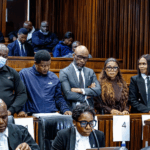
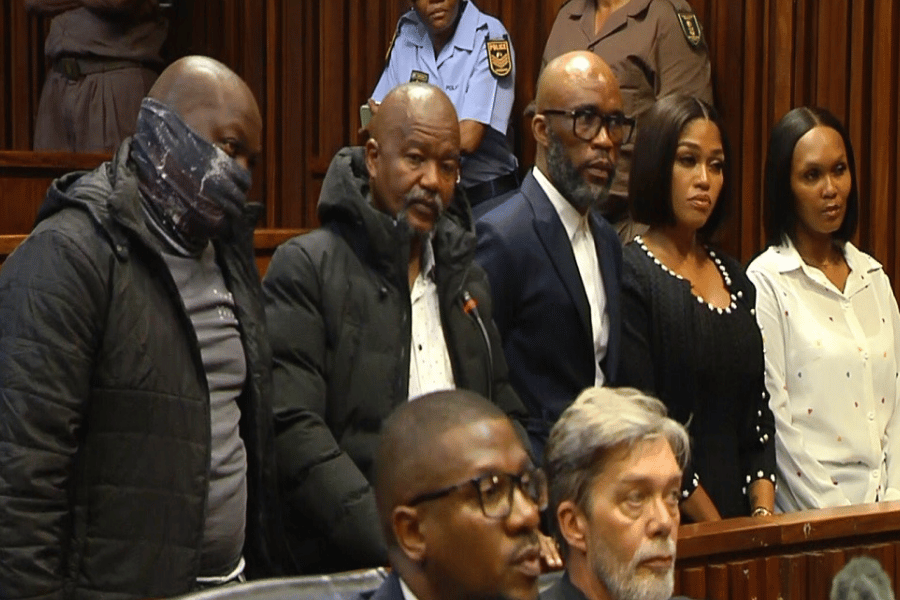
The trial-within-a-trial, before Judge Cassim Moosa, concerns the lawfulness of Musa Kekana’s arrest on 17 April 2024 and whether firearms and ammunition allegedly recovered afterwards may be admitted in the main trial against Vusimuzi “Cat” Matlala and four co-accused.
Under cross-examination the witness said his training was conducted in-house and covered the device, its capabilities, installation and testing, and the desktop software used to monitor the fleet.
He was not trained on the firmware, the operating code inside the tracking unit, which he said determines the device’s capabilities.
He does not know what firmware was installed on these units.
He was able to say that the latest available firmware for the device had been installed across the fleet, based on his working relationship with C-Track’s technical department, but could not say when it was last updated on this particular vehicle.
Faults on police vehicles are recorded on a call logging system that he can search by vehicle. He told the court he had not checked the fault history for each of the vehicles identified in his evidence.
He only checked the Golf and it showed a single maintenance call, on 24 February 2021, reporting the unit faulty.
No testing was carried out after 17 April 2024, and none to date.
There is no routine maintenance on the units, he said.
Asked whether C-Track only becomes aware of a problem once it is reported, he said the company would be aware of a fault before it is reported, but would act on it only once a report is received.
The prosecutor put it to him that a status column reading “excess idle” while the coordinates showed the vehicle moving would amount to a fault event. He agreed it would, though he said the term was not one used in his line of work.
He told the court he had never encountered the fault in nineteen years, and that after noticing it he asked C-Track’s technical department to check whether any other police vehicle was affected.
He was told none was. The State asked whether that made the claim hearsay, he agreed that it did.
But he drew one distinction, he personally examined the vehicle’s parameters and saw the setting was incorrect, and each police vehicle has a specific profile that he verified against the standard configuration.
That much is within his own knowledge.
The finding that no other vehicle in a fleet of roughly 38,000 is similarly affected rests on his colleague’s check.
Asked who had set the device up incorrectly, and whether the error arose at installation or later, he said C-Track had tried to establish when and how it happened and had been unable to do so.
The witness told the court that device settings are not applied physically at the unit. They are sent to the device from the software.
For police vehicles the device records on ignition-on, then at irregular intervals not exceeding five minutes while the vehicle is driving, with a final recording sent on ignition-off, after which it stops until the next start.
Certain events such as harsh braking, GPS unlock, battery tamper and speed violations are recorded immediately.
The device draws power from the vehicle battery and carries an internal backup that does not last indefinitely. If the power source is disconnected, the system logs a battery tamper status.
The witness said he had not scrutinised every status entry on every vehicle, but did not recollect seeing any battery tamper status on the vehicles in question.
On vulnerabilities, he listed device failure, physical removal of units, and jamming.
Signal to the satellite can also be affected by basement parking, tall buildings, bridges, and he accepted solar flares and atmospheric conditions.
In each case, he said, a loss of communication is recorded as a GPS unlock status and is therefore visible on the report.
Judge Moosa questioned the witness directly on how much of the report can be trusted.
Taken to a sequence showing the vehicle driving, driving again seconds later, and then in excess idle, and asked whether the court must accept the report as it stands, the witness said it should not.
He asked the court to accept the ignition-off and start-up statuses as correct and to disregard all other statuses, given the setting fault.
The judge also established the system’s margin of error. The devices used on police vehicles make provision for an inaccuracy of up to ten metres from the obtained GPS coordinates.
The witness qualified this, a vehicle is within ten metres of the coordinate, not necessarily of the street address shown in the location description, which is only the system’s best available description of that point.
The court was also taken to a start-up recorded at 06:50:36, followed roughly five minutes later by a recorded disconnection from the satellite.
In re-examination the witness confirmed that the longitude and latitude in the exhibit can be plotted line by line on a map to show where the vehicle moved, and that he had no reason whatsoever to doubt that the vehicle moved as those coordinates reflect.
The same, he said, applies to every other vehicle covered in the movement reports and the area reports.
It was put to him that, where a witness relies on memory to account for where and how he drove, and that version is contradicted by the objective GPS record, the court should prefer the contemporaneous objective evidence over recollection. He agreed.
The trial continues tomorrow, 15 September.