Dear Monsieur Ricard,
I am writing to you directly because this is not a matter I believe can reasonably be left with a local marketing team or treated as an unfortunate social media misjudgement.
The Glenlivet has apologised for an advertising campaign that invoked the historic Women’s March in Pretoria in South Africa in 1956, featuring the images and legacies of women who stood against apartheid, alongside a harmful alcohol product whose purpose is, ultimately, to be sold. The advert has been deleted and an apology has been issued. An investigation has been promised into how the campaign was “conceptualised and approved”.
Wonderful, but I have a question. Conceptualised and approved by whom?
Because somewhere between the first creative brainstorm and the moment that campaign went live, there must have been an entire room full of adults. Adults with access to Google. Adults with access to South African history, who presumably knew that the 1956 Women’s March was not a lifestyle aesthetic. Adults who knew that Ms Sophie Williams-De Bruyn is not a vintage photograph, and that Ms Winnie Madikizela-Mandela’s voice is not an atmospheric sound effect.
Yet somehow, not one of them stopped and asked: “Guys, are we really putting the 1956 Women’s March into a whisky advert?” That is the part I cannot get past. The stupidity is almost impressive.
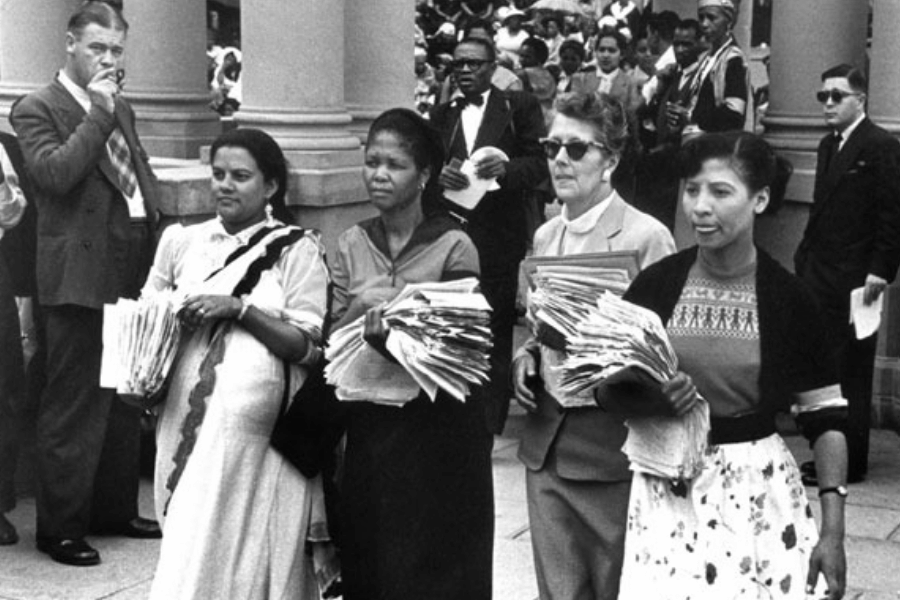
More than 20,000 women marched to the Union Buildings in 1956 to resist apartheid pass laws. Among the leaders was Mama Sophie Williams-De Bruyn, now the last surviving leader of that historic march. This year, South Africa marked 70 years since that defining act of resistance, honouring the courage, dignity and political agency of the women who marched.
Mama Sophie has spent this anniversary year reminding us that the work is unfinished. This is the woman whose legacy was apparently available for somebody’s mood board. Somebody looked at all of that history and thought: “Excellent material for a whisky campaign.”
That is not merely tone-deaf. It is in fact intellectually bankrupt.
The 1956 Women’s March was not an aesthetic. It was not a marketing opportunity. It was an act of political defiance by women confronting a brutal system that sought to control their movement, dignity and lives. The women who marched were not cultural props or marketing symbols. They were leaders whose sacrifices and struggles helped secure the freedom and democracy we enjoy today.
You cannot take Mama Sophie’s or any woman’s image from that march without taking the history attached to it. It is inconceivable that you would use Winnie Madikizela-Mandela’s voice as an emotional device without carrying the weight of the woman whose life that voice belonged to. You do not get to extract the icon and leave the struggle behind.
And this is where The Glenlivet apology becomes almost comically inadequate. “We acknowledge the concerns and offence caused by the post.”
No. You caused more than “offence”. You demonstrated an extraordinary failure of judgement about whose history you were touching. And the damage is done. What is worse is that it continues.
I saw the advert this morning on 29 August 2026 after The Glenlivet had already removed it and apologised. I encountered it because the content had already been copied and is circulating beyond the brand’s own social media channels. It continues to move across social media platforms and WhatsApp groups, where the brand’s deletion has absolutely no power to erase it.
That matters because the apology seems to assume that removing the original post somehow closes the incident. It does not. An apology does not unsee what people have already seen, nor does it retrieve screenshots. It does not erase copies or stop WhatsApp forwards. It does not prevent the video from continuing to circulate, nor does it undo the association the campaign deliberately created between the women of 1956, their struggle and a bottle of whisky.
The damage is no longer sitting neatly on The Glenlivet’s social media account waiting to be deleted. It is out there. And that is precisely why an apology, while necessary, is insufficient to simply let this go.
Monsieur Ricard, I have looked closely at the corporate structure behind The Glenlivet because I wanted to understand how this happened. The Glenlivet is part of Chivas Brothers, which is owned by Pernod Ricard, the French multinational of which you are Chairman and CEO. Pernod Ricard has operated in South Africa since 1994, with an African leadership structure that includes Sola Oke as CEO of Pernod Ricard Africa, Dudu Mokholo as Marketing Director, Pamela Nkuna as Corporate Affairs Director and Brendan Coogan as Chief Transformation Officer for Africa Middle East. In other words, this is not some distant brand operating independently of the corporation you lead. There is a corporate structure connecting The Glenlivet directly to your office, with a substantial African operation sitting between the global group and the South African market.
So how did this happen?
How many white men in this Scottish brand team, operating under a French multinational and selling into South Africa, were sitting in the room when this idea was conceptualised? Where did they find the audacity to decide what to do with the history of Black South African women?
These questions matter, and not because white people have no right to engage with South African history. Of course they do. Our history is the history of the country.
But there is a world of difference between engaging with a history with humility and presuming that you can appropriate its most sacred symbols for commercial purposes because you have decided they will make your campaign culturally resonant.
There is something deeply colonial and arrogant about that instinct.
To look at the story of Black women who confronted an apartheid state, extract the images that carry the greatest emotional and political power, strip away the historical struggle that gave those images meaning, and put them to work selling whisky requires an extraordinary sense of entitlement.
Pernod Ricard calls a white man its Chief Transformation Officer. I cannot help wondering what transformation means when a campaign like this can still emerge from your machinery.
The African National Congress (ANC) has rightly pointed to another layer of absurdity. Under colonialism and apartheid, alcohol was itself used as an instrument of exploitation and control, including through the notorious dop system in which workers were partly compensated with alcohol rather than fair remuneration. The history of alcohol in Black working-class communities is therefore not some neutral backdrop against which liberation history can be casually placed.
But this is bigger than alcohol. It is about what happens when liberation history becomes a commercial asset.
Brands have become too comfortable with turning our struggle into aesthetic. White-owned and controlled brands, in particular, need to understand that Black South African history is not a box of culturally resonant props from which you can select whatever makes your campaign look more profound.
Suddenly the blood, courage, sacrifice, political organising and human cost disappear behind a beautifully produced brand story, effectively turning struggle icons into whiskey-guzzling drunkards.
That is the obscenity. Not everything that can be accessed is yours to appropriate.
South Africans are not obliged to surrender our liberation history to whoever has the biggest marketing budget. The women of 1956 did not fight for freedom so that decades later a foreign alcohol brand could walk into the archive, take what it liked, add some cinematic production and call it cultural storytelling.
Mama Sophie did not march so that 70 years later a whisky brand could borrow the moral authority of her courage to make its bottle feel culturally meaningful. She marched because an apartheid government was trying to strip Black women of their rights. And here we are, seven decades later, watching a corporation strip something else from her: context, dignity and agency.
We are not interested in another carefully worded apology. South Africans want to know who thought this was a good idea, who approved it, what cultural and historical consideration was given to the campaign before it was released, and whether anyone in that approval chain understood what the 1956 Women’s March actually represented.
Deleting the post does not delete the thinking that produced it. And until that thinking is confronted, your apology is not the end of this conversation.
Regards
Kay Sexwale