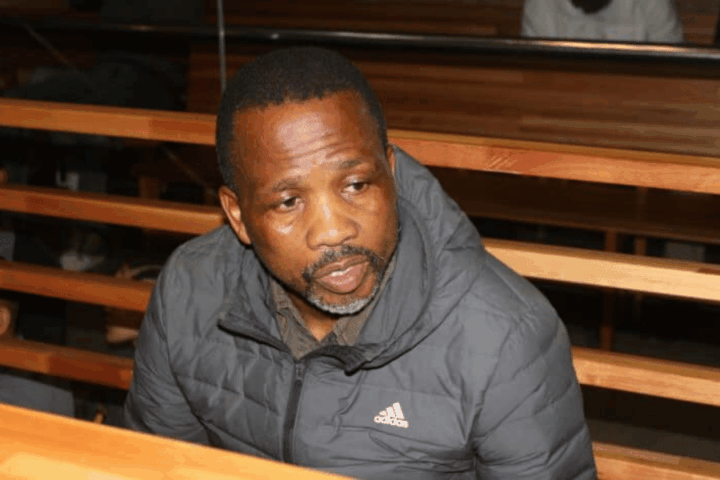
Johannesburg High Court-Satellite tracking data drawn from the South African Police Service’s own fleet management system placed sixteen police vehicles at Kew residential address on the day Musa Kekana was arrested.
A defence expert told the Johannesburg High Court on Monday, 14 September.
Ten more police vehicles were recorded at a second address on 8th Road that same day, the court heard, and nine of them had also reported at 34 fifth Road.
The evidence was led in the trial-within-a-trial in the attempted murder case against Vusimuzi “Cat” Matlala and four co-accused, before Judge Cassim Moosa.
The five face 25 consolidated charges including attempted murder, conspiracy to commit murder and money laundering.
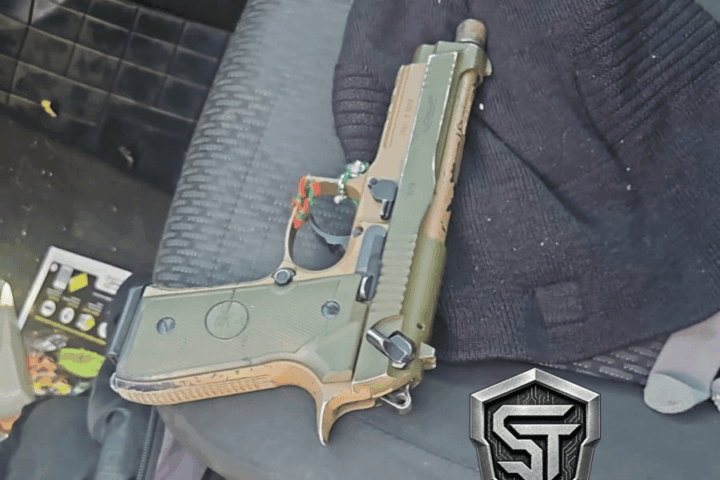
The trial-within-a-trial is examining the lawfulness of Kekana’s arrest on 17 April 2024 and whether firearms and ammunition allegedly recovered afterwards may be admitted in the main trial.
The witness is a consultant employed by C-Track, which he told the court is currently the sole supplier of vehicle tracking to the SAPS.
He has worked for nineteen years on the SAPS Automatic Vehicle Location (AVL) project, a fleet management system provided to the police.
His duties include overseeing the installation and de-installation of satellite tracking devices on police vehicles, extracting data from the system, assisting with investigations and court matters, and training SAPS users.
Approximately 38,000 police vehicles are currently fitted with the devices, he said, with installation ongoing as new vehicles are procured.
He understood there to be a national instruction requiring all SAPS vehicles to be fitted.
He appeared under a subpoena duces tecum, a point counsel confirmed was common cause between the State and the defence which required him to establish the movements of a particular vehicle on 17 April 2024, whether it was stationary at 8th Road and 34 Fifth Road in Kew, and whether any other police vehicles reported at those two locations.
The witness compiled a movement report for a VW Golf GTI, then used the GPS coordinates recorded by that vehicle to run area reports searches that identify every police vehicle reporting within a defined radius of a coordinate during a defined period.
The Golf’s day, according to the data, ran as follows, it reported at Midway Mall, a few hundred metres from the Fifth Road address, from 07:41 to 08:37.
Its ignition was switched off at 8th Road at 08:50.
It remained there until 12:01, returned at 12:20, and stayed until 15:55.
At 16:01 its ignition was switched off at the Fifth Road location, where it remained until 19:52.
An unmarked Toyota Fortuner, which has featured centrally in earlier evidence, tracked the Golf closely.
It reported at Midway Mall from 07:38 to 08:37, arriving three minutes before the Golf and leaving in the same minute.
It then moved between the two Kew addresses repeatedly, 8th Road on four occasions and Fifth Road on five, with stays running from 08:46 through to 21:40.
At several points the two vehicles moved within a minute or two of each other.
The Fortuner left 8th Road at 08:51, a minute after the Golf switched off there.
Both departed 8th Road in the late afternoon, the Golf at 15:55, the Fortuner at 15:56 and both arrived at Fifth Road within a minute, at 16:01 and 16:02.
The Fortuner’s movement report shows zero in the speed and odometer columns from beginning to end.
The witness told the court that all SAPS vehicles are configured to draw speed readings from the GPS satellite system. This vehicle, for reasons unknown to the witness, was set to obtain its speed from the vehicle’s own speedometer, something he said is not possible on the installation.
The consequence was that the vehicle recorded no speed and no odometer readings.
Because the system infers movement from speed, the status column logged the vehicle as continuously stationary throughout the day, when in fact it had moved, as the changing GPS coordinates in the same report demonstrate.
The misconfiguration did not affect the location data, he said, and there was no reason to doubt the accuracy of the GPS coordinates.
He had received no reports or complaints about the vehicle’s failure to record speed or distance.
The witness compiled spreadsheets summarising which police vehicles were identified at each address, their makes and models, the SAPS component each is attached to, and the periods each was present.
Among those named in evidence:
A 2023 VW Polo attached to a Pretoria North TRT unit, recorded at 34 Fifth Road from 09:03 until 21:43 more than twelve hours and never at 8th Road.
A 2020 BMW 3 Series attached to a murder and robbery unit, at Fifth Road from 09:05 to 10:23 and again from 10:30 to 18:13.
On the court’s request, the witness confirmed the vehicle reported 19 metres from the identified coordinate.
A 2023 Honda attached to a crime prevention unit, which moved between the two addresses four times between 10:17 and 12:16.
A 2019 Nissan NP300 attached to a TRT unit, and a 2020 Toyota Corolla attached to a crime prevention unit.
The vehicle recorded at 8th Road from 09:52 to 15:54 and at Fifth Road from 16:02 to 20:18.
Not every vehicle picked up by the area reports stopped at the addresses. A 2022 platform truck belonging to Johannesburg District Support Services was recorded in the vicinity of Fifth Road but, the witness said, drove past at 19:06.
Counsel Annelene Van der Heever began cross-examination on the platform truck, taking the witness line by line through its route on the morning of 17 April 2024.
The witness conceded he did not know what a platform truck is.
Under cross-examination he placed the truck’s 07:05 stop near Fifth Road, which lasted roughly an hour and forty-five minutes, at 160 metres from the coordinate used for the Fifth Road area report.
In evidence-in-chief he had described the vehicle as having stopped a few metres from the location
He further clarified that a zero reading in the odometer column does not mean a vehicle did not move, only that it travelled less than a kilometre between recordings, as the field is measured in kilometres.
On the reliability of the system generally, the witness told the court that technology can fail, and that a faulty tracking device provides no information at all.
Where communication between a device and the GPS satellite is lost, the system records a GPS unlock status, so such failures are visible on the report.
Cross-examination continues.