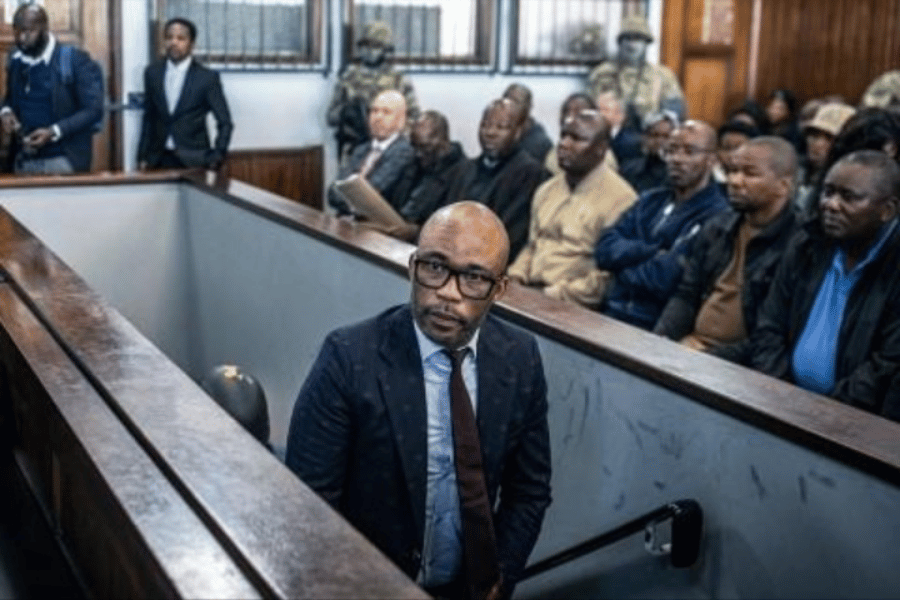
Three police officers who took part in the arrest of accused number one in the Matlala matter have given the Johannesburg High Court conflicting accounts of how they travelled to the scene and which vehicles were there.
Sergeant Mayisela John Ledwaba told the court under cross-examination on Friday, 11 September, that he collected Captain Sekgobela in Benoni at about 6am on 17 April 2024, drove him along the N12 while the captain arranged a meeting point by telephone, and continued to Bramley and then to the street where Musa Kekana was arrested.
Ledwaba said he drove the white Volkswagen Golf 7 GTI throughout.
Advocate Riaan Gissing, for Kekana, put to him that Captain Sekgobela had told the court something different, that the Captain had driven alone that morning, from OR Tambo to Norwood, that Ledwaba had not been in Benoni; and that Ledwaba had not been driving.
“One of you is lying, the question is who is lying,” said Gissing.
Ledwaba did not accept the proposition.
He told the court he had no reason to lie, and that he did not believe Captain Sekgobela had any reason to lie either.
He suggested the Captain may have forgotten, noting that the incident occurred more than two years ago and that the officer had attended many scenes since. He also pointed out that the N12 route passes OR Tambo.
The vehicles are disputed too. Lieutenant Colonel Tumelo Thomas Tsotetsi, who testified, places himself at the arrest scene and denies that any white Toyota Fortuner was there.
Ledwaba’s evidence is that Tsotetsi was at the meeting point rather than at the arrest scene, and that a Fortuner had been with the team at both addresses attended that day.
That corroborates Warrant Officer Johannes Phiri, who testified on Thursday that he drove an unmarked white Fortuner to both scenes.
Captain Sekgobela’s evidence, as put in cross-examination, is that there was no Fortuner at the arrest scene at all, not in the street, not at a neighbouring property and that Fortuners had not yet been issued to the team.
Asked repeatedly whether he disagreed with his commander, Ledwaba declined to comment on another witness’s evidence, suggesting only that Captain Sekgobela may not have seen the vehicle or may not have known which unit it belonged to.
Gissing put to him that he was refusing to concede the obvious in order to protect his colleagues. Ledwaba said he had answered every question put to him.
Gissing then put to Ledwaba a movement report for the Golf, recording automatic vehicle location data for 17 April 2024. On that report, he said, the vehicle’s ignition was switched off at 7:41 at what Ledwaba accepted was likely the meeting point, moved again at 8:37, and reached the arrest scene at 8:50. It left at 15:55 and arrived at the second address at 16:01.
That sequence would place the Golf at the arrest scene for about seven hours.
Ledwaba’s evidence is that he drove Kekana to the second address shortly after the arrest and remained there for the rest of the day.
Ledwaba said he could see the entries but could neither agree nor disagree with them, as he is not an expert in the system.
Offered an opportunity to correct his statement, he declined, saying there was nothing he wished to change.
The court raised the question of the reliability of the movement data. Gissing indicated that an expert would be called at a later stage.
Ledwaba told the court that Kekana was handcuffed behind his back at the arrest scene, and that by the time they arrived at the second address he was handcuffed in front.
Asked when the change occurred, Ledwaba said he did not see it happen and that it must have taken place during the journey, a journey in the vehicle he was driving, with Captain Sekgobela seated in the back beside the accused.
The trial-within-a-trial continues this morning, Monday, 14 September.