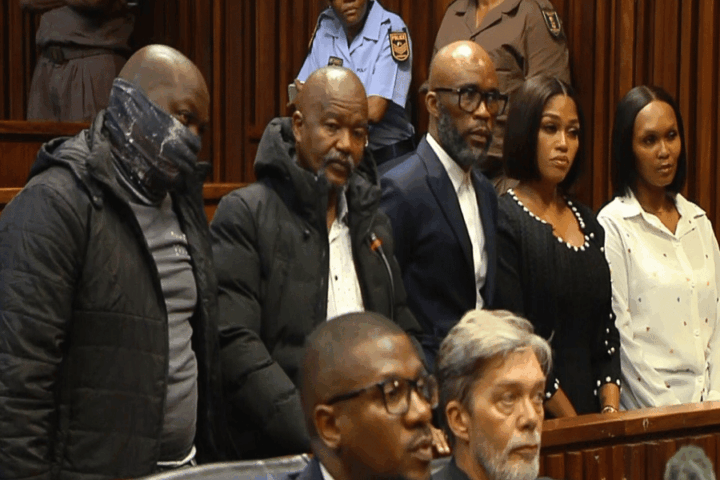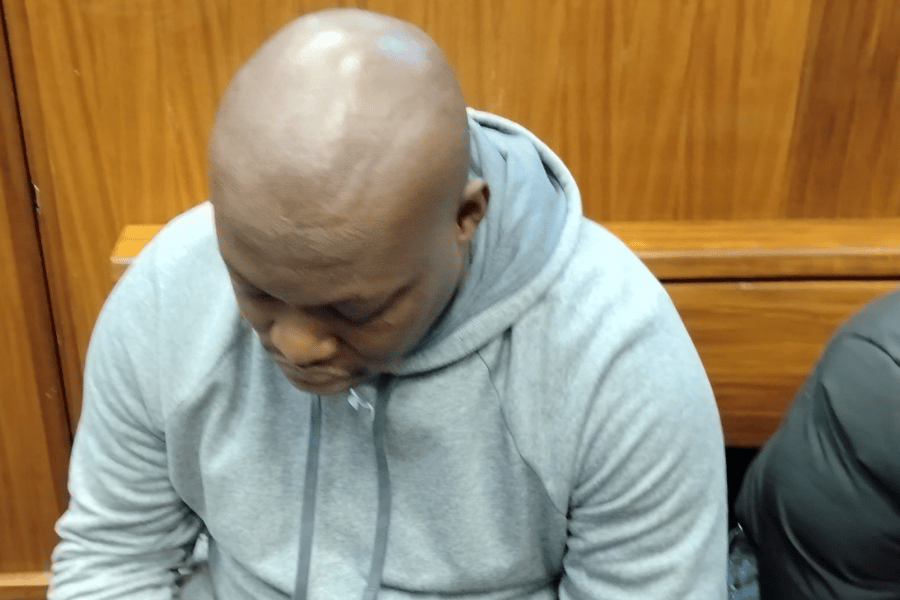
Graphic allegations of police brutality emerged in the Johannesburg High Court on Friday, where Police Captain Phimi Alfred Sekgobela denied claims that he and his team suffocated accused No. 1, Musa Kekana with a plastic courier bag, assaulted him, tied him with his own belt and threatened to shoot him.
Sekgobela rejected every allegation put to him by the defence, insisting that, as a captain, he would never have allowed such conduct by himself or his team.
“I cannot be the leader and allow such mistakes to happen. I have to ensure each and every member follows protocol. I’d never do that,” said Sekgobela.
Acting on Kekana’s instructions, Gissing put a detailed version of events to the captain.
Gissing put it to the Sekgobela that Kekana was forced to kneel and had a duvet cover placed over his head.
That Sekgobela said: “Give me the guns, otherwise I’ll blow your head off.”
Acting on Kekana’s instructions, Gissing put it to Sekgobela that Kekana was forced to kneel and had a duvet cover placed over his head.
He further alleged that Kekana started praying while other officers punched him as he repeatedly denied knowing anything about firearms.
According to the version put to the court, the duvet cover was then removed and Kekana was told he was being given “one chance.”
Gissing alleged that officers removed Kekana’s trouser belt, forced him to lie on his stomach, tied his hands with the belt and pinned him down by pressing a knee into his back.
He further put it to Sekgobela that a plastic courier bag found inside the house was repeatedly pulled over Kekana’s head to suffocate him while officers questioned him about the whereabouts of firearms. They wanted to know who owned the Hyundai, and the whereabouts of a Mercedes-Benz.
Finally, Gissing alleged that Kekana collapsed and lost consciousness.
While unconscious, he may have uttered only “yes” or “no” as officers put information to him for confirmation or denial.
He further alleged that the bag was placed over Kekana’s head again after he regained consciousness and that, when it was finally removed, Kekana began coughing up blood.
Sekgobela’s denials were flat and repeated. “That’s not true. We don’t do those things. We don’t go around assaulting and torturing people,” he said.
Sekgobela also denied the allegation, telling the court he had not even seen the plastic courier bag.
He denied ever seeing Kekana kneeling or praying, insisted that no assault took place in his presence, and rejected the claim that he had uttered the words attributed to him.
“He was cooperative and on his feet at all times. He was never on the floor, never confused, and never tied with a belt,” said Sekgobela.
But the defence pointed to medical records in support of the allegation.
Gissing referred the court to a medical progress report recording that Kekana had been coughing up blood after an alleged assault.
Asked to respond, Sekgobela said: “No comment on that.”
Counsel then took the court to a further hospital entry dated 18 April 2024, which recorded a diagnosis that the blood was coming from the lung.
“I understand… but that was not done by us,” said Sekgobela.
Gissing then referred the court to the diagnosis and management notes, putting it to Sekgobela that the medical findings were consistent with the defence’s account that Kekana had been punched and suffocated with a plastic courier bag.
He further argued that Kekana had reported being assaulted on the very day of the incident, making the complaint contemporaneous rather than something recently fabricated.
“But we didn’t assault him,” Sekgobela replied.
The coughing, and the timeline
Sekgobela maintained that the coughing had begun before the alleged assault.
He testified that he first noticed Kekana coughing at the original arrest scene, at 8th road Kew before police travelled to house number 34, 5th road Kew.
Gissing challenged that evidence.
“Now we’re hearing for the first time that he started coughing at the first scene,” he told the Sekgobela.
Sekgobela replied that he had mentioned it previously.
Sekgobela also testified that he instructed a member to call an ambulance.
Asked when it arrived and how long it remained at the scene, he said he would need to refresh his memory but estimated that it arrived before 1pm and left at about 3pm, during which time Kekana was treated and arrangements were made for a police escort.
Gissing then referred him to hospital records showing Kekana was admitted at about 8:30pm.
“I’m not disputing that,” Sekgobela said.
Asked how that could be reconciled with his own evidence, he replied: “No comment.”
Cross-examination also returned to the disputed search of house number 34, 5th road Kew.
Gissing put it to Sekgobela that Kekana had never consented to the search and that the gate had been opened manually.
Sekgobela rejected both propositions.
He maintained that Kekana opened the gate himself using the remote, cooperated with police throughout, and unlocked the rooms with his own keys.
No doors were forced, he said, and no officer left the scene because there were too few members to split the team.
“He gave us permission to search,” Sekgobela told the court.
Asked whether there had been reasonable grounds for the arrest, he replied:
“There were reasonable grounds. In South Africa, if you break the law, you get arrested.”
Gissing finally put it to Sekgobela that Kekana had been tortured so severely he was no longer in his sober senses.
Sekgobela rejected that allegation, maintaining that Kekana remained fully conscious throughout and that police had called an ambulance once they noticed him coughing.
Cross-examination concluded on Thursday. The trial-within-a-trial continues.