Parliament’s oversight meeting on the Department of Sport, Arts and Culture collapsed on Tuesday, 27 October after the department’s top leadership failed to show up to answer for a damning set of audit findings.
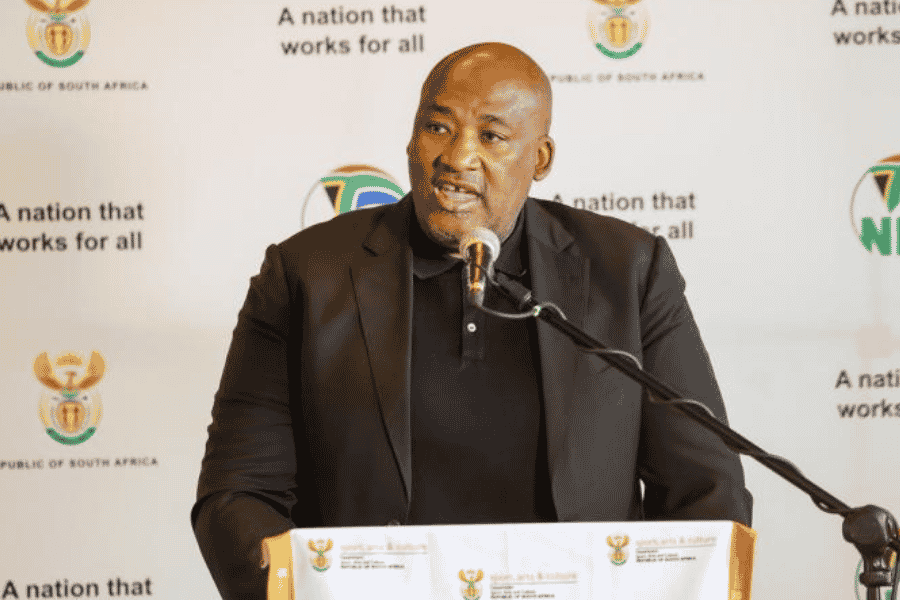
Minister Gayton McKenzie, Deputy Minister Peace Mabe and director-general Cynthia Khumalo were absent from the virtual meeting of the National Council of Provinces’ Select Committee on Education, Sciences and Creative Industries.
The meeting was meant to examine the Auditor-General’s findings on the department and the National Arts Council (NAC). Instead, it ended without either the department or the NAC presenting their reports, after committee chairperson Makhi Feni refused to proceed without political leadership from the department.
The shutdown came as the Auditor-General laid bare persistent weaknesses across the portfolio, including an outstanding irregular expenditure balance of R839 million, failures in consequence management and a R7.5 million material irregularity involving money transferred for purposes for which it was not used.
For a department whose leadership was expected to account for these findings, its absence left Parliament without the people best placed to explain what was being done to address them.
“If the deputy minister is not here, we are not going to proceed with this meeting. Political accountability is very important. We’re dealing with the financials of the department. It can’t just be left to the administrators,” Feni said.
He said that the committee’s standing rule was that, in the minister’s absence, at least the deputy minister and the head of administration should attend.
“That on its own shows a serious lack of taking accountability seriously,” he said.
The chairperson had allowed the Auditor-General’s team to proceed with its presentation because he had been told Mabe was on her way.
“We were told that the deputy minister was on the way to the meeting,” he said.
DSAC official, Sibusiso Tsanyane told the committee that Mabe was not on the virtual platform and that the department would contact her office to establish whether she would still join. She never arrived.
Feni said the audit findings raised issues requiring political oversight, not merely administrative explanations.
He refused to allow the meeting to continue in the absence of the deputy minister, saying doing so would undermine the committee’s oversight responsibilities.
ANC MP Pat Sibande supported the decision, pointing to the seriousness of the findings. “What was raised by the Auditor-General includes a lot of non-compliance with the PFMA, and funds which were not utilised. This needs political leadership to be there. If they’re not there, we can’t proceed,” he said.
Another MP also backed Feni, citing the Auditor-General’s finding that slow intervention by leadership was one of the underlying causes of the portfolio’s problems.
The leadership no-show came against a background of persistent accountability failures identified by the Auditor-General.
The portfolio had an outstanding irregular expenditure balance of R839 million. Only about 5% of the irregular expenditure reported in the previous year had been dealt with during the 2025/26 financial year, while approximately 95% remained unaddressed.
The Auditor-General warned that the slow pace of consequence management was undermining accountability and allowing problems to persist.
The portfolio also reported R67 million in irregular expenditure for 2025/26. But the Auditor-General cautioned that this figure was incomplete.
A further R51 million was still under assessment after the department disputed audit findings relating to supply chain and contract management and referred the matter to National Treasury for a determination.
The Auditor-General also identified a R7.5 million material irregularity involving transfer payments made by the department that were not used for their intended purpose.
The department was pursuing recovery through civil litigation. The Auditor-General said the material irregularity would be resolved because the department had taken appropriate action.
These are not minor administrative shortcomings. They concern public money, compliance with financial management laws and whether those responsible for public funds are held accountable when things go wrong.
Yet the officials expected to provide political answers were absent from the meeting convened to examine the findings.
McKenzie told the committee in a letter dated 19 October that he could not attend because of “prior political commitments”.
His office had already submitted an apology for the same meeting a day earlier, on 19 October.
Khumalo, meanwhile, said in her letter that the committee’s invitation, dated 25 September, had “only reached my Office on 20 October 2026”.
She said she had prior official commitments arranged before receiving the invitation.
Mabe did not submit an apology to the committee, according to the information presented during the meeting.
The explanations raise questions about how the department coordinated its attendance at a parliamentary meeting dealing with its financial management and audit outcomes.
Feni explained that the meeting formed part of the committee’s programme and that the Minister’s absence should have been handled in accordance with the committee’s agreed arrangements.
The Auditor-General’s team had already presented its findings when Feni stopped proceedings. The department and the NAC did not get their opportunity to present their reports or respond to the issues raised.
The Auditor-General identified several other weaknesses across the portfolio, including material misstatements in financial reporting, procurement and contract management failures, unspent conditional grants and shortcomings in internal audit and audit committee oversight.
The department achieved 80% of its performance targets, leaving 20% unmet. The Auditor-General linked some of the failures to inadequate supporting documentation and late budget approvals.
The NAC achieved approximately 92% of its targets, with one target in Programme 2 not achieved. However, its financial statements contained material misstatements that were corrected during the audit process, and the Auditor-General raised concerns about significant unspent conditional grant funding.
The presentation also identified weaknesses in the monitoring of money transferred to beneficiaries, including suspected fraud involving invalid bank account details, manipulated payment amounts and inconsistencies between proof-of-payment documents and bank statements.
The Auditor-General said slow responses by leadership to recommendations, ineffective monitoring of action plans, weak consequence management and vacancies in critical positions were among the root causes of the portfolio’s problems.
The office said it had obtained commitments from the executive authority to lead interventions addressing negative audit outcomes and support efforts to fill critical vacancies.
But the meeting ended before the committee could question the department and the NAC about those commitments or scrutinise their plans for implementing them.