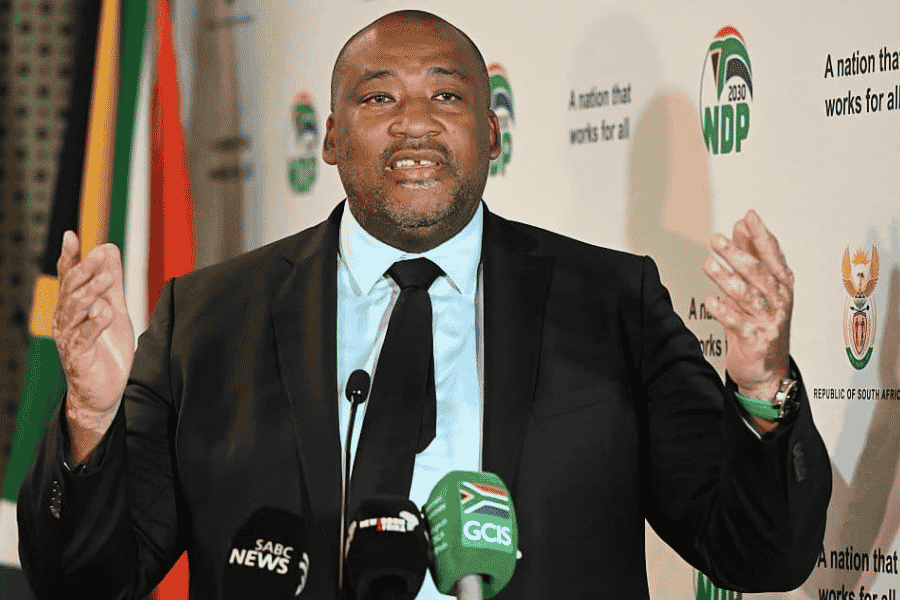
The Department of Sport, Arts and Culture (DSAC) never commissioned a separate feasibility study before transferring R20 million to the South African Football Association (SAFA) for the implementation of Video Assistant Referee (VAR).
The admission is contained in McKenzie’s response to DA MP Leah Potgieter, who has repeatedly questioned whether a feasibility study and contractual agreement underpinned the transfer and, if not, why he approved the payment without such documentation.
Minister Gayton McKenzie has confirmed in a written parliamentary reply.
“The Department did not commission a separate feasibility study,” McKenzie replied.
The reply provides a written explanation for a document the DA has been seeking and comes amid continued questions over how the R20 million allocation was assessed before the money was transferred to SAFA.
McKenzie argued that a separate departmental feasibility study was not required.
“The implementation of VAR does not fall within the sole discretion of a member association or of government,” he said.
“It is governed by FIFA’s VAR Implementation Assistance and Approval Programme, in terms of which no country may implement VAR without FIFA approval, and that approval requires an appointed VAR Project Team, a detailed project plan and a confirmed technology solution,” he continued.
He said that the preparatory work was therefore undertaken through that process.
He pointed to a request for proposals issued by SAFA in April 2025, to which local and international providers responded.
A Tender Evaluation Committee was then constituted, comprising representatives from SAFA, the department and the Premier Soccer League.
A technical mission also observed live VAR operations abroad in November 2025, while four prospective suppliers were shortlisted that month.
“The Department assessed the implementation plan and detailed budget submitted by SAFA and was satisfied that the programme was implementable within the timelines proposed by SAFA,” McKenzie said.
According to McKenzie, the department’s decision to demand the return of the R20 million was not based on the absence of a feasibility study, but on SAFA’s failure to perform against the implementation plan.
The written reply states that the department transferred the R20 million to SAFA on 6 March 2026 after National Treasury approved it as the first tranche of a three-year implementation plan.
He said that SAFA’s first-year budget was R20,477,800. An Allocation Agreement was concluded between the department and SAFA on 3 March 2026, with an implementation plan and detailed budget submitted by SAFA on 28 February forming part of the agreement.
The agreement required the money to be used exclusively for the approved project and imposed reporting and financial controls on SAFA.
The department was also entitled to withdraw the grant if SAFA failed to comply with the agreement.
According to McKenzie, the implementation plan included specific milestones, including the commencement of training for match officials in July 2026.
The department requested a written progress report from SAFA on 8 April.
“No report was provided,” McKenzie said. By 13 August, he said, the department had received neither the reporting required under the agreement nor written proof of progress against any of the project milestones.
The director-general then demanded repayment of the money. “On 18 August 2026 SAFA responded, apologised for the delay, confirmed that the funds were intact and unutilised, and requested a further period of up to 21 days in which to conclude its internal budget verification,” said McKenzie.
He said that SAFA requested another 21 days to complete an internal budget verification. The department granted the extension, with the final deadline expiring on 9 September.
“SAFA submitted a report to the Director-General on 9 September 2026. That report is receiving the attention of the Department, and the Department has reserved its rights in respect of the repayment demanded,” he said.
He also confirmed that he accepts responsibility for the original decision to allocate the money.
“Yes, the decision to allocate funding for the implementation of VAR was mine and I stand by it,” he said.
He said that the allocation had been made against an implementation plan and detailed budget prepared by SAFA and assessed by the department.
McKenzie said that the fact that SAFA had not delivered against the plan was the reason the department was seeking to recover the money.
“It is precisely because I accept responsibility for the allocation that the Department will exercise the right to recall the funds, a decision currently under review,” he said.
The reply also confirms that SAFA has not spent the R20 million. McKenzie said the full amount remained in a separate account together with the interest earned on it, and that the repayment demand covered both the capital and interest. He rejected any suggestion that the department’s responsibility ended once the money was transferred.
“The Department’s responsibility for the funds did not end once they were transferred to SAFA,” he said.
He said that DSAC retained oversight through reporting requirements, financial controls and its right to request additional information or withdraw the grant.
But he declined to name SAFA officials whom he had previously raised concerns about.
“Where I have raised concerns regarding conduct within football administration, those concerns will be taken up in the appropriate forums and, where warranted, with the appropriate authorities. It would not be proper for the Department to place on the parliamentary record the names of individuals who have not been the subject of any formal process and who have not been afforded an opportunity to respond,” he said.
He said that the department’s basis for recalling the funds was “documented non-performance”.