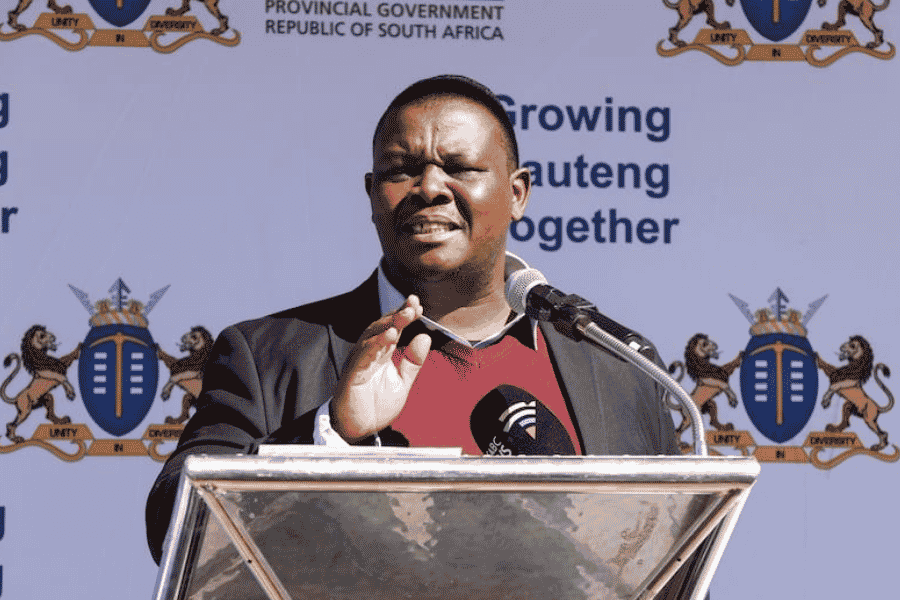
Gauteng MEC for Cooperative Governance and Traditional Affairs Jacob Mamabolo has cracked the whip on municipalities, demanding an urgent end to the culture of financial mismanagement that is bleeding the province of hundreds of millions of rands.
Mamabolo has told all 11 municipalities in Gauteng to tighten governance and crush unauthorised, irregular, fruitless and wasteful expenditure, warning that public money must be protected at all costs.
His tough talk follows a damning update from the Governance Workstream at the weekly Intergovernmental Forum on the Gauteng Local Government Turnaround Strategy on Thursday.
The forum, led by Members of Mayoral Committees from across the province, raised red flags about deep-seated weaknesses in governance and financial management.
And the numbers tell a bleak story.
The latest Auditor-General consolidated report for the 2024/25 financial year shows that only two of Gauteng’s 11 municipalities achieved clean audits. Four received unqualified opinions with findings, while five limped home with qualified audit opinions.
Mamabolo said the Turnaround Strategy must now pivot sharply towards prevention, accountability and consequences.
“Our message to all municipalities is that public resources must be protected. Every municipality must have effective systems to prevent financial losses, identify problems early and ensure accountability when controls fail,” Mamabolo said.
He ordered municipalities to strengthen internal controls, fix broken supply chain management systems, address all Auditor-General findings, and investigate every cent of unauthorised, irregular, fruitless and wasteful expenditure in line with the Municipal Finance Management Act (MFMA).
While the warning applies to all municipalities, the City of Ekurhuleni has emerged as a stark case study of how not to manage public finances.
The metro reported a staggering combined R693.7 million in unauthorised, irregular, fruitless and wasteful expenditure over three financial years.
This includes approximately R397.1 million in unauthorised expenditure, R296.2 million in irregular expenditure and R407,323.93 in fruitless and wasteful expenditure.
Behind those figures lies a litany of procurement failures.
The City’s own response points to tenders with poorly defined scopes and deliverables, bidders who failed to meet prescribed personnel requirements, inconsistencies between CVs and certificates, inadequate company experience, incomplete financial statements and bidders not being evaluated according to technical requirements.
Most alarming, the City admitted that none of the irregular expenditure has been condoned, with amounts still undergoing processes. It reported recoveries of only R1.2 million over three years, while conceding that not a single case of financial misconduct during the period resulted in disciplinary proceedings.
For Mamabolo, that is unacceptable.
“Ekurhuleni must now translate these findings into a clear programme of corrective action. We want to see stronger controls, improved accountability and a sustained improvement in the City’s audit outcomes,” he said.
Mamabolo has now directed Ekurhuleni to urgently prioritise corrective action, including tightening preventative controls and procurement processes, accelerating investigations into irregular expenditure, pursuing recoveries where the law requires, and enforcing consequence management where wrongdoing is established.
The MEC emphasised that Ekurhuleni is not alone and that the intervention forms part of the broader Local Government Turnaround Strategy, through which the provincial government is working with municipalities to strengthen governance, improve financial sustainability and accelerate service delivery.