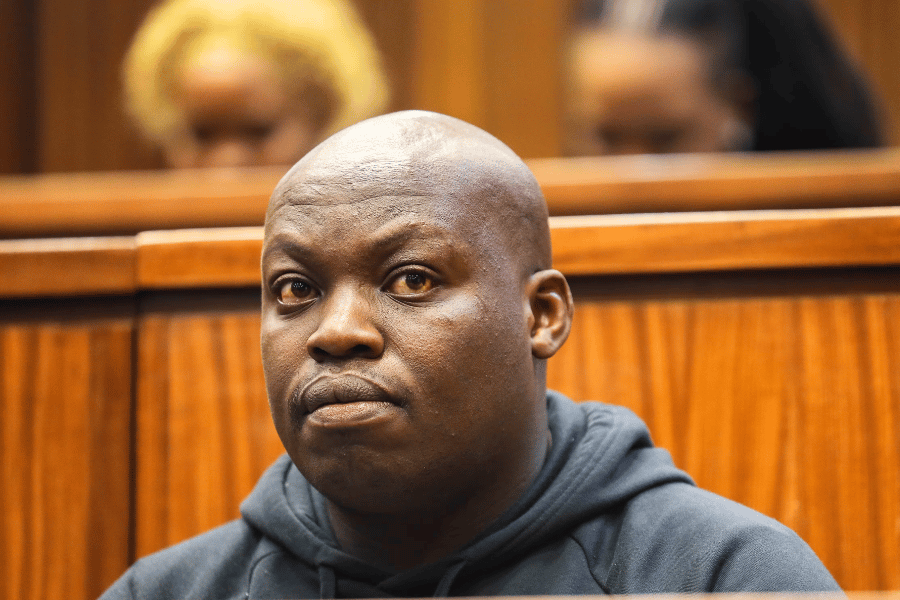
The police captain, who led the arrest of accused No. 1, Musa Kekana, conceded in the Johannesburg High Court that he had failed to comply with both a national police instruction governing crime scenes and the Criminal Procedure Act.
Captain Phimi Alfred Sekgobela made the admissions under cross-examination by Advocate Annellene Van der Heever, who appeared for Cat Matlala and his wife Tsakani Matlala in their attempted murder against the crime kingpin’s ex girlfriend, TV actress Tebogo Thobejane.
Acting on the court’s earlier direction, counsel produced National Instruction 1 of 2015 and questioned the officer clause by clause on the duties of a first responder.
Reading from the section dealing with crime scene management, Van der Heever outlined the responsibilities of the first officer on the scene including assessing the situation, arresting the suspects, secure the scene and remove unauthorised persons, including arrested suspects.
Sekgobela agreed that he had been the first responder.
He testified that after securing the first crime scene at 8th Road, he left it under the control of Captain Tsotetsi before proceeding to a second property in 5th Road, Kew. He confirmed that both scenes had been cordoned off and that steps had been taken to prevent contamination.
However, when asked whether he had removed the arrested suspects from the crime scene as required by the National Instruction, he replied:
“No, I didn’t do that.”
Van der Heever then turned to the Criminal Procedure Act.
Sekgobela agreed that the Act requires an arrested person to be detained and taken to the nearest police station. Asked whether he had complied with that requirement, he answered that he had not.
Van der Heever put it directly to him that he had contravened both the National Instruction and the Criminal Procedure Act.
“Yes,” the captain replied.
Later in the proceedings, Sekgobela attempted to explain the deviation, saying that after the arrests at 8th road the team proceeded to a second location to recover a vehicle allegedly linked to the murder investigation.
He could not say what time the accused were eventually taken to a police station and confirmed that the second arrested man, Michael Pule Tau, had likewise not been taken there immediately after his arrest.
Counsel then turned to another requirement of the National Instruction: the recording of injuries sustained by arrested persons.
Asked whether he had documented the point at which Kekana began coughing blood. Sekgobela initially testified that the incident had been recorded in his pocket diary when an ambulance was called.
When Van der Heever asked him to produce the diary entry, the captain changed his evidence, saying he had delegated the ambulance arrangements to another officer.
Pressed on the inconsistency, he corrected himself.
“I’m only realising now that it is not in my diary, but it’s contained in my statement.”
He also confirmed that paramedics had been allowed into the crime scene and that no access register had been maintained to record who entered or left the property.
Van der Heever further put it to Sekgobela that police officers had left the house in disarray, with household items scattered across the floor, and that no officer had been instructed to restore the premises.
“That’s true,” Sekgobela answered.
He confirmed that he had never instructed members of the team to return and tidy the property.
When counsel suggested that he had failed to follow the law, Sekgobela declined to engage.
“No comment.”
The most sustained exchange centred on the legal basis for Kekana’s arrest. Throughout his evidence, Sekgobela maintained that Kekana and Tau had been arrested for a murder committed in Vereeniging.
Van der Heever, however, referred him to the official notice of rights issued to Kekana after his arrest.
The document reflected a Bramley case number and listed only possession of an unlicensed firearm and ammunition as the offences. It contained no reference to murder.
She then produced the occurrence book. The entry recording Kekana’s transfer to hospital carried the same Bramley case number and referred only to the firearm offences. A later entry documenting his return from hospital likewise made no mention of murder.
Van der Heever added that the April detention register contained no murder charge and that the statement of Tau similarly omitted any reference to murder.
Despite the documentation, Sekgobela maintained that the operation had always been aimed at arresting a murder suspect.
He testified that officers first went to the 8th Road property to arrest the suspect and then proceeded to the 5th Road address to recover the vehicle allegedly used in the murder.
Van der Heever suggested that the absence of any contemporaneous murder charge demonstrated that police had lacked a reasonable suspicion to arrest either accused for murder.
“I did have,” Sekgobela replied but could not demonstrate how.
He said both men had been informed at the first property that they were being arrested for murder and were advised at the second property that additional charges were being added.
Van der Heever indicated she would argue that, had police genuinely possessed evidence linking the accused to the murder, the murder charge would have appeared in the arrest documentation from the outset.
She also submitted that the searches conducted at both properties and of the vehicle were unlawful.
Sekgobela rejected that proposition.
“There were reasonable grounds for the searches.”
He said police had relied on urgency.
Questioned about the forensic examination, Sekgobela identified the two Local Criminal Record Centre investigators who attended the scene as Mohale and Botha.
Asked what role the second investigator performed, he said he could not say because, once the forensic team arrived, he handed over responsibility and allowed them to conduct their work.
He confirmed that the request for the Local Criminal Record Centre had been made by a member of the tracking team who arrived after him.
When Van der Heever referred him to records indicating that crime scene investigators only arrived at 9:50 a.m., he declined to comment.
“No comment.”
During re-examination, the State sought to reinforce its argument that officers had acted under urgent circumstances.
Sekgobela testified that police intelligence indicated the vehicle used in the Vereeniging murder had travelled to the house number 34, 5th Road, Kew, where surveillance later observed occupants leaving in a Mercedes-Benz Viano before they were apprehended.
Asked about obtaining search warrants, he said he had applied for warrants four times during his career. Although the application itself could take less than three hours, securing judicial authorisation on the same day was uncommon, with many applications only being signed the following day.
Van der Heever asked whether officers could simply have secured the premises while waiting for a warrant.
Sekgobela said that would not have been effective because the property’s high walls prevented officers from seeing what was happening inside.
He estimated the distance between the two properties at less than two kilometres, a drive of under five minutes.
Asked what police expected to recover, he said investigators were looking for the vehicle allegedly used in the murder, the firearms used to commit it and a cellphone.
He acknowledged that he could not remember every event in chronological order, explaining that his unit carries out similar operations twice each week.
In the final exchanges, Van der Heever put it to Sekgobela that his affidavit had been commissioned by a police officer who formed part of the investigating team in the same matter and that the information supplied by Crime Intelligence amounted to hearsay.
Sekgobela again declined to respond.
“No comment.”
Cross-examination then concluded.