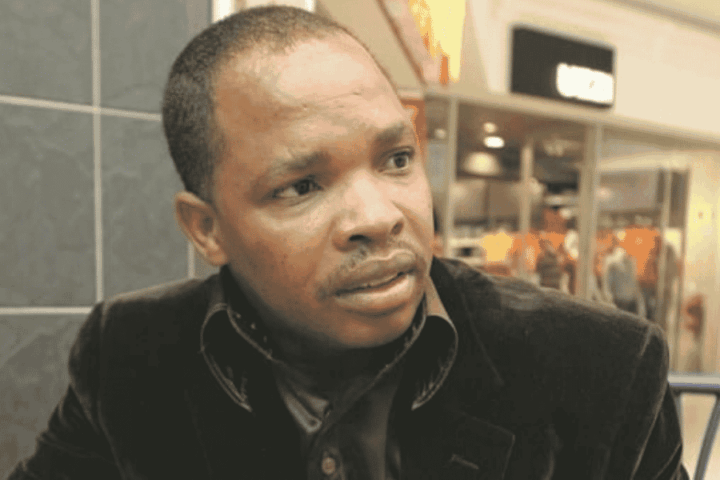
As police hunt those responsible for the deaths of nine women in Ekurhuleni, actor Hlomla Dandala has revealed a project he once developed with his colleagues.
The project was designed to get “boots on site” within three minutes of a woman being threatened.
But it never got off the ground.
Dandala says the project faced resistance, alleged attempts to extract millions of rands and, ultimately, a terrifying confrontation involving armed men.
Dandala’s revelations come as authorities intensify the investigation into the deaths of nine women whose bodies have been discovered in Ekurhuleni over the past two months.
SAPS says a multidisciplinary team has been mobilised to investigate the cases and identify those responsible.
Police have appealed for information, while government has announced an expanded Operation Shanela in Ekurhuleni.
Police had earlier warned that the perpetrators’ “freedom is temporary” and said investigators, intelligence officers, tracking teams and forensic experts were following leads. A R400,000 reward was also announced for information leading to the arrest of perpetrators.
Against that backdrop, Dandala’s account of an abandoned project aimed at stopping attacks before they became murders raises an uncomfortable question, what happens when people attempt to build their own response to a crisis and the system around them fails to make room for it?
Dandala says the project began with an approach that deliberately rejected the usual public conversation about gender-based violence.
“We did something different. We went to prisons to speak to rapists,” he explained.
The questions were deliberately uncomfortable.
“We don’t understand. You’re holding a gun, but you’re also beating her up, and you have to get naked, and you have to get her naked. That’s a lot of admin. How do you do it? Just walk us through the process,” they asked rapists.
According to Dandala, the conversations produced a disturbing insight into the psychology of an attack. Some perpetrators described entering a state of rage in which they “see red”.
“The guys would say, I get in a rage, where I see red, and all I need is someone to just click me out of it,” he said.
“Because if I have no one to click me out of it, then I follow through,” a rapist allegedly told Dandala.
He then used reenactments and other exercises to examine how quickly an attack could unfold.
Dandala said that they arrived at a figure that became the foundation of their project.
“Between the man introducing himself to the potential victim and actual penetration, three minutes. Three minutes,” he said.
And that, he says, became their deadline.
“Anything we were going to create needed to have boots on site in three minutes.”
The idea that followed was not another panic button that simply sends an alert to a security company.
Dandala says they looked instead at the culture of the taxi rank, where the word Vimba can be used as a cry for help.
“Think of it as a digital Vimba,” he says.
The proposed device was a discreet button roughly the size of a five-rand coin. It could be carried on the body and activated when someone felt threatened.
But instead of sending the alert to one person, it would broadcast it to people within approximately 100 metres.
“Someone within a hundred-meter radius of you needs help right now. Will you help?”
Those who accepted would become part of the response.
The system would show them how many others had responded and whether anyone was already at the scene.
“You get a sense of the lay of the land,” Dandala says. “These are the number of people who are coming in. They have all responded, and they are all taking responsibility, and they’re moving, ” he continued.
Then came the evidence trail. Dandala said that the phones of people who accepted the alert would begin streaming video to the cloud as they approached.
“When you get there, we don’t want to send you into a hot situation, and then they take your phone, and then you get hurt too,” he explained.
The system, he says, would effectively create a digital evidence file from multiple phones.
“Whoever pressed the button is generating their own digital docket,” he said.
The concept was not to create an army of vigilantes.
Responders would instead establish whether the person who triggered the alarm was safe and wait for armed security or police.
He said that the phones could also capture audio from devices within approximately five metres of the person who triggered the alert, with the material sent to cloud storage.
But the ambitious concept never made it to scale.
“We were on a very steep funding drive, and everywhere we pitched, not only would they not give us money, they would then steal little elements of it,” he alleged.
He said that they encountered resistance from senior figures and organisations.
One unnamed senior figure, Dandala allegedly rejected the concept because it had been developed by men.
“A very, very, very senior citizen of this country basically said, ‘No, I can’t take it if it doesn’t come from men. Find a way. It needs to come from women.’ Totally rejected it,” he recalled.
Another person, he alleged , wanted 30% of the project in exchange for helping take it to influential people.
Then came the allegation that takes the story into far more dangerous territory.
He alleged that they were contacted by a “very senior person in the security cluster”.
The message, according to Dandala, was blunt, the security establishment had not been included.
According to Dandala the person said: “Look, I see what you have done, but you didn’t include us.”
“Essentially the arrangement was that we’d pay the senior person five million rand, and then we also contribute another five million rand to a particular political organization, which will remain nameless,” he explained.
They refused and the situation allegedly escalated.
He recalled being at their lawyers’ offices in Northcliff when “a bunch of people walked into the office. They were carrying weapons,” he explained.
The questions, he says, were chilling.
“Who are you? Who trained you? What intelligence organization do you work for? How could you have created something like this? Who are you? Who are you?Literally there were guns,” Dandala revealed.
They eventually decided that whatever they had stumbled into was bigger and more dangerous than they had anticipated.
“We looked at each other and went, Dude, I think we might be kicking a hornet’s nest here,” he said.
So they stopped.
“We wrapped it up and we put it away. It’s still collecting dust right now,” he said.
Dandala’s account is not an allegation that can simply be treated as established fact.
He does not name the alleged security-cluster official, political organisation or people who allegedly entered the lawyers’ office.
But his central complaint is not about the project failing.
It is about the narrative that men have done nothing.
“I refuse to have a narrative that says men did nothing. I refuse to have a narrative that says men did nothing. We did stuff,” he said.
He said that people who were involved paid a price for trying.
“ I am part of a group of guys who did something, and we had guns in our faces for it. We lost money from it. We lost time,” he explained.
Now, as police search for answers to the deaths of nine women in Ekurhuleni, Dandala’s abandoned three-minute concept sits in a particularly uncomfortable place.
The government has now approved a Comprehensive Emergency Strategy to accelerate the pursuit of those responsible for the Ekurhuleni killings, while an expanded Operation Shanela has been launched to increase law-enforcement visibility.
The state is mobilising after the bodies have been found.
Dandala’s story is about an attempt to mobilise before the bodies were found.
And that is what makes his final message so pointed.
“It may not be, and it may not say that men did nothing, or men are doing nothing. We did stuff, ” he said.
The question now is not whether Dandala’s abandoned project could have prevented any of the Ekurhuleni killings, there is no evidence to establish that.
The harder question is whether South Africa has become so accustomed to responding to violence after the fact that ideas designed to intervene before an attack can be lost to funding battles, institutional resistance, competing interests and fear.
For the families now waiting for answers, that distinction is not academic.
Nine women are dead.
And police are still hunting for the people responsible.