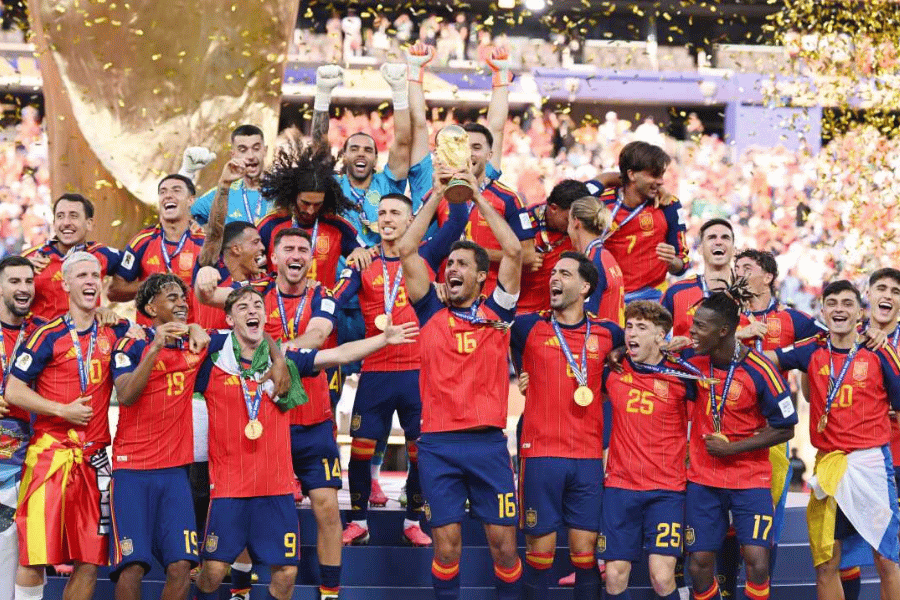
The curtain came down on one of the most exciting FIFA World Cups in history as Spain defeated defending champions Argentina 1-0 in the final at MetLife Stadium in New Jersey, United States, to lift their second FIFA World Cup title and their first since winning the tournament in South Africa in 2010.
The tournament, jointly hosted by the United States, Canada and Mexico, featured a record 48 teams and 104 matches, making it the biggest World Cup ever staged.
Spain’s triumph capped a remarkable campaign in which they combined disciplined defending with attacking football, conceding very few goals throughout the tournament before edging Argentina in a tightly contested final.
Individual Awards
France captain Kylian Mbappé finished as the tournament’s leading scorer after winning the Golden Boot with 10 goals, becoming the first player since Ronaldo Nazário to score double figures at a World Cup and adding to the Golden Boot he won in Qatar in 2022.
Spain midfielder Rodri was named the Player of the Tournament (Golden Ball) after producing commanding performances from midfield that inspired Spain to the title. Goalkeeper Unai Simón received the Golden Glove for his outstanding performances between the posts, while Spanish teenage defender Pau Cubarsí walked away with the Best Young Player Award, confirming his status as one of world football’s brightest emerging talents.
Spain coach Luis de la Fuente emerged as the tournament’s outstanding coach after guiding his side to World Cup glory with an unbeaten campaign and tactical consistency throughout the competition.
Record Goals and Expanded Tournament
The expanded 48-team tournament produced more than 300 goals, comfortably surpassing the 172 goals scored at the 2022 FIFA World Cup in Qatar, which had only 32 participating nations. The larger number of matches and attacking style of football contributed to the tournament becoming the highest-scoring World Cup in history.
New nations make history
Several nations made their FIFA World Cup debuts following the expansion to 48 teams. Among the first-time participants were Curacao, Uzbekistan, Jordan and Bosnia and Herzegovina, while countries such as Cape Verde and DR Congo made historic returns to the global stage after lengthy absences. Their participation highlighted FIFA’s objective of giving more nations an opportunity to compete at football’s biggest tournament.
Africa’ strongest world cup showing
Africa enjoyed one of its finest World Cup campaigns.
Ten African nations represented the continent, with Morocco, South Africa, Egypt, Senegal, Algeria, Tunisia, Ghana, Cape Verde, Côte d’Ivoire and DR Congo all taking part.
Morocco once again led the continent’s charge by reaching the quarter-finals after eliminating Canada and the Netherlands before eventually losing to France.
South Africa reached the knockout stage for the first time in their history after finishing second in Group A before narrowly losing 1-0 to Canada in the Round of 32.
Egypt also reached the Round of 32 before suffering a heartbreaking penalty shoot-out defeat to Australia, while Cape Verde impressed on their World Cup debut by progressing to the knockout stage.
Although no African nation reached the semi-finals, the continent’s performances demonstrated the growing strength and competitiveness of African football on the world stage, with several teams producing memorable upsets and fearless displays against traditional football giants.
The 2026 FIFA World Cup will be remembered for its expanded format, record-breaking number of goals, outstanding individual performances and the emergence of several new football nations. Above all, it will be remembered as the tournament where Spain reclaimed football’s biggest prize and confirmed themselves once again among the world’s elite footballing nations.