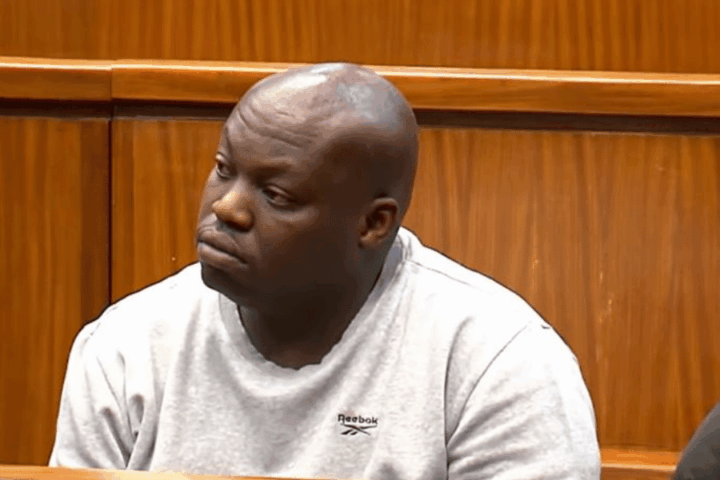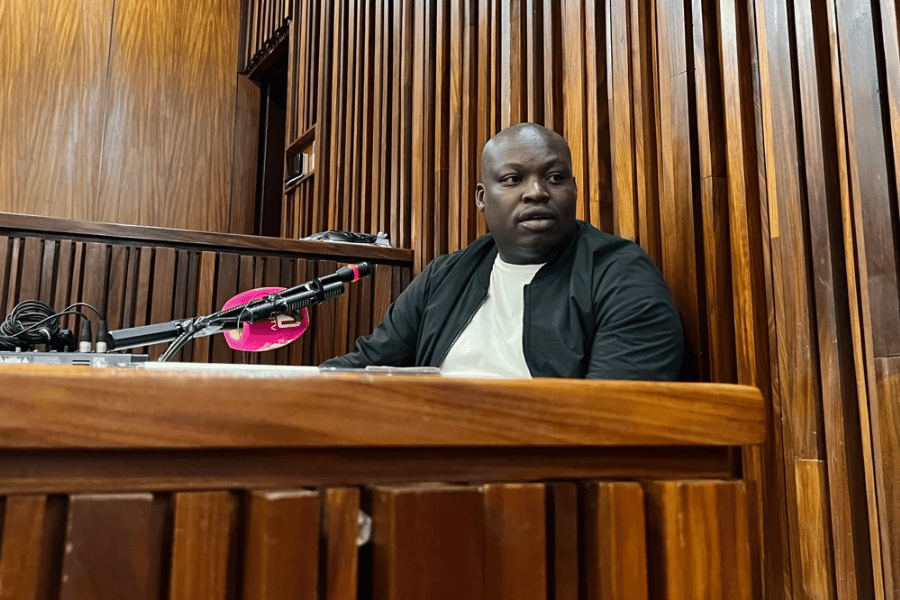
Alleged hitman Musa Kekana faced a sustained attack on his credibility in the Johannesburg High Court on Wednesday, after Judge Cassim Moosa ruled that the State may cross-examine him on hospital records his own legal team placed before the court.
Kekana, accused number one in the attempted murder trial of Vusimuzi “Cat” Matlala and four others, is testifying in a trial-within-a-trial.
It will decide whether evidence obtained after his arrest on 17 April 2024 can be used in the main trial.
He alleges police assaulted and suffocated him, and he challenges the lawfulness of the search that followed.
Proceedings began late, as Judge Moosa considered legal authorities handed up that morning.
The authorities related to an objection raised on Tuesday by Kekana’s counsel, Adv Riaan Gissing, when State prosecutor Adv Elize le Roux began questioning Kekana on page 51 of Exhibit N, an Edenvale Regional Hospital emergency department booklet.
The defence argued that the entries were hearsay because their authors had not been called, and that the page was irrelevant.
Judge Moosa disagreed. He noted that Kekana’s own counsel had handed in the booklet in July without any limitation on its use.
“Counsel never stood up and said, ‘My Lord, you can ignore pages so-and-so.’ That document came onto the record as an entire bundle,” he said.
The judge invoked the legal doctrine against approbation and reprobation, under which a party may not rely on evidence when it helps and disown it when it does not.
“To permit this would allow a party to weaponise a document offensively while disarming the other side defensively,” Judge Moosa said.
He drew a distinction between clinical observations made by medical staff and statements attributed to Kekana himself, which he said are admissions rather than hearsay.
He found the objection “not justified and not sound in law” and overruled it.
Le Roux then read the “current complaint” recorded on page 51, relating to a hospital admission on 3 March 2024, about six weeks before the arrest: “Drank a bottle of Hennessy, then became unresponsive, and shortness of breath.”
Kekana said he was unconscious when he arrived at hospital.
“I don’t know the person who wrote this note, where they got it from, or how it came about that they wrote this,” he said.
He later told the court he had been drinking, lost consciousness and woke up in hospital, and denied ever describing the admission as food poisoning.
Le Roux then took him through the doctor’s notes from after his arrest.
Kekana accepted that he had told the doctor he was assaulted and suffocated by police, that he had lost weight, and that he vapes and uses alcohol.
He denied mentioning night sweats, denied saying where the suffocation took place, and denied telling the doctor about an earlier admission for food poisoning.
“So she sucked that from her thumb?” Le Roux asked.
“I don’t know. Maybe you should have asked her that when she was here,” Kekana replied.
Le Roux put it to him that “the portions you deny are everything that doesn’t suit or support your version.”
“That is not so,” Kekana said, suggesting that hospital staff may have copied from his previous notes.
The cross-examination then moved to the day of the arrest. Kekana said he was handcuffed when police drove him from 8th Road to his property on 5th Road without needing his directions.
He told the court a white Golf, which he described as a traffic department vehicle, had followed them and that a shot was fired from it.
At the gate, Kekana said, Captain Phimi Sekgobela told him to open up. He replied that he did not have the keys, which were on the same bunch as the gate remote and had been left in the Mercedes-Benz Viano he was arrested in.
According to Kekana, Sekgobela immediately sent one officer to fetch the keys and told another to open the gate by hand.
Le Roux questioned that account. “If the key is on its way, why?” she asked.
Kekana said he could not explain the captain’s decision, “but that’s what he did.”
Kekana explained that the gate motor has a manual release.
Le Roux then pointed out that he had earlier described using a key to open the motor box, and he now said the box does not lock. Kekana said the “key” he meant was the release wheel itself.
Le Roux then put the State’s version to him. “I put it to you that this gate was never opened manually. It was opened with your remote, which was in your trouser pocket and which you took out yourself,” she said.
“That is not true. I was handcuffed. My keys were left in the vehicle,” Kekana replied.
Le Roux told him his evidence “does not make sense on many levels.”
“Unfortunately, that’s what happened,” Kekana said.
Sekgobela previously testified that Kekana allowed police to enter and search his property without a warrant.
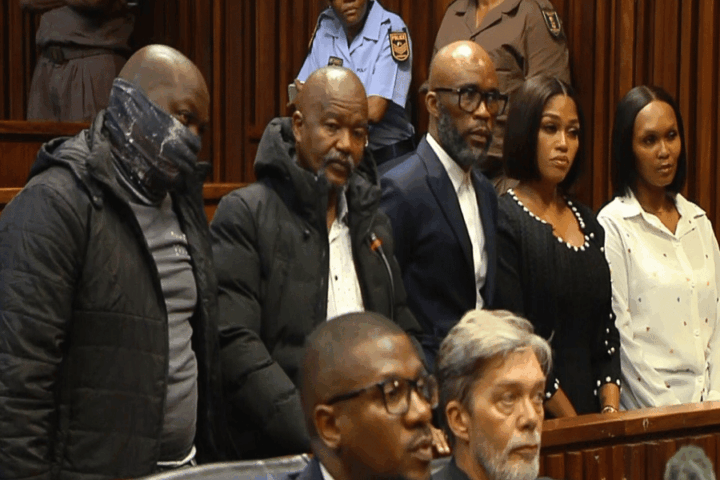
Matlala, his wife Tsakane Matlala, Kekana, Tiego Floyd Mabusela and Nthabiseng Nzama face 25 charges, including conspiracy to commit murder and attempted murder.
Cross-examination continues.