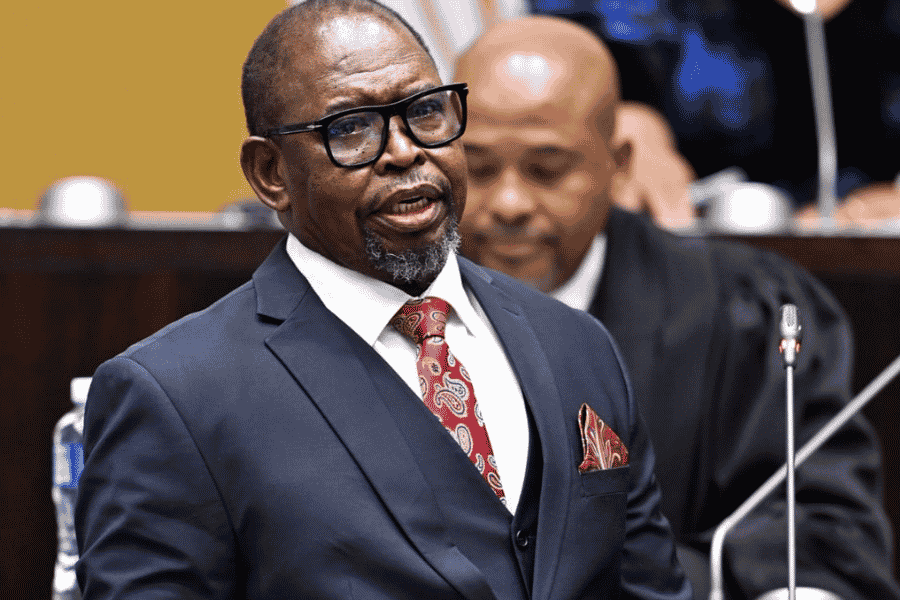
Finance Minister Enoch Godongwana has warned failing municipalities to fix their finances or lose funding as government enforces payment discipline and ends fiscal bailouts that deliver no results.
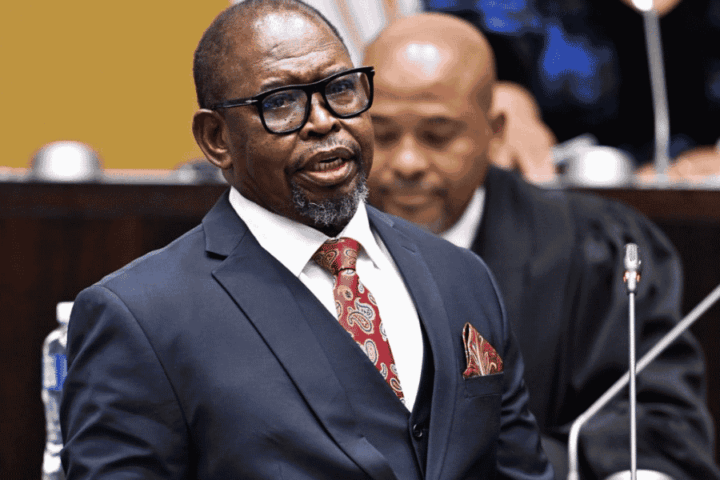
Tabling the Medium-Term Budget Policy Statement, Godongwana said the era of transferring money to municipalities that fail to pay creditors, collect revenue and deliver basic services is over, revealing that he has already suspended equitable share transfers to 69 non-compliant municipalities.
“In June, after extensive engagement, I suspended the next equitable share transfer to 69 municipalities that persistently failed to pay all creditors,” Godongwana told Parliament.
“By the end of July, 37 of them had concluded council-approved repayment plans, and R4.2 billion had been paid to creditors.”
The crackdown is central to Godongwana’s broader fiscal message that while local government will get more money, it must show results. Over the medium term, local government’s share of non-interest spending will reach 10% for the first time, which he called “a significant milestone.”
“We are allocating an additional R21.8 billion to the local government equitable share, to cover the higher bulk costs of free basic water, sanitation, electricity and refuse removal. We are increasing the general fuel levy allocation by R13.4 billion, restoring the metros’ share to 23 per cent,” he said.
But Godongwana stressed that money alone will not fix local government, framing the crisis as one of governance and accountability.
“Honourable members, citizens experience the state most directly at the local level. Yet, the financial and operational performance of many municipalities remains weak. This is untenable. It affects the delivery of basic services. It undermines economic activity. And it erodes public confidence,” he said.
“The issue can no longer be only about resources. It must also be about results.”
The Minister said National Treasury is now enforcing payment discipline both ways, forcing municipalities to pay Eskom, water boards and other creditors while also enforcing payments by national and provincial departments that owe municipalities.
He singled out revenue collection failures as a key driver of municipal collapse, announcing an aggressive rollout of smart meters as a non-negotiable intervention.
“Interventions also aim to improve revenue collection, such as the use of smart meters. On top of the R2 billion allocated, we are adding R3.5 billion over the MTEF for even wider rollout of smart meters,” Godongwana said.
He pointed to successes in places like Sol Plaatje, Kannaland, and Bela-Bela Local Municipalities – municipalities long cited among the worst-run in the country – as proof that collection can improve when systems are fixed.
Kannaland in the Western Cape has previously been flagged for governance collapse and inability to pay salaries, while Bela-Bela in Limpopo and Sol Plaatje in the Northern Cape have struggled with water and electricity debt and declining audit outcomes.
Godongwana said municipalities must also stop diverting service charges to bloated running costs.
“Our review of municipal funding has found that most municipalities have enough money for day-to-day operations, but they spend too much on running costs. This leads to insufficient funding provisions for long-term infrastructure investment and maintenance.”
The warning comes with major legislative muscle. Godongwana announced the first comprehensive modernisation of the Municipal Finance Management Act in 23 years.
“The changes focus on funded budgets, improved revenue management, clearer accountability and earlier intervention when municipalities experience financial distress. The Bill requires municipalities to demonstrate that their budgets are genuinely funded,” he said.
“It also introduces stronger mechanisms to investigate financial misconduct and recover losses, together with a clearer framework for financial recovery and intervention in distressed municipalities.”
He linked municipal reform to his four-point fiscal strategy: supporting growth, improving value for money, reducing debt-service costs and embedding a principle-based fiscal anchor. Debt-to-GDP has stabilised at 78.4% for the first time in nearly two decades, while the primary surplus is growing from 1.7% to nearly 3% by 2030.
The Minister tied local government performance directly to the November 2026 local government elections.
“Every rand transferred to municipalities must translate into visible improvements in people’s daily lives. Communities should have reliable water, functioning sanitation, well-maintained roads and safe, well-lit public spaces,” he said.
“With local elections approaching, citizens will judge municipalities by their performance and the quality of services they receive.”