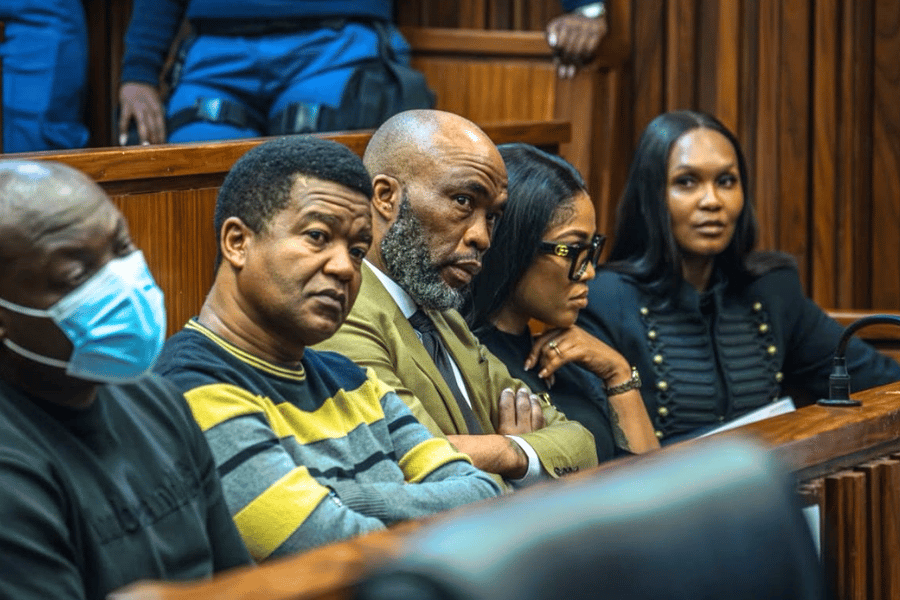
Eight days into the trial, the trial-within-a-trial has already produced some of the case’s sharpest clashes.
A search without warrant, a disputed set of keys, and an arresting officer who told the court he could not remember all the rights he says he explained to the accused.
The trial-within-a-trial is not about whether the accused committed the offences. It is about whether key evidence was obtained lawfully and can be used in the main trial. That distinction is critical.
The court is not yet deciding whether accused No. 1, Musa Kekana is guilty of any offence. It is deciding whether the State obtained key evidence lawfully and whether that evidence may be used in the main trial. Those are different questions, governed by different legal tests.
THREE PRESSURE POINTS FOR NOW.
So far, the defence is not relying on just one argument.
It has raised at least three separate challenges, and the court will decide each one independently.
The entry: Captain Phimi Alfred Sekgobela has confirmed he had no search warrant. His evidence is that he moved fast because he feared evidence would be destroyed, and that he asked for and obtained permission to search.
Both are recognised legal grounds for entering a property without a warrant, but they are different and depend on different facts. The State cannot rely on both without proving each one.
If its case is that Kekana consented, the court will want to know exactly what was said, in what language, and under what circumstances to a man who was already handcuffed.
If its case is urgency, the court will want to know why officers did not send members ahead or call for backup sooner, the very issue the defence raised on Wednesday.
The rights: Sekgobela’s evidence is that he explained the accused’s constitutional rights in Sepedi and that the accused confirmed he understood.
Under cross-examination, the witness could name only three of the rights he said were explained to the accused. He told the court he forgot the rest and would have to check.
The defence’s version is more direct, that no rights were explained at all.
Those are different challenges. One is that the explanation was incomplete, the other is that it never happened.
It is for the court to decide which, if either, of those versions is supported by the evidence.
The chain: The keys, the photograph of the Viano’s interior, and the question of who opened the gate and how may seem like minor details but they are not.
They go to the heart of whether the officer’s account is internally consistent. In disputed arrest cases, courts often decide the biggest issues by testing the smallest details.
WHY A VIOLATION DOES NOT AUTOMATICALLY MEAN EXCLUSION
This is the part most likely to be misunderstood. South African law does not automatically exclude evidence because someone’s rights were infringed. Section 35(5) of the Constitution requires the court to answer two questions.
First, was the evidence obtained in a way that violated a right in the Bill of Rights?
If the answer is yes, the court must then decide whether admitting that evidence would make the trial unfair or otherwise harm the administration of justice.
That second step is crucial. A rights violation on its own does not automatically mean the evidence will be excluded.
That second stage is where cases are won and lost.
A rights violation does not automatically determine the outcome. South African courts have admitted evidence even after finding that rights were violated, and have excluded evidence even where police acted in good faith.
The court looks at the whole picture, including how serious the violation was, whether it was deliberate, and whether admitting the evidence would undermine the fairness and integrity of the trial. There is another important legal distinction.
Much of the evidence being challenged is real evidence, physical items recovered from the property rather than statements or admissions allegedly made by the accused.
Courts are generally more reluctant to exclude physical evidence because it exists independently of any alleged rights violation. Unlike a confession or admission, its reliability does not usually depend on how it was obtained.
That principle is not absolute. Even physical evidence may be excluded where the rights violation is so serious that admitting it would render the trial unfair or undermine the administration of justice.
But it would be wrong to assume that the evidence will automatically be excluded simply because the rights challenge succeeds.
The court must still decide whether admitting it would render the trial unfair or otherwise be detrimental to the administration of justice.
WHAT TO WATCH
THE DIARY: The matter has been adjourned for tomorrow, Thursday, 30 July so the defence can examine Sekgoba’s Diary.
A contemporaneous note recording the time of the arrest, the rights explained to the accused and any consent given could significantly strengthen the State’s case, carrying more weight than a witness’s recollection months or years later.
If those details are missing, incomplete or inconsistent, they could strengthen the defence’s challenge.
WHETHER ANYTHING WAS WRITTEN DOWN: So far, the State’s evidence that the accused’s rights were explained rests entirely on the Sekgobela’s recollection, and that recollection has been shown to be incomplete.
No witness has yet told the court that the rights were recorded in writing or that such a document exists. Whether a contemporaneous record was made, and whether it forms part of the docket, remains a question for the evidence.
If a written record is produced, Sekgobela’s inability to recall every right from the witness box may matter far less. If no such record is produced, the captain’s recollection will remain the primary evidence that the accused’s rights were explained.
THE LOCATION CONFLICT: The officer’s account of where the vehicles were located does not, at present, appear to align with the indictment. Until that is explained or reconciled, it remains a loose thread in the State’s case, one the court is likely to examine closely.
Whatever the court decides, the ruling will deal only with the admissibility of this evidence.
If the court finds that the search was unlawful, it does not mean the accused is innocent. If it admits the evidence, it does not mean he is guilty.
Either way, the main trial will continue, with the State’s case either unchanged or limited by whatever evidence the court excludes.
That is important to remember when the ruling is delivered, because it will almost certainly be portrayed as a victory for one side or the other.
It is a decision about what evidence the court is legally entitled to consider.