On Mandela Day, Kay Sexwale reflects on what service truly demands, drawing a powerful line from Nelson Mandela’s willingness to die for freedom to Dr Hussam Abu Safiya’s extraordinary courage and sacrifice amid Israel’s genocide in Gaza.
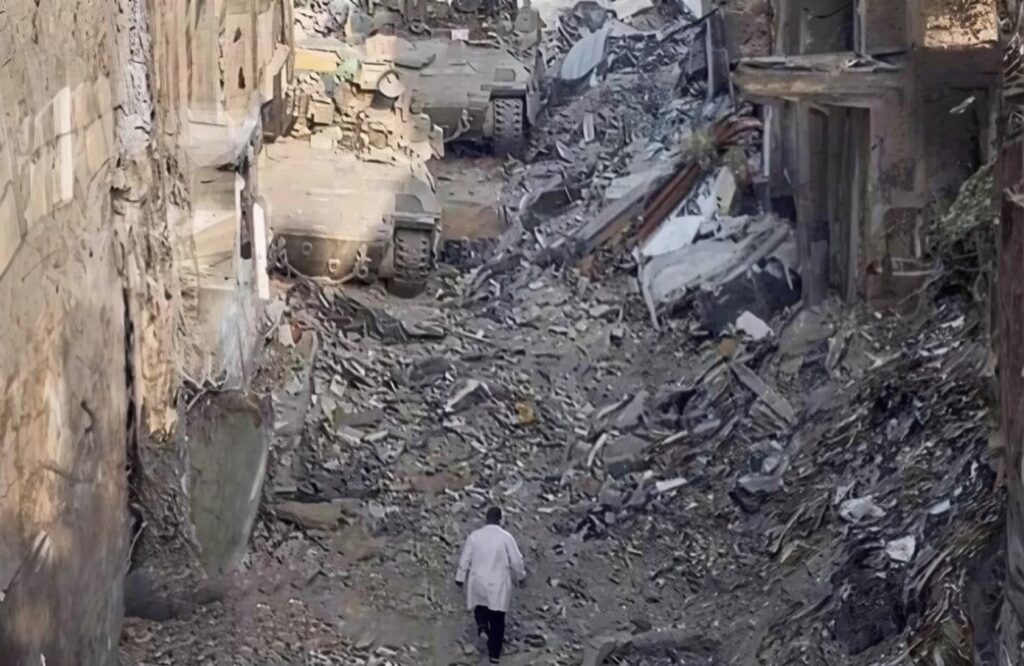
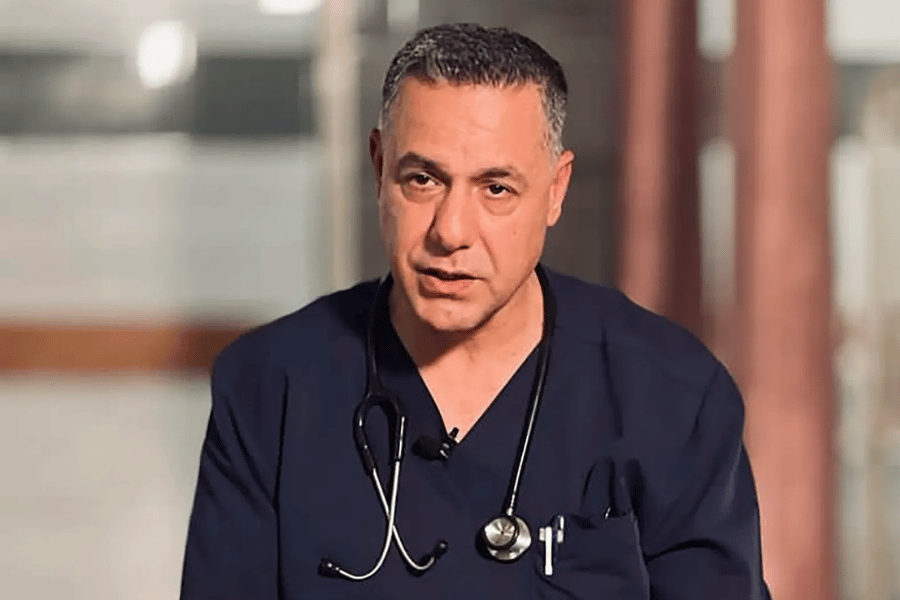
Dr Hussam Abu Safiya, director of Kamal Adwan Hospital, walks alone through the ruins towards Israeli Occupation Forces tanks in December 2024, shortly before his detention. He remains imprisoned without charge or trial.
Dr Hussam Abu Safiya is service personified. As Israel’s genocide devastated Gaza’s health system, he continued treating the sick and wounded at Kamal Adwan Hospital when self-preservation offered every reason to leave. He had already buried his son, Ibrahim, yet continued his work. As the Israeli Occupation Forces (IOF) tightened their grip around the hospital, he explained: “We have babies and newborns that are in the ICU. Even if we can evacuate a few patients, we cannot leave the hospital because there is no other hospital that is providing services and treatment to children.”
He was detained by the IOF in December 2024 and, in keeping with the practices of Israel’s apartheid regime, remains unjustly imprisoned without charge or trial. His service has not been measured in minutes, but in loss, endurance and an extraordinary willingness to place others before himself.
On 20 April 1964, Nelson Rolihlahla Mandela stood before the Pretoria Supreme Court as Accused No. 1 in the Rivonia Trial. The criminal apartheid state had marshalled its unjust laws, police and prosecutors against the leadership of Umkhonto we Sizwe in a case that could send Mandela and his co-accused to the gallows.
Mandela did not plead for mercy. He placed apartheid itself on trial, explaining why decades of peaceful resistance met with repression had made armed struggle inevitable and why a democratic, non-racial South Africa was worth any sacrifice. He concluded: “It is an ideal for which I am prepared to die.”
Mandela believed he might be hanged. We should remember the enormity of that commitment because we have become comfortable celebrating sacrifice once the danger has passed. We revere yesterday’s freedom fighters when history has vindicated them. Recognising courage while injustice is unfolding and those resisting it are still paying the price is considerably more demanding.
There is perhaps no more haunting contemporary image of this than Dr Abu Safiya walking alone through Gaza’s ruins towards IOF tanks in his white medical coat. Behind him lay a devastated hospital and a people enduring genocide. Ahead stood the terrorist machinery of an occupation that had systematically destroyed almost all the health infrastructure upon which those people depended.
The World Health Organisation reports that all 36 of Gaza’s hospitals and most primary healthcare centres have been damaged. South African doctor and former UN Special Rapporteur on the right to health, Dr Tlaleng Mofokeng, described the reality plainly: “The health system in Gaza has been completely obliterated, and the right to health has been decimated at every level.”
This is where our annual celebration of Mandela should become uncomfortable.
Mandela Day asks us to give 67 minutes in recognition of the 67 years Mandela devoted to public service. Schools are painted, meals prepared, blankets distributed and vulnerable communities supported. These acts matter. But somewhere along the way, the symbolism swallowed the substance, until a lifetime of radical service and sacrifice became an annual ritual.
Mandela did not spend 67 years fighting for freedom so that his name could become an annual public relations exercise. Yet that is precisely what Mandela Day has too often become.
Weeks are spent planning corporate activations, commissioning branded clothing, arranging photographers and preparing social media content. Mandela becomes a seasonal brand asset, while some institutions return the next morning to practices bearing little resemblance to the dignity and humanity they spent 67 minutes publicly celebrating.
Politics has fared little better. Every July, politicians who spend the rest of the year tearing one another apart suddenly discover Mandela. Opposition parties that routinely define themselves in opposition to the ANC invoke its most iconic leader, selecting the Mandela who preached reconciliation while ignoring the Mandela who fought relentlessly for justice, equality and transformation. Others selectively quote him to suit their ideological projects.
Mandela has become less a historical figure than a political mirror. Everyone sees the version they want.
Nowhere is this more revealing than Palestine. Mandela was unequivocal: “We know too well that our freedom is incomplete without the freedom of the Palestinians.” Yet the Mandela marketed to the world is stripped of precisely this conviction. The revolutionary becomes merely a reconciler, the liberation leader a universal grandfather, and the man prepared to die resisting apartheid an agreeable symbol of forgiveness whose politics inconvenience nobody.
The Palestinian Centre for Human Rights gives the genocide a human face through the testimony of Hanaa Mohammed Al-Qahwaji. Eight months pregnant, displaced and forced to walk kilometres under bombardment, she eventually gave birth to Ahmed. Sixteen days later, amid deprivation and conditions inadequate to protect a newborn, Hanaa woke to feed him: “I woke up to breastfeed my baby, but I found that he had passed away.” Ahmed died before his birth certificate had even been issued.
People like Hanaa and babies like Ahmed give meaning to Dr Abu Safiya’s refusal to abandon his hospital. In Gaza, service meant treating patients amid bombardment after burying his own son, knowing the forces dismantling the health system might eventually come for him too.
The sanitised Mandela is easier to celebrate because he asks so little of us. He can be printed on a T-shirt and quoted at a corporate breakfast. The real Mandela is more demanding. He understood that reconciliation without justice could not constitute liberation, that dignity could not be separated from material conditions and that freedom was indivisible. His solidarity with Palestine flowed naturally from South Africa’s liberation struggle.
That is why Dr Abu Safiya belongs at the centre of Mandela Day. Mandela’s courage existed when he was hunted, prosecuted, imprisoned and branded dangerous by those in power. The apartheid regime called Mandela and his comrades terrorists. Today we celebrate them as liberation heroes. There is something profoundly hollow about venerating yesterday’s freedom fighters while finding reasons for silence or selective outrage when confronted by oppression and those resisting it today.
Service demands more than convenience. Sometimes it is giving an hour to feed the hungry, and that matters. But sometimes it is a doctor refusing to abandon his patients while bombs fall and hospitals are destroyed. It is continuing after burying your child and walking through ruins towards the oppressor’s tanks because people have entrusted their lives to your care.
As South Africans again give 67 minutes, those minutes should unsettle rather than congratulate us. Nelson Mandela stood in the dock prepared to die for an ideal. Decades later, Dr Hussam Abu Safiya was also prepared to die as he walked towards the oppressor’s tanks, choosing service even when it demanded almost everything from him.
Across those two acts of extraordinary courage lies a challenge far greater than 67 minutes: service is not an annual performance but a way of living. Solidarity means little when reserved for struggles already won, and the most meaningful way to honour those who sacrificed for freedom yesterday is to refuse to look away from those paying the price for it today.