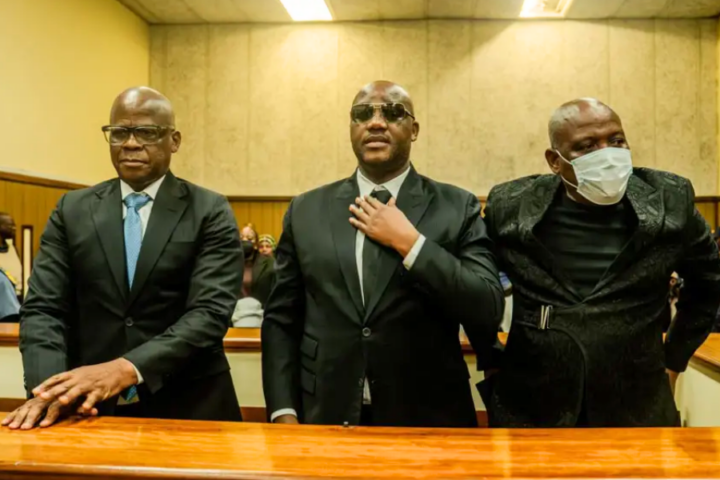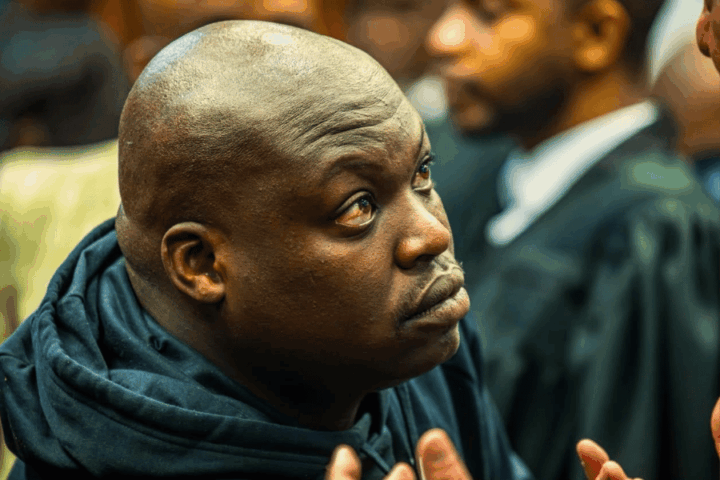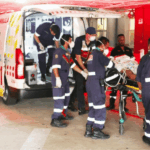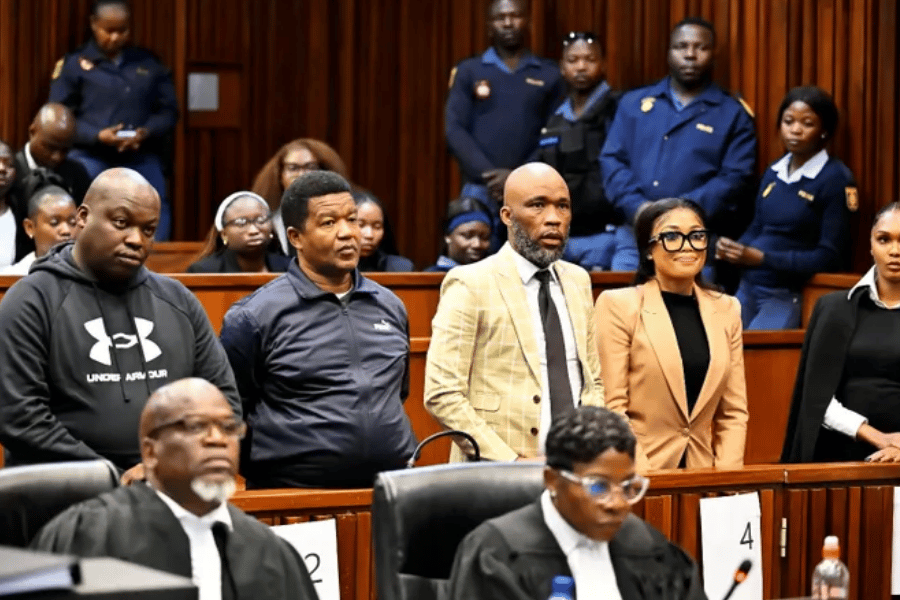
A Netcare 911 paramedic’s recollection of the events surrounding Matlala co-accused Musa Kekana’s encounter with police came under sustained scrutiny in the Gauteng High Court in Johannesburg on Monday, as the defence exposed a series of details she could no longer remember or had not recorded at the time.
Mary Kgapele, who attended to Kekana on 17 April 2024, remained firm on some aspects of her evidence but repeatedly conceded that she could not recall key details about what happened before, during and after the police took Kekana into a property in Fifth Road.
Her evidence became particularly significant because she maintained that she could independently remember the incident, despite acknowledging that she relied on her contemporaneous medical documentation for some of the details.
One of the most significant concessions came when defence counsel Riaan Gissing questioned her about information Kekana allegedly gave her at the scene.
Kgapele testified that Kekana told her he had been assaulted by police.
But the allegation was not recorded in the patient report form she completed on the day.
Gissing put it to her that she had a duty to document information obtained from the patient and the scene.
Kgapele agreed. “It was not correct. I should have recorded it.”
She further accepted that this obligation applied regardless of whether she treated the matter as a medical or trauma case.
Her initial explanation for the omission was that she had treated Kekana as a medical patient.
But under questioning, she conceded that she could not provide a satisfactory reason for failing to record the allegation.
The issue became more complicated when Gissing asked whether Kekana had specifically told her that he had been suffocated.
Kgapele could not confirm this. “No, I cannot.”
She maintained that she remembered him saying that he had been assaulted, but could not remember him explaining how the assault allegedly occurred.
Kekana’s version, put to the witness by his counsel, is that he told Kgapele he had been suffocated before he began coughing blood.
Kgapele could not confirm that account. She also accepted that the allegation of assault should have been documented.
Another part of the witness’s recollection came under pressure when the defence challenged her evidence concerning Kekana’s previous hospitalisation.
Kgapele’s clinical notes referred to Kekana having been intubated approximately two weeks earlier because of suspected poisoning.
But Kekana disputes this, saying his previous hospitalisation occurred approximately five weeks earlier.
Kgapele accepted that she could have made a mistake.
The defence also scrutinised the ambulance records. Kgapele confirmed that the patient report recorded the ambulance leaving the first scene at 14:25. But she could not provide recorded times for the arrival at the second location, the departure from that property or the subsequent journey to hospital.
She acknowledged that the document did not provide a complete timeline of what happened during that period.
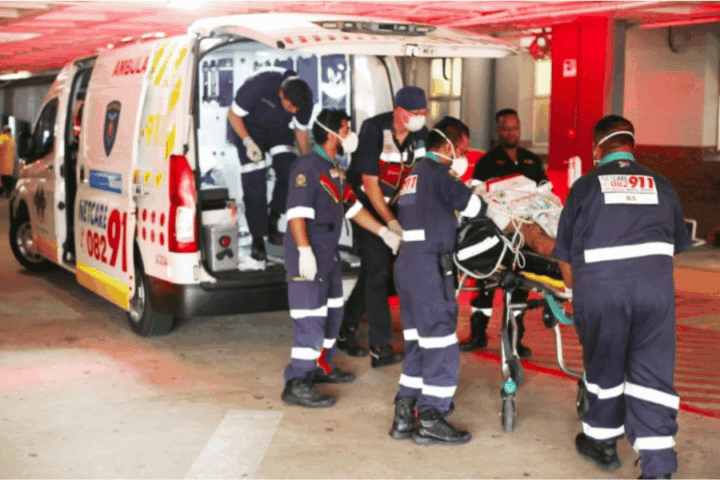
That second location became particularly important. Kgapele testified that police instructed the ambulance crew to follow them to Kekana’s home in Fifth Road.
Once there, police removed Kekana from the ambulance while he remained attached to the medical monitor and oxygen.
Kgapele and her colleague then escorted him into the property. The ambulance crew subsequently remained outside. Kgapele estimated that Kekana spent approximately an hour at the property before he was eventually taken to hospital.
But when questioned about precisely what happened during that period, her recollection became less certain.
She could not remember how many times she went inside to check his vital signs. She also accepted that there were occasions when Kekana could have moved outside her line of sight.
Gissing then put to her allegations that Kekana had been threatened, pulled or pushed by police.
If such conduct occurred while he was outside her view, she accepted that she could not dispute it.
“I wouldn’t, dispute that,” she said.
The same applied to Kekana’s allegation that police officers pulled his oxygen pipe. Kgapele accepted that she could not dispute such an allegation if it occurred outside her field of vision.
The witness nevertheless maintained that whenever she personally observed Kekana, he remained attached to the monitor and oxygen. She also testified that she saw him coughing blood.
But when asked to describe precisely what the blood looked like, her recollection became less certain. The defence questioned her about the colour, consistency and quantity of the blood.
Kgapele eventually said: “I cannot remember.”
She remembered that the blood was mixed with saliva or mucus and that Kekana would cough intermittently and wipe his mouth with a cloth.
She could not remember the colour of the cloth, although she accepted it could have been a towel.
She did, however, remember that there was blood on it.
The circumstances surrounding a statement Kgapele later gave police also came under scrutiny.
She testified that she was contacted by a female sergeant towards the end of July or beginning of August, several months after the incident.
At the time, she did not have her medical records with her. She told the sergeant that she needed the documents to provide accurate information.
According to Kgapele, she was subsequently asked to retrieve information from her former employer, but was unable to do so. Police later arranged to meet her at her home. Three officers arrived, she said, and showed her the patient report form.
Kgapele then gave her recollection of the incident while a male officer typed the statement on a laptop. The statement was printed, with one copy given to Kgapele and another retained by police.
The sequence raises an obvious evidentiary question, how much of the witness’s later recollection was based on her independent memory and how much was reconstructed or refreshed from documentation months after the incident?
The defence appeared to be probing precisely that distinction.
Kgapele’s evidence also revealed a tension between her description of Kekana as medically stable and his recorded vital signs.
She testified that Kekana was fully conscious and responsive. His blood pressure was recorded as elevated, as was his heart rate.
Under questioning, Kgapele agreed that stress or fear could cause elevated blood pressure and heart rate. She nevertheless maintained that Kekana was stable because, in her assessment, there was no life-threatening condition at the time.
She also confirmed that Kekana was complaining of difficulty breathing and that he was coughing blood.
Oxygen was administered and an intravenous line was maintained. Kgapele testified that these interventions were appropriate because of his breathing difficulty and blood loss associated with coughing blood.
She further accepted that the treatment would not necessarily have been different if the bleeding had resulted from suffocation.
By the end of the cross-examination, Kgapele remained certain about several broad aspects of her encounter with Kekana, she attended to him on 17 April 2024, saw him coughing blood, observed elevated vital signs and accompanied him from the roadside to the Fifth Road property and ultimately to hospital.
But on several details capable of establishing what happened during the crucial period at the property, her evidence was less certain.
She could not remember the number of times she checked on Kekana. She could not remember exactly when she left the second location. She could not say what clothing he was wearing. She could not remember the colour of the cloth on which he wiped blood. She could not remember whether Kekana specifically told her he had been suffocated.
And crucially, she acknowledged that the allegation that he had been assaulted should have been recorded in her contemporaneous medical documentation.
The defence’s challenge therefore went beyond whether Kekana was assaulted.
It placed the reliability, completeness and provenance of the paramedic’s recollection under the microscope, particularly where her present memory differs from, or goes beyond, what she recorded at the time.
The trial within a trial continues.