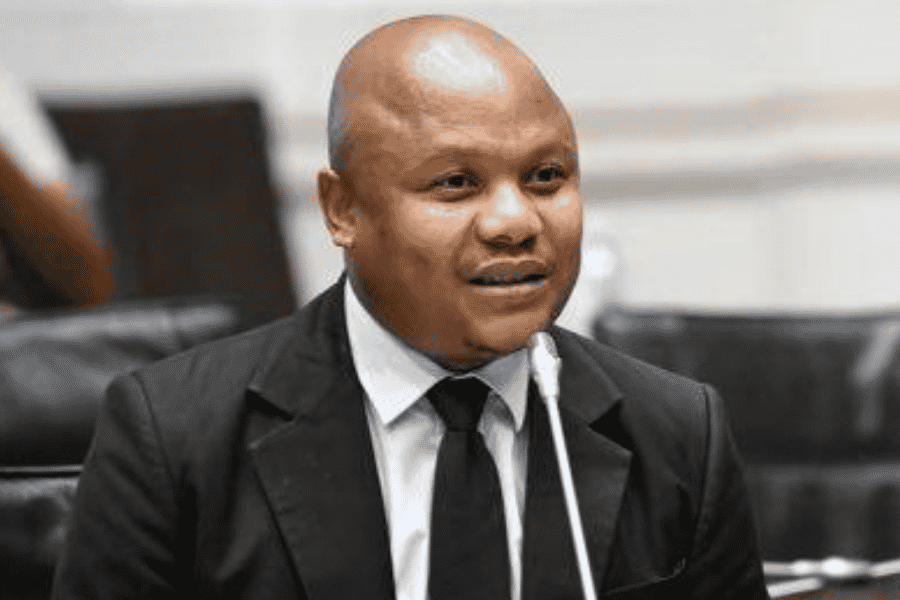
Someone is impersonating Parliament’s Justice committee chairperson, Xola Nqola, and using his identity to approach government officials for sensitive information.
Nqola told Parliament’s Justice committee on Tuesday that he had opened a criminal case after discovering that someone was using his name, photograph and a different cellphone number to contact officials.
The revelation came at the end of a briefing by the Information Regulator, which is responsible for enforcing laws governing the protection of personal information.
“I also have an issue that I did not report, I only went to open a criminal case at the police station. There is a person whose number is not my number, who is impersonating me, who is calling and texting government officials, requesting sensitive information,” Nqola said.
The impersonator is also using a photograph of Nqola and his wife as the WhatsApp profile picture.
“When I look at the profile picture of the WhatsApp of this guy, it’s me and my wife in the profile picture. And when I check on Truecaller, it’s written ‘caller’. It’s not my number,” Nqola said.
He said he opened the criminal case to ensure that any criminal activity by the impersonator was not attributed to him.
“So I had to go so that whatever this guy does is not attributed to me. I had to go and open an official case,” he said.
Nqola asked the Information Regulator whether it could assist, warning that identity theft and information breaches were becoming a serious problem.
“There are a lot of personal information breaches happening, the scams and all of that. In the problems that are besieging the country, we must find a way of how we play our part to ensure that people’s identities are not stolen for purposes of committing criminal offences,” Nqola said.
Nqola did not disclose how many officials had been contacted by the impersonator, what information had been requested or whether any official had handed over sensitive information.
The revelation came as the Information Regulator disclosed that it has limited capacity to investigate security compromises and complaints involving personal information.
The regulator’s executive responsible for the Protection of Personal Information Act, Advocate Tshepo Boikanyo, told MPs that only eight investigators are dealing with complaints across the country.
Just three staff members are dealing specifically with security compromises, he said.
The senior manager post responsible for the team is currently on hold because of a lack of funding.
Boikanyo said the regulator was relying on overtime to cope with the workload.
“We are doing something that is not sustainable, which is embarking on an overtime project,” he said.
Nqola’s case highlights the potential consequences of stolen identities being used to target officials and obtain information under false pretences.
Nqola is the ANC MP and has chaired the Justice committee since July 2024. The committee oversees the Department of Justice and Constitutional Development, the National Prosecuting Authority, the Special Investigating Unit and the Information Regulator.
He is not the first senior public figure to have his identity hijacked.
In November 2022, Parliament warned about a scam involving the name of then National Assembly Speaker Nosiviwe Mapisa-Nqakula.
The scammer initially used email before moving the conversation to WhatsApp and targeting Parliament staff. The WhatsApp profile picture was not Mapisa-Nqakula but that of then National Council of Provinces chairperson Amos Masondo.
The Electoral Commission of South Africa has also warned about an impersonator using the name of its chairperson, Mosotho Moepya, on WhatsApp.
The IEC said the impersonator was attempting to solicit money by promising to influence election results and that the matter had been reported to the police.
The problem has continued beyond Parliament and election bodies.
In September, the Western Cape Education Department again warned about fake WhatsApp messages using the names and photographs of principals and district officials.
Teachers were targeted with demands for R2,800 in exchange for posts that did not exist.
The Southern African Fraud Prevention Service has also warned that fraudsters can manipulate caller identification services by registering numbers under names that appear legitimate or official.
It advises victims of impersonation to report the matter to the police and through its Yima platform.
Impersonating another person online to commit fraud can potentially constitute cyber fraud under the Cybercrimes Act of 2020, while fraud is also recognised as a common-law offence.
For Nqola, the immediate concern is that someone is already using his identity to gain access to government officials.
And the Information Regulator’s own admission suggests that the country’s watchdog has limited capacity to respond to the growing threat.