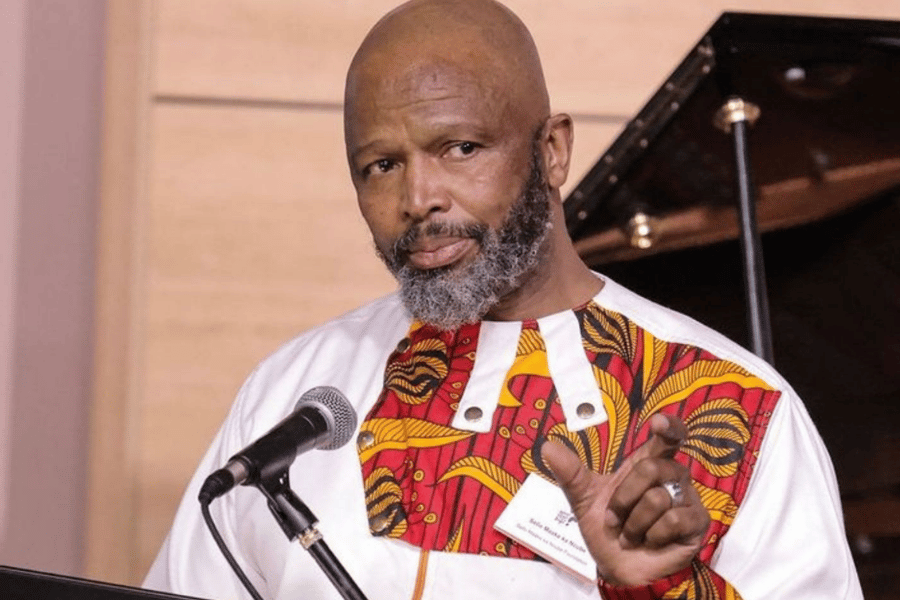
Outspoken legendary actor Sello Maake kaNcube has fired a broadside at the Department of Sport, Arts and Culture for pretending to care about his predecessor and fellow actor Bra Sol Rachilo, who died after a house fire last week.
Maake kaNcube accused the department of only becoming vocal about artists after their deaths, while allegedly failing to assist them when they are alive, vulnerable and in need of support.
In a strongly worded email addressed to senior department officials named Dr Khumalo and Tsanyane, Maake kaNcube questioned the timing of the department’s statement following the death of Rachilo, a veteran actor, poet, playwright and cultural activist.
The former Generations thespian said he was troubled by what he described as a familiar pattern in which government becomes “eloquent” about artists only after they have popped their clogs.
“We appear to become eloquent about our artists once they are no longer here to hear us,” Maake kaNcube said.
The revered doyen of. South African theatre argued that government’s responsibility to artists should not begin at their funerals and should extend to providing meaningful support while they are still alive.
“Government’s responsibility to artists cannot begin at the funeral. It cannot be limited to condolence statements, tributes, photographs, speeches and declarations of how much a person contributed to South Africa,” he said.
Maake kaNcube said he had recently written to the department about issues affecting artists , including Rachilo, and the broader creative sector, but had not received a response.
He said the lack of a response was particularly troubling when contrasted with the department’s ability to issue a public statement after Rachilo’s death.
“The silence of your no response spoke loudly when contrasted with the Department’s ability to produce public statements after an artist has died,” he said.
Rachilo, who was 96, spent decades contributing to theatre, literature, community arts and the development of young artists.
Maake kaNcube described him as a “living archive” from whom he was still learning and said his life embodied the principles of recognising past injustices, honouring those who fought for justice and respecting people who contributed to building the country.
He questioned how many more cultural elders would have to die before systems were developed to properly recognise and support the artists who helped shape South Africa’s cultural landscape.
“How many more artists must reach the end of their lives in circumstances that could have been addressed through meaningful intervention, only for government to later issue beautiful, flowery statements devoid of fragrance about their legacy?” he asked.
Maake kaNcube , who also starred in the Skeem Saam soap opera, stressed that his criticism was not directed personally at the minister Gayton McKenzie , but at the department and its institutional culture.
“This is not an attack on the minister personally. It is a challenge to the institution and to the culture within which it operates,” he said.
He called on the department to move beyond what he described as “performative recognition” of artists after their deaths and instead provide practical support to living artists.
“If the department genuinely believes, as the statement says, that artists such as Ntate Sol are ‘cultural elders’, then that recognition must have practical meaning,” he said.
“Cultural elders need systems of care. Vulnerable artists need accessible mechanisms of support. Living artists need departments that answer their correspondence, engage with their concerns and intervene where intervention is warranted.”
Maake kaNcube said artists should not have to die before their contributions are recognised by government.
“Artists should not have to die for their contribution to become an urgent matter. They should not have to become a headline before government finds the time to listen. They should not have to be memorialised before they are acknowledged.”
He urged the department to respond to his previous correspondence and said Rachilo’s death should prompt a wider discussion about how the country treats its artists.
“Are we genuinely caring for our artists, or have we become better at mourning them than protecting them?” he asked.
Africa Daily learnt that after the national department turned a blind to Maake kaNcube’s email, his foundation reached out to the Gauteng Department of Social Development which agreed to sent Rachilo to an old age home in Joburg South hours before he kicked the bucket.
Attempts to solicit comments from will-o-the wisp departmental spokesperson Stacey-Lee Khojane drew a blank as she ignored our phone calls and a text message we sent to her. She also failed to respond to the questions we emailed to her.
Speaking to Africa Daily , kaNcube confirmed that he has written the email to the department.
“The officials entrusted with steering DSAC remind me of the captain of the Titanic
—sitting at the helm of something enormously valuable, yet failing to understand
the magnitude of what is in their hands. The creative industry is not a peripheral sector; it is the soul, memory, identity and economic engine of a nation, and South Africa possesses extraordinary cultural capital. But most of all the cradle of moral regeneration. The tragedy is that those entrusted with managing this sector appear to take its value for granted, not necessarily because they intend to destroy it, but because they lack the understanding, the urgency and the vision required to navigate it,” he said.
He added: “ You cannot properly manage what you do not understand, and you cannot protect an industry you have failed to recognise as a national asset, when you are driven especially by just survival, a job and politics of the stomach. Artists deserve leadership that understands the weight of what it has been entrusted with.”