The Department of Sport, Arts and Culture has no research to back up how it moves sport development money between provinces.
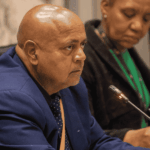
On Friday, acting DDG for sport Teboho Thebehae admitted to Parliament that the practice rests on “discussions”.
MKP MP Sthembile Nkosi pressed him on why the department tops up the Northern Cape with money taken from bigger provinces. Thebehae said it was a resolution of the committee of sport department heads.
“Based on what, what informs the resolution that was taken?” asked Nkosi.
“It’s the discussions that were undertaken at the time that informed this particular resolution, ma’am,” Thebehae said.
“I’m worried, because you are presenting this as evidence,” Nkosi said.
The exchange happened at the Portfolio Committee on Sport, Arts and Culture.
Nkosi had asked whether any study supported the department’s case.
“Has there been research to this effect? Is there something that can prove the claims? Because I can claim the same for Eastern Cape and Limpopo. You mention these things so boldly, and for me it sounds like a discussion, unless you’re able to say, ‘Actually, we did a feasibility study, this is the evidence,'” said Nkosi.
The money comes from a conditional grant under the Division of Revenue Act.
“It’s earmarked funding specifically for sport development,” Thebehae said.
He said the grant is first split using National Treasury’s equitable share formula. But the department changes the outcome.
“If we were to apply that criteria as it is, most smaller provinces would not get anything,” he said.
So each province first gets a R20 million baseline. After the formula is applied, the department takes money from bigger provinces like Gauteng and KZN and moves it to the Northern Cape.
Thebehae said every province must carry out the same national sports plan.
“The mandate of implementing the National Sport and Recreation Plan does not distinguish whether this province must do less of the plan and the other must do more,” he said.
He gave an example. If the Northern Cape gets R14 million for school sport and must ring-fence R10 million for championships, it is left with R4 million.
“They are left with R4 million to do everything else that is expected,” he said.
He said the province is vast, with scattered communities that need regular transport.
Nkosi said Treasury’s formula should already take such things into account.
“If there is an equitable share formula that’s done at Treasury level, surely they’ve taken a lot of issues into consideration,” she said.
“Ultimately you are going against the formula. You should be able to tell me how you determine that this is not equitable, or that this province deserves more money,” she said.
She then asked what criteria were used.
“Do they just decide, ‘Oh, we think there’s less money in Gauteng today, let’s give them more money’? Maybe because their friends are in Gauteng. I don’t want to get there,” she said.
Thebehae said the department does not move money as it pleases.
“The movement of money is not done according to what we prefer. It’s based on policies, and these are gazetted processes,” he said.
He said the Northern Cape top-up is a condition allowed by National Treasury.
Nkosi first raised the issue over uneven athlete support. The department funds more than 9,000 athletes through sports academies. Over 2,000 are in KwaZulu-Natal. Just under 200 are in the Western Cape.
“As a national department, you have a responsibility for a national footprint. But it seems as though there is a discrepancy in the way the funding is distributed across the provinces,” she said.
Thebehae’s answer was delayed at first. His computer froze, then his mic did not work.
“I like how these mics just suddenly don’t work when a question is asked,” Nkosi said.