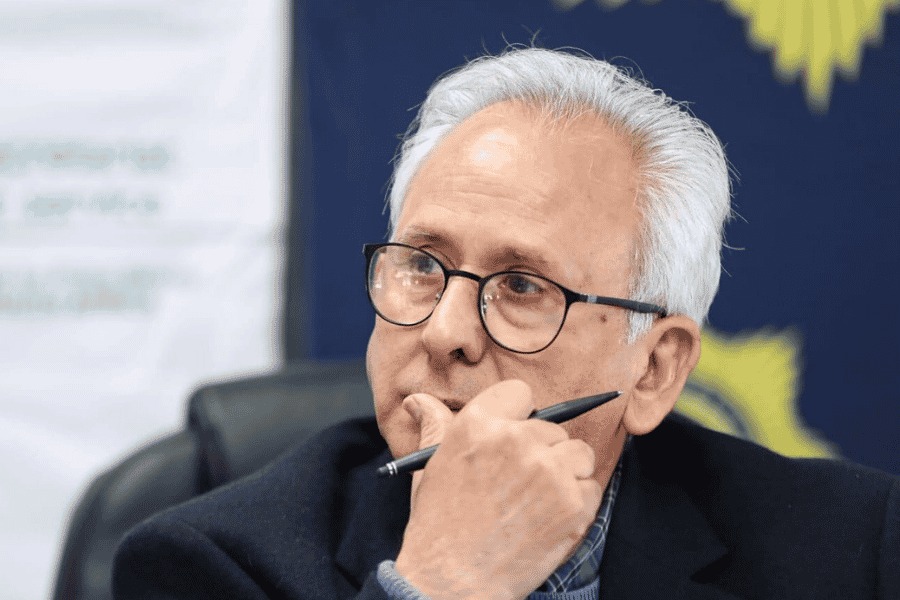
The police minister, Firoz Cachalia, has been ordered to pay R750,000 to a Randfontein police officer who was handcuffed at his own station and driven away in his uniform after being arrested without a warrant on corruption charges that were later withdrawn.
The Johannesburg High Court ruled on 7 October that the arrest of Lieutenant Colonel Kenalemang Daniel Nkhulang on 15 May 2013 was unlawful, finding that the State had failed to prove that police had a lawful basis to arrest him without a warrant.
Acting Judge Mohlala also recorded that the State’s legal team walked out during the trial without closing its case.
“The court would be remiss should it not place it on record that during the hearing of the matter on trial, during the first hearing the Defendant staged a walk out during proceedings without closing their case,” the judge said.
The court continued with the proceedings. Nkhulang was arrested alongside two colleagues after two men accused the officers of demanding a bribe when they went to sell scrap metal at a scrapyard in Aureus on 22 April 2013.
According to a complainant’s statement read in court, the officers demanded R4,800. The officers disputed that account. Their version was that the men were attempting to sell stolen scrap metal and had tried to bribe them to keep quiet.
The corruption allegations led to the three officers being arrested on 15 May 2013. Nkhulang testified that he was on duty and wearing his full police uniform when his station commander called him and his colleagues into a boardroom at Randfontein police station.
There, he encountered plain-clothes men he did not know. They demanded his R5 rifle, and he said nobody explained what was happening. The officers were handcuffed and taken to Jeppe police station in unmarked private vehicles while still wearing their uniforms.
Nkhulang testified that the arresting officers did not initially tell them what they were being charged with. He said their rights were not properly explained to them, even after they arrived at Jeppe police station.
The court heard that Nkhulang spent nine days in custody, including time at Johannesburg Central Prison, commonly known as Sun City. He was granted bail on 24 May 2013.
The National Director of Public Prosecutions later decided not to proceed with the corruption prosecution. The charges were withdrawn in August 2015 after key witnesses died.
The civil case turned on whether police were legally entitled to arrest Nkhulang without a warrant. The judge found that they were not.
Under the Criminal Procedure Act, police may arrest a person without a warrant in specified circumstances, including where they reasonably suspect that person of committing an offence listed in Schedule 1.
The State argued that the allegations could also support charges of theft or kidnapping, which could provide a basis for an arrest without a warrant.
The judge rejected that argument. Corruption was not one of the offences listed in Schedule 1, the court found. The kidnapping argument also failed because the charges in the docket referred to corruption, not kidnapping.
The judge described the proposed kidnapping charge as “a construct” introduced through the evidence of the State’s witness, the prosecutor who had enrolled the criminal case.
The court also heard from a retired police captain who took over the investigation after the lead investigator died.
The captain had not been present when Nkhulang was arrested. Under cross-examination, he conceded that he lacked the authority to review the conduct of a more senior officer.
The judge found that his evidence was hearsay and could not establish whether the officers who carried out the arrest had reasonable grounds to do so.
The two officers involved in the arrest, Lieutenant Colonel Tswaile and Warrant Officer Teffo, had both died by the time of the civil trial.
The judge said their deaths did not excuse the State from proving that the arrest was lawful. The court found that the State had failed to discharge that burden and declared the arrest unlawful.
In assessing damages, the judge considered the humiliation Nkhulang suffered when he was arrested in uniform and taken away in front of colleagues and members of the public.
The court noted that he had been arrested by plain-clothes officers who did not initially explain the charges against him, and that he was transported in an unmarked vehicle while still dressed as a police officer.
The judge said the arrest had damaged both his dignity and his standing in society.
“His dignity and status in society have been severely diminished by the unlawful arrest and detention and the subsequent withdrawal of the charges,” the judge said.
The court awarded R750,000, placing the amount at the higher end of compensation for unlawful arrest because of the humiliation Nkhulang endured and his position as a police officer.
Nkhulang had initially claimed R1.5 million. However, he withdrew his claims relating to malicious prosecution and unlawful detention, leaving the court to determine the unlawful-arrest claim.
The minister was ordered to pay the R750,000, interest from the date of judgment until payment, and Nkhulang’s legal costs. Nkhulang, in turn, was ordered to pay the State’s wasted costs associated with the withdrawn claim.
The judgment does not establish that the original corruption allegations were false. It establishes that the State failed to prove that Nkhulang’s arrest without a warrant was lawful.