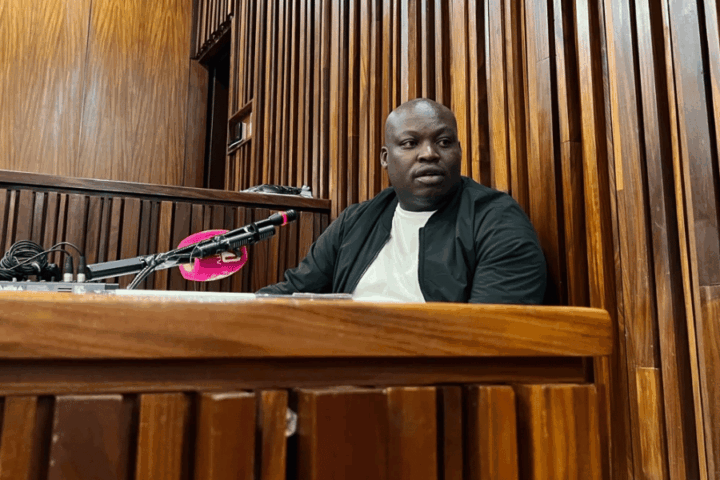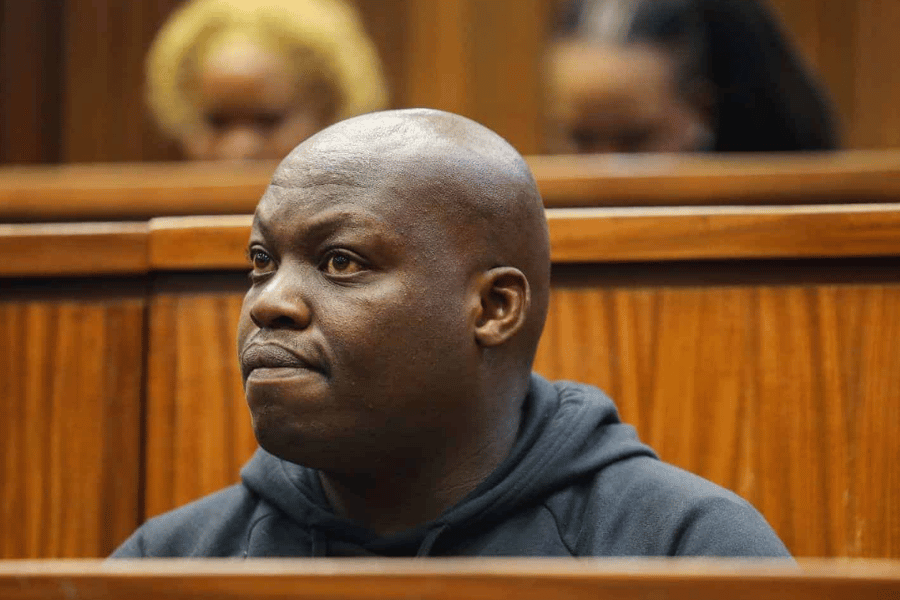
Musa Kekana, accused number one in the Vusimuzi “Cat” Matlala attempted murder trial, spent Wednesday afternoon defending his account of torture and an unlawful search.
The State argued that doctors, his former lawyer and even his current counsel had each recorded a version that differs from the one he gave in court.
Kekana is testifying in a trial-within-a-trial in the Johannesburg High Court before Judge Cassim Moosa.
The inquiry will decide whether evidence obtained after his arrest on 17 April 2024 can be used in the main trial.
He alleges police assaulted him and suffocated him with a plastic bag at his home, and that they entered and searched his property without consent.
Before the lunch adjournment, Kekana made a new allegation, that a Hyundai key had been planted on him at 8th Road, where he was arrested in a Mercedes-Benz Viano with Michael Pule Tau.
Demonstrating with a towel, he told the court an officer placed the key in his hands and told him to put it in his pocket.
“I did not put the key in my pocket. He came back and said, ‘I said you must put this key in your pocket,’ and then took the key himself and placed it in my pocket. Then he came back again, took it out and put it in an evidence bag,” Kekana said.
State prosecutor Adv Elize le Roux described the account as “surprisingly new evidence” and “bizarre,” and said it had never been put to the officer when he testified.
Kekana’s counsel, Adv Riaan Gissing, argued the issue belonged to the main trial.
Kekana said he had raised it in his 2024 bail affidavit. Le Roux read the affidavit to the court. It states that a Tactical Response captain gave him a Hyundai key, took it back and placed it in an evidence bag, but it makes no mention of the key being put in his pocket.
The key relates to a Hyundai i20 that was parked at Kekana’s home.
Le Roux told the court that police had information that the car was allegedly involved in a serious crime that morning.
Kekana said he had told Captain Phimi Sekgobela at the scene that the car belonged to a tenant.
“My exact words to the captain, when he asked me about the car, were that it belonged to a tenant,” he said.
Asked why he had not told police the tenant lived in an outside room, which he says was never searched, Kekana replied: “I don’t know how the police work.”
Kekana testified that Sekgobela personally searched the i20 in his presence.
Le Roux put it to him that he was lying, saying Sekgobela and Sergeant Mayisela Ledwaba had both testified the car was left untouched while police waited for the SAPS forensic crime-scene unit.
The State then turned to tracking data from the police Toyota Fortuner, which shows the vehicle arriving at Kekana’s home at 08:56 and leaving at 10:08.
Le Roux cited Sergeant Thabiso Mohale’s evidence that he took control of the 8th Road scene at 09:50 and that nothing was removed from it. She also cited photo metadata showing the keys in the Viano at 11:03. On Kekana’s version, police had fetched those keys from the Viano to open his house.
Le Roux said this “objective, scientific evidence… convincingly shows that you are lying about those keys.”
Kekana pushed back. He reminded the court that Mohale had testified he could set the camera’s clock manually.
“So how do we know he didn’t reset the time backwards to suit all the times they’re talking about?” he asked.
Kekana told the court he believed his own account of that day. “I believe what happened to me that day is the truth,” he said.
He confirmed that, on his version, police entered his home without asking permission or explaining his rights. He said any agreement he gave the captain came only while he was being suffocated, and that he never physically pointed out anything incriminating.
Le Roux then focused on a nebuliser that Kekana said he asked for because he could not breathe after the suffocation. She read from the record of 30 July, where Gissing had told Sekgobela that Kekana was uncuffed only after using the nebuliser.
Kekana testified on Wednesday that he was uncuffed first, after he began coughing blood.
“Maybe there was a mistake in the questioning, but I would not have been able to use the nebuliser while cuffed,” Kekana said.
“Exactly my point, sir,” Le Roux replied.
Kekana said he and his counsel “didn’t understand each other correctly,” adding: “Mistakes do happen.”
Le Roux then went through the others who, on Kekana’s version, had recorded his account incorrectly.
He said the doctor’s notes that he was suffocated at a police station and had earlier been admitted for food poisoning did not come from him.
He said most of what was in his bail affidavit was different from what he told his former attorney.
Kekana described being suffocated several times, losing consciousness.
He said a colonel who stood beside him told him: “Had you given us what we want, you wouldn’t be in this situation.”
Le Roux then read from the record of 4 August, when the defence told the colonel he was not present during the assault and had arrived directly afterwards.
Kekana said his instructions were that Sekgobela assaulted him, while the colonel was the officer who helped him.
Le Roux then put the State’s position to him directly. “I put it to you that you were never assaulted,” she said, adding that all three officers who testified had denied it, and that Sekgobela had said Kekana was treated with professionalism.
Kekana said his hands were cuffed behind his back and his size 40 leather belt was used to tie his hands and feet together.
The court accepted the belt’s length as about 120cm. When Le Roux suggested that was not long enough, Gissing objected that the witness could not answer the point.
In the final stretch, Le Roux pointed to a line in the bail affidavit saying police had searched his motor vehicle, singular. Kekana has testified that three cars were searched.
“Maybe on this line we just need to add an ‘s’ to make it ‘vehicles’,” Kekana said.
He told the court he had noticed errors when the affidavit was read at his bail hearing, but his lawyer told him to relax because “most things would be fixed as we went on with the trial.”
“He’s the lawyer. I’m just a client, so I listened to him,” Kekana said.
Matlala, his wife Tsakane Matlala, Kekana, Tiego Floyd Mabusela and Nthabiseng Nzama face 25 charges, including conspiracy to commit murder and attempted murder.