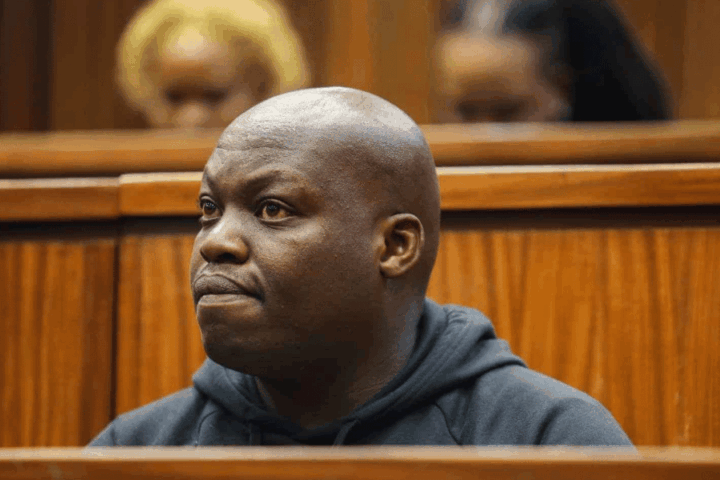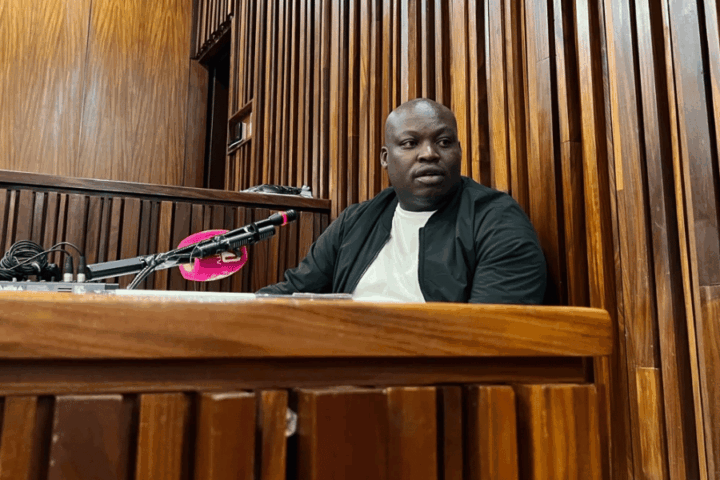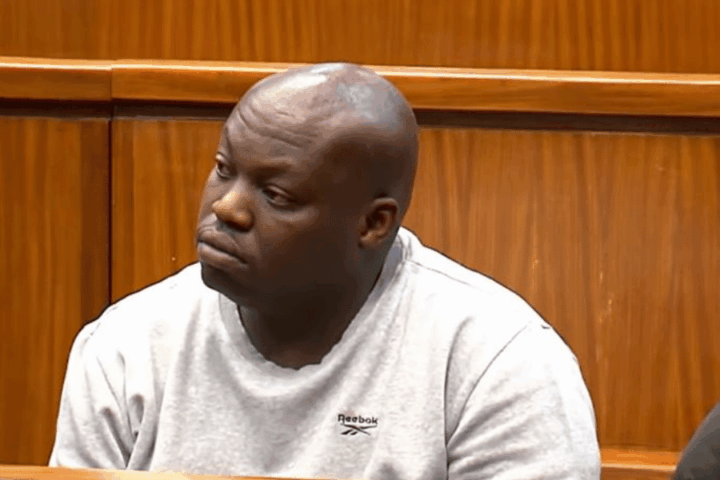
The defence has closed its cross-examination of Captain Phimi Alfred Sekgobela, one of the state witnesses in the attempted murder trial of alleged crime kingpin Vusimuzi ‘Cat’ Matlala in the Joburg High Court.
The challenge to the arrest and search of accused No. 1, Musa Kekana, is now fully before the court. The issues have been set out in evidence. What remains is for the court to decide which version it accepts.
The State has not re-examined, and no rebuttal evidence has been heard.
By the time cross-examination ended, the defence case had narrowed into four separate lines of attack, each aimed at a different part of the State’s version.
- Whether the arrest itself was lawful.
Gissing challenged whether there were reasonable grounds for the arrest.
Sekgobela’s answer was general rather than specific, his response was: “In South Africa, if you break the law you get arrested.” A statement of principle rather than an explanation of the specific information that led him to suspect Kekana of committing an offence.
2. How the officers got into the property, and on what authority.
Sekgobela’s case rests on two distinct legal grounds. First, that the circumstances were urgent because a second vehicle was unaccounted for and evidence might be destroyed.
Second, that Kekana consented to the search after being asked. Each ground has its own legal requirements, and the court will have to decide whether either, or both, has been established.
The defence disputes both, and says the gate was opened manually.
Consent and urgency are separate legal justifications, each with its own facts. If the court is not satisfied that Kekana freely consented to the search, it is likely to examine the claim of urgency more closely, including why no officer was sent ahead to secure the property and whether backup could have been called sooner.
3. The rights. The captain says he explained them in Sepedi at the scene.
He could not recall the full list from the witness box. The defence version is that they were never explained at all, and that the notice of rights the State relies on was brought to Kekana’s hospital bed the following day, already filled in, for signature.
4. The alleged assault. This is the one that changes the character of the enquiry.
A procedural irregularity and an allegation of assault are fundamentally different kinds of challenge. Both may affect the admissibility of evidence, but they do so for different reasons and carry different consequences.
Section 35(5) of the Constitution does not exclude evidence merely because a right was infringed. The court asks first whether there was a violation, and then whether admitting the evidence would render the trial unfair or otherwise be detrimental to the administration of justice.
That second stage weighs how serious the breach was and whether it was deliberate.
A failure to explain one of the prescribed rights sits at one end of the scale. A finding that a handcuffed suspect was suffocated with a plastic bag to force him to reveal the whereabouts of firearms sits at the other. The first may not, on its own, be fatal to the admissibility of the evidence.
The second, if established, goes to the heart of the fairness and integrity of the criminal process itself.
Most of what is in dispute is one man’s account against another’s.
For now, much of the dispute is one person’s word against another’s. Sekgobela gave evidence from the witness box, Kekana’s version was put to him through Counsel.
On that evidence alone, the court is faced with two competing and irreconcilable accounts.
The hospital records are different, and that is why they carry particular significance. A progress note recording that Kekana was coughing up blood after an alleged assault, and a hospital entry the following day recording that the bleeding originated from the lung, are contemporaneous medical records that exist independently of either man’s testimony.
They do not, by themselves, establish how the injury occurred. But they provide an objective point of reference against which the competing accounts can be assessed.
The captain’s answer to both was “no comment.” His alternative explanation that the coughing had begun earlier, at the first scene was itself challenged as new.
There is a second documentary thread. On Sekgobela’s evidence, the ambulance arrived before 1pm and left at about 3pm. The hospital file, however, records Kekana’s admission at about 8:30pm.
Sekgobela did not dispute that entry. When asked to reconcile it with his own evidence, he answered: “No comment.”
Whether the difference has an innocent explanation is a question that may yet be addressed. For now, it remains another point the court will have to weigh.
If the discrepancy is not reconciled, it leaves a significant gap in the timeline during the very period the defence alleges Kekana was assaulted.
Beneath the competing versions lies a question that has yet to be answered, what, exactly, does the State want to use?
If the State is seeking to rely on physical items recovered during the search, its position is stronger.
South African courts have generally been more reluctant to exclude real evidence because it exists independently of any alleged rights violation and, unlike a confession or admission, its reliability does not ordinarily depend on the manner in which it was obtained.
If the State relies on anything Kekana said, or on anything he pointed out, the position is very different, and the defence has already put a version that speaks directly to it.
Counsel’s instructions were that after Kekana collapsed, he may have made utterances, a yes or a no, in a confused state, while information was put to him to confirm or deny.
That is precisely the evidence most vulnerable to exclusion, and it would put the reliability question squarely alongside the fairness one.
Three things are likely to shape the ruling more than anything heard so far.
First, Sekgobela’s contemporaneous diary, which the defence has now examined.
If it records the arrest, the explanation of rights, or any consent to search, it may either reinforce or undermine Sekgobela’s recollection.
Second, the complete ambulance and hospital records, rather than the extracts put to the witness during cross-examination.
They may help fill, or deepen, the gaps in the timeline.
Third, the evidence of any other officers present.
The defence alleges other officers carried out the assault, while Sekgobela maintains that no assault occurred under his supervision.
If the State intends to answer those allegations with more than a denial, that evidence will have to come from the officers who were there.
Whatever the outcome, the ruling will decide only what evidence the court is entitled to consider.
A finding that the arrest or search was unlawful is not a finding that Kekana is innocent.
Equally, a ruling admitting the disputed evidence is not a finding that he is guilty.
It will almost certainly be portrayed as a victory for one side or the other but legally, it is neither.
It is a ruling about the rules of the trial, not its final outcome.