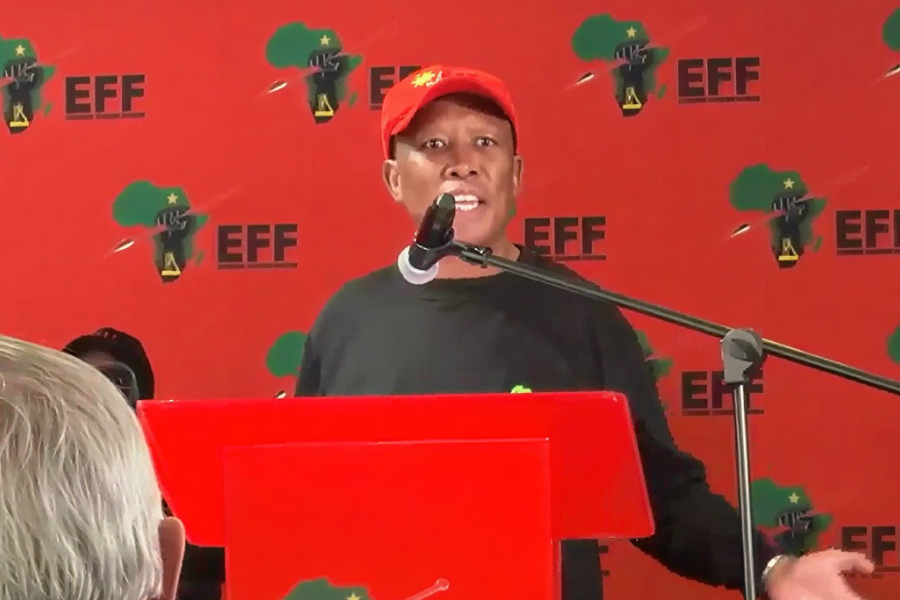
EFF leader Julius Malema acknowledged contacting suspended Crime Intelligence Major-General Feroz Khan through tobacco businessman Mohamed “Mo” Sayed after Khan was shot, while denying allegations that he prevented the senior police officer from appearing before a parliamentary committee.
Malema addressed the allegations on Thursday at a media briefing, following evidence before the Madlanga Commission of Inquiry, where WhatsApp messages presented by investigators allegedly suggested a close relationship between the EFF leader, Khan and Sayed.
The commission has heard allegations that Khan leaked confidential police information, drafted parliamentary questions for Malema and received political protection in return.
Malema has denied any wrongdoing.
Malema said his only interaction after Khan was shot was to contact Sayed to establish what had happened.
“I know Khan, and I’ve already made it very clear I know Khan,” Malema said.
He explained that conflicting reports had emerged about the shooting and he wanted clarity on Khan’s condition.
“If any call which I made was to Mohamed,” he said.
“I asked him, ‘What’s happening? Did they really shoot this guy or what is the story?’”
According to Malema, Sayed confirmed Khan had been shot and was receiving treatment in hospital.
Malema said he did not visit Khan or communicate with him directly after that conversation, insisting he had deliberately kept his distance while the commission continued its work.
“I couldn’t go and see him. I can’t call him. I can’t do anything until Madlanga has done his work,” he said.
“If there’s anything wrong that Khan has done, the Madlanga Commission must take him on.”
Malema also rejected allegations made by the uMkhonto weSizwe party (MKP) that he blocked Khan from appearing before Parliament’s ad hoc committee investigating allegations made by KwaZulu-Natal Police Commissioner Lieutenant-General Nhlanhla Mkhwanazi.
He insisted he had never opposed Khan’s appearance before the committee but had merely questioned why members wanted him called as a witness.
“I never did that,” Malema said.
“Whoever said we must call Khan should have given the reasons why, because I had no reason to call Khan.”
He said asking fellow MPs to motivate why a witness should be called was part of Parliament’s ordinary oversight process.
“So I shouldn’t ask you a question when you say, ‘Let’s call Khan,’ and I ask you why?”
Malema accused some committee members of failing to justify their proposals before later blaming him when Khan was ultimately not called.
“They don’t say anything and then Khan doesn’t get called. They blame it on me as if I was running the committee alone,” he said.
The EFF leader said he had adopted the same approach when committee members proposed summoning judges.
Recalling one of the committee’s meetings, Malema said he insisted members identify specific judges instead of making broad references to the judiciary.
“You can’t say judges. You must say a name because judges is huge,” he said.
He warned that making sweeping allegations against the judiciary risked undermining one of South Africa’s most important constitutional institutions.
“When it comes to the judiciary, you must be very specific when you attack it,” he said.
“If we delegitimise that sphere of government, we must know we’re all in danger.”
The Madlanga Commission has heard allegations that Khan used police resources to gather confidential information and pass it to Malema through Sayed, while also allegedly drafting parliamentary questions for the EFF leader to use against former Inspector-General of Intelligence Isaac Dintwe.
Evidence leaders have further alleged that Malema provided political support to shield Khan from disciplinary action and efforts to remove him from Crime Intelligence.
Malema has repeatedly denied the allegations, accusing the commission of relying on speculation instead of verifiable evidence.
In addition, Malema said the EFF reiterated its support for the commission’s work to expose corruption within the criminal justice system but urged its evidence leaders to rely on credible evidence rather than media reports.
The party also called for the commission’s preliminary findings and interim reports to be made public, arguing that they belonged to South Africans rather than the Presidency.
“The use of news articles as evidence by such a credible commission only serves to undermine the credibility of the process and turn the commission itself into a weapon of propaganda,” Malema said.
The party maintained that despite attempts to implicate its leadership, no evidence had been presented linking it to any criminal wrongdoing.