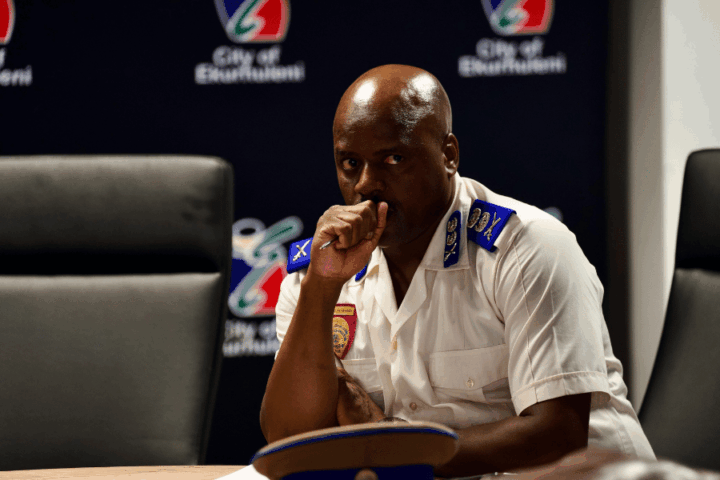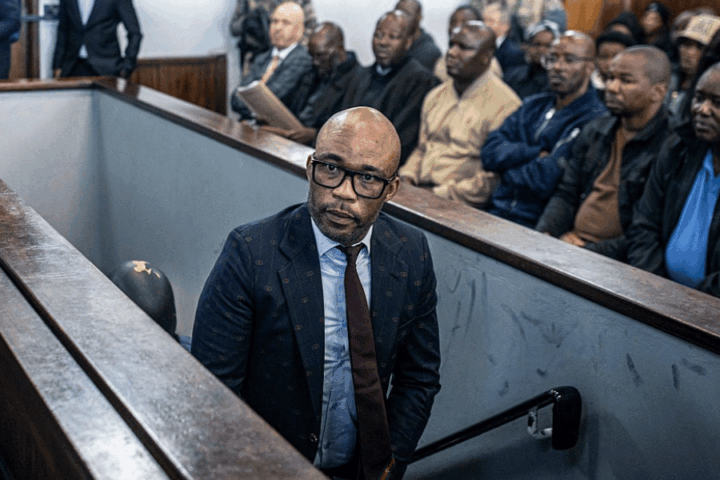
Johannesburg – The police captain who arrested accused No. 1 told the Johannesburg High Court on Thursday that he could not remember all the rights he said he had explained to the accused at the time of his arrest.
Pressed by defence counsel Advocate Riaan Gissing on which rights he had conveyed, Captain Phimi Alfred Sekgobela said he had explained the accused’s constitutional rights, the right to remain silent, and that he need not say anything that might incriminate himself.
Beyond that, he told the court, he could not remember.
“I forgot other rights that I explained to him, I’ll have to check them up and remind myself as I always do,” Sekgobela told the Court.
Sekgobela’s evidence is that he spoke to accused No 1, Musa Kekana, in Sepedi, and that Kekana confirmed he understood.
The exchange goes to the heart of the trial-within-a-trial now under way, in which the court must decide whether evidence obtained during the arrest and the search that followed is admissible.
The rights document was already at the centre of the dispute when the matter was before the court on Tuesday, 28 July.
Kekana’s own version, put to the witness by Gissing, is not that the rights were incompletely explained but that they were never explained at all.
According to Kekana, he was sitting in the driver’s seat of the vehicle, with Tau in the passenger seat, when Captain Sekgobela approached, called him by name and remarked that he was “still stout”.
Kekana said the captain then handcuffed and arrested both men without explaining their rights.
“That’s not true,” the captain replied. “I didn’t know his name at the time.”
He maintained that he had explained their rights and that both men said they understood them.
Gissing then put Kekana’s version to Sekgobela.
He said Kekana was placed in the boot of a white Fortuner and driven to house number 34, 5th Avenue in Kew, where the gate was closed and his hands were still cuffed behind his back.
According to Gissing, when officers asked who was inside the house, Kekana said he did not know.
He also told them he lived there with children and tenants and did not have the keys because they had been left in the Viano at the arrest scene.
Sekgobela rejected most of that version. He denied there had been a white Fortuner, saying the State had not issued his team with one.
He also said Kekana’s handcuffs had been moved from behind his back to the front while they were still at the arrest scene.
He agreed that Kekana had said he did not know who was inside the house, but testified that Kekana also said he lived there with his wife.
He denied that Kekana had mentioned children or tenants.
Much of the morning’s cross-examination centred on a set of keys.
Sekgobela testified that when they arrived at House No. 34, 5th Avenue, Kew, Kekana took keys from his left pocket and unlocked the gate. Gissing questioned how Kekana could have done so while handcuffed.
“He was handcuffed in front. He had enough movement in his hands,”
Sekgobela replied.
Gissing put it to him that he had told the court everything had been confiscated.
“Why didn’t you tell the court yesterday that keys were not confiscated but still in his pocket?” he asked.
“You see, you’re being caught out in a lie, ” said Gissing.
“There are no lies here,” the Sekgobela responded.
He was then shown a photograph of the interior of the Mercedes Benz, taken after Kekana had been removed to the Kew house.
Asked whether he had been present when the photograph was taken, Sekgobela replied that he had not.
The cross-examination then focused on that point.
Gissing argued that, if he was not there, he could not say whether the keys were inside the vehicle when the photograph was taken.
Gissing further put it to him that the gate had been opened manually.
“That is not true. It was opened with the remote,” Sekgobela replied.
Sekgobela again confirmed he had no search warrant when he entered the Kew house.
Asked why he had not applied for a search warrant, Sekgobela said he left the arrest scene immediately because he feared evidence at the Kew property could be destroyed if police delayed.
He said that, as the operational commander, he had already made his decision and believed the operation had gone according to plan.
He added that he had called for backup, but it did not arrive.
“We were eight members, and I was the eighth person,” he told the court.
Gissing put it to him that this contradicted his earlier evidence that he had not thought of calling for backup.
“I’m not changing. I’m simply adding,” said Sekgobela.
The matter was adjourned to Thursday, 30 July to allow the defence to examine Sekgobela’s 2024 diary.
The trial-within-a-trial continues.
Proceedings opened with a change in representation.
Advocate Timothy Chauke and his instructing attorney withdrew from representing accused No 5, Nthabiseng Zandile Nzama, citing a lack of financial instructions.
Advocate Nardus Grover has been instructed to represent both Nzama and accused No 2, Tiego Floyd Mabusela.