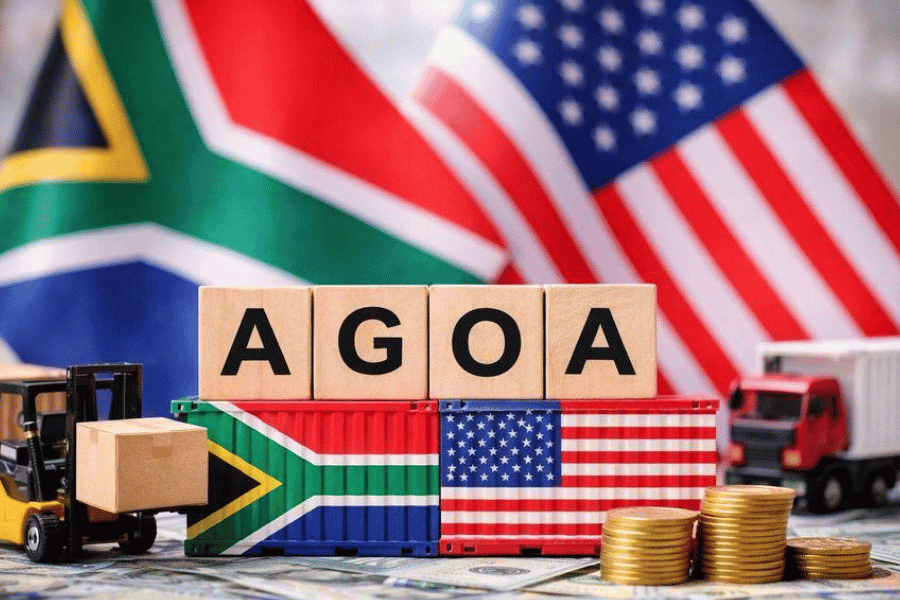
SA faces the loss of thousands of jobs if it is removed from the African Growth and Opportunity Act (AGOA), with Cosatu warning that agriculture and manufacturing are already bleeding under high US tariffs.
The warning comes as the White House reviews the list of participating countries, with a decision expected by 1 November 2026.
Relations between South Africa and the US have soured in recent years, largely driven by Pretoria’s decision to drag Israel – America’s biggest ally – to the ICJ over the war in Palestine.
While organisations have warned that SA could be out before Christmas, Cosatu says the impact on workers will be devastating if that happens.
Cosatu spokesperson Matthew Parks said exclusion from AGOA would cut favourable tariff access for key exports and trigger further retrenchments in an economy battling a 43.8% unemployment rate.
“If South Africa is exited from AGOA and thus loses favourable tariff access for certain exports, it would hurt our agricultural as well as key manufacturing sectors including clothing, jewellery and chemicals. This would threaten thousands of badly needed jobs,” Parks said.
He said while mineral exports and some agricultural products are exempted from tariffs, and motor manufacturing and steel are governed by a separate 25% duty similar to other exporters, the remaining sectors face ruin.
“Given our 43.8% unemployment rate, we cannot afford to lose a single job,” Parks said.
“We have already seen painful job losses in jewellery in Cape Town, manufacturing in Atlantis and this week hundreds of jobs will be lost in agriculture in Tulbagh due to the high tariff duties imposed by the US.”
Cosatu further said SA cannot be forced to choose between its non-aligned foreign policy and trade.
“South Africa cannot afford to choose between being non-aligned and promoting trade opportunities. The two issues complement each other,” Parks said.
He said the crisis requires sensitivity because jobs are at stake, but insisted South Africa’s constitutional democracy is non-negotiable.
“These are complex matters that need to be handled with the necessary sensitivity and sobriety. This requires key role players to tread lightly as jobs are at stake. South Africa is a constitutional democracy and that cannot be held to ransom by any state or party,” he said.
Parks said government must urgently cushion affected businesses and workers, including through the UIF Temporary Employer/Employee Relief Scheme, tax holidays and sectoral relief.
“Government needs to move with speed to put in place support for affected businesses and jobs. This should include ensuring the UIF Temporary Employment Relief Scheme is able to provide support for affected companies and workers. Other relief should be considered including tax holidays and sectoral relief,” he said.
He also called for an aggressive drive to unlock new markets, as dependence on the US leaves workers vulnerable.
“Equally important is for government and industry to aggressively expand and unlock new trade opportunities,” Parks said.
The federation pointed to Premier Group citing high tariffs as a reason to retrench workers and close its plant as an example of what is to come.
“This is a devastating blow to these workers, their families and communities,” Parks said.
Cosatu said it continues to support engagement with Washington to preserve AGOA membership and enhance trade, but on the basis of mutual respect.
“It is critical that South Africa’s government continue to engage the US on South Africa’s continued membership of AGOA, how to enhance trade and investment opportunities and resolve bilateral issues.
This must be done based upon mutual respect, including for South Africa’s constitutional democracy and our transformation journey. These are non-negotiable,” Parks said.
He noted that AGOA is not a trade agreement but an Act of Congress that empowers the US administration to review and even remove member states, as has been done to other countries before.
Cosatu said it has made submissions to both the US administration and Congress arguing that AGOA benefits workers in SA, Africa and America, and that should guide the review rather than geopolitics
“Cosatu has made submissions to and engaged with the US administration and Congress on why we believe AGOA is beneficial for workers in South Africa, Africa, and America. That is what should guide this review. Not geo-political and other issues,” Parks said.
The latest review shows a shifting approach in Washington. Trade advisory firm XA Global Trade Advisors said AGOA is increasingly being framed as a strategic trade tool to advance American commercial, industrial and geopolitical interests rather than a development instrument, noting the US goods trade deficit with South Africa widened to $10.1 billion in 2025.
Solidarity Union estimates up to 250,000 jobs partially or fully dependent on AGOA are at risk, with more than 500,000 jobs dependent on overall trade with the US.