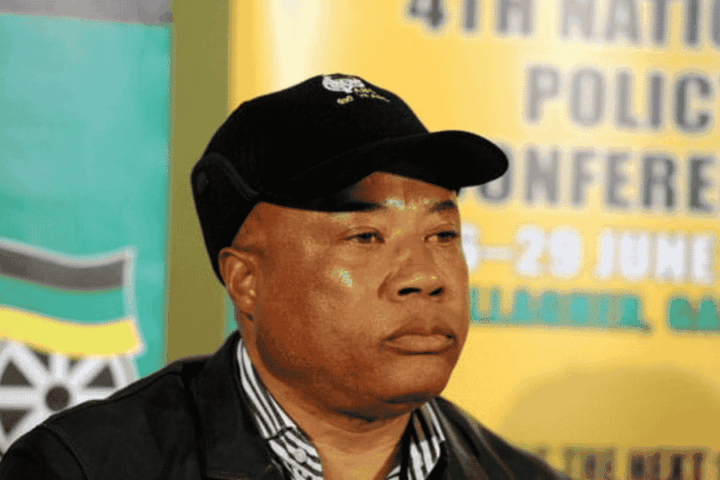
Former EFF MP Mbuyiseni Ndlozi has launched a pointed attack on veteran ANC politician Tony Yengeni over his support for the March and March anti-illegal immigration movement and his criticism of African intellectuals.
In an open letter titled On the Mood of the Masses and the Anatomy of Truth, Ndlozi challenged Yengeni’s argument that intellectuals should not assume they know better than the masses.
Yengeni had written on X that he was “always annoyed” by people who considered themselves intellectuals or thinkers because they allegedly assumed they knew better than the masses.
He also wrote: “Illegal immigrants are NOT investors. It’s a white lie.”
Ndlozi said the comments amounted to dismissing younger African thinkers rather than engaging with their arguments.
He specifically took issue with Yengeni’s repeated references to the “mood of the masses” following the nationwide March and March demonstrations on 30 June.
Ndlozi said Yengeni had previously argued that second-guessing the mood of thousands of people who marched across nine provinces would lead to “wrong, unscientific” and “reactionary” conclusions.
But Ndlozi argued that the size of a crowd could not determine whether a political position was correct.
“The mood is not the criterion of truth,” Ndlozi said.
He used South Africa’s history of witchcraft-related violence during the 1980s and early 1990s to challenge what he described as an uncritical acceptance of popular sentiment.
Ndlozi pointed to the Ralushai Commission of Inquiry into Witchcraft Violence and Ritual Murders in the Northern Province, which was established in 1995 to investigate witchcraft violence and ritual killings. The commission’s report examined violence linked to accusations of witchcraft in the province. (Google Books)
According to Ndlozi, the historical example demonstrated that mass mobilisation could not itself be treated as proof that a political position was correct.
He argued that communities experiencing poverty, drought and other hardships could develop explanations for those conditions that were not supported by scientific evidence.
Ndlozi said the same principle should be applied to contemporary political mobilisation around undocumented migration.
The March and March movement organised nationwide demonstrations on 30 June demanding that undocumented foreign nationals leave South Africa. Thousands participated in protests across the country, with isolated incidents of violence and intimidation reported. (ACLED)
Ndlozi acknowledged that the grievances underlying the protests — including unemployment, municipal failures, corruption, crime and economic hardship — were real.
However, he argued that directing those grievances at poor African migrants amounted to misdirecting class anger.
“You will say that undocumented migration reduces wages and serves the interests of capital. You are right,” Ndlozi wrote.
“But as a student of Marx, you know that the enemy is the mining boss, the agricultural tycoon, and the corporate elite who illegally hire and exploit unregulated labour to maximise profit.”
Ndlozi further questioned the theoretical basis for making undocumented migrants the focus of working-class mobilisation, arguing that migrant workers should be distinguished from the businesses and employers who exploit them.
He also challenged Yengeni’s statement that undocumented migrants are not investors, arguing that the issue was separate from whether migrants constituted an exploiting class.
Ndlozi said Yengeni’s position was particularly significant given his history in the liberation movement, including his involvement in the ANC and the development of South Africa’s post-apartheid constitutional and defence framework.
He said Yengeni’s political generation had helped establish institutions and principles that should not now be undermined by populist mobilisation.
Ndlozi concluded by arguing that a large crowd should not automatically be regarded as evidence of a revolutionary political programme.
“A crowd gathered around a populist promise, however large, is a sign of societal despair, not a validation of a revolutionary program,” he wrote.
Ndlozi signed off the letter with “Again, with the greatest respect, Salute!” and identified himself as a host of the African Renaissance Podcast and a fellow at the Thabo Mbeki Foundation.
Please visit Africa Daily’s Opinion Pages to read Mbuyiseni Quintin Ndlozi ‘s unedited letter.