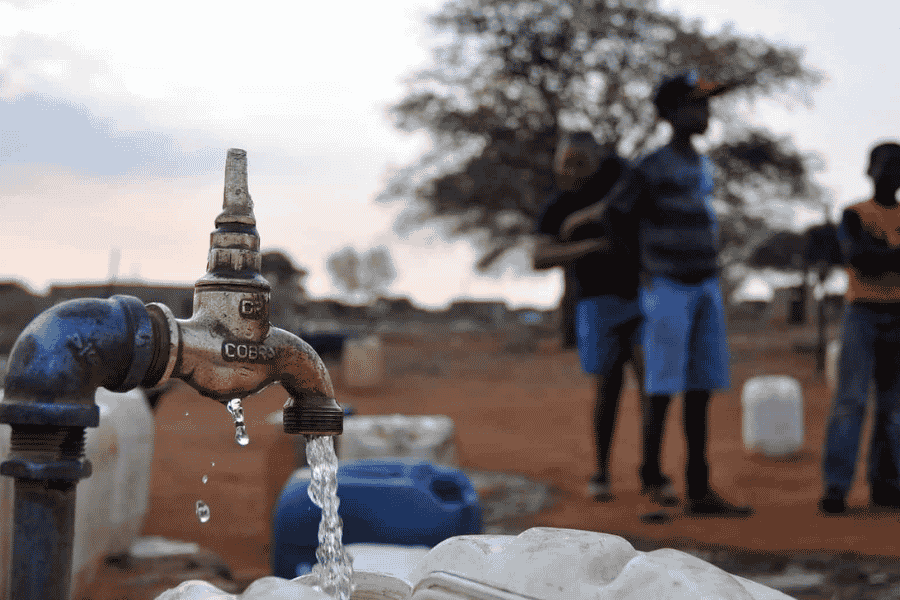
For the largely rural Doctor Ruth Segomotsi Mompati District Municipality in the North West, water is not a right. It is a daily struggle, a commodity bought for R1, and a reminder that the democratic promise of dignity has not reached the village.
The district has now been earmarked as one of the top eight national priority infrastructure development projects in South Africa, with a R1.87 billion project that promises to build water security for its residents. On paper, it is a breakthrough. On the ground in Cokonyane in Taung, residents are not holding their breath.
Access to water remains a serious concern, and residents say they have heard promises before.
“We buy water here and pay R1 and when we do not have money to buy the water, we sometimes go to bed without bathing,” one resident said.
“It also becomes a nightmare in the morning when kids have to prepare for school because we don’t have taps in our yards and the communal ones don’t work. What’s irritating is that we are now getting water and we know it’s because it’s time for elections.”
It is a familiar pattern in South Africa’s forgotten villages. Water comes and goes with the election calendar, while permanent infrastructure stalls, collapses or is never built at all.
In Doctor Ruth Segomotsi Mompati, previous water and sanitation projects had stalled, leaving the municipality to rely on private water tankers to supply people – a costly, unsustainable stopgap that has become permanent in many rural municipalities.
Municipal mayor Motseokae Maje admits the scale of the crisis.
“We are the first to acknowledge that we are registered with a serious delivery backlog, amongst them water and sanitation in the entire district, and that’s why for some time we even relied on water from private water tanks to supply our people,” Maje said.
“We then developed both medium-and long-term measures. Recently, we have been crisscrossing the region to help oversee completed water projects and sanitation projects. Among them are water treatment plants, because we are aware of the reality that this situation poses to the health of our community members.”
But acknowledgement is not water in a tap.
The story of Cokonyane is the story of rural South Africa where water matters have always been against village people. While metros debate water-shedding schedules, villages live it permanently. Children learn to bath from buckets, women walk kilometres to communal taps that run dry, and the elderly are forced to choose between buying water and buying bread.
This is not unique to the North West. The ghost of the Giyani Bulk Water Project in Limpopo looms large over every new multi-billion-rand promise. Announced in 2014 as a R3 billion solution to Giyani’s water crisis, the project became a symbol of corruption, maladministration and state failure. Years later, after Special Investigating Unit probes, contractor LTE Consulting was implicated in irregularities, costs ballooned to over R4.5 billion, and taps in Giyani remained dry. President Cyril Ramaphosa himself had to intervene in 2022 to plead with residents as water finally started trickling after nearly a decade of failure.
Giyani taught the country one lesson: earmarking billions does not equal water security. Implementation, maintenance and political will do.
Now, Ruth Segomotsi Mompati faces the same test. Will the R1.87 billion become pipes, treatment plants and yard connections that work beyond election day, or will it become another case study in stalled projects and tenderpreneur tankers?
For now, the people of Cokonyane are still paying R1 for water that should be free, still going to bed without bathing when they cannot afford it, and still watching their children struggle to get to school clean.