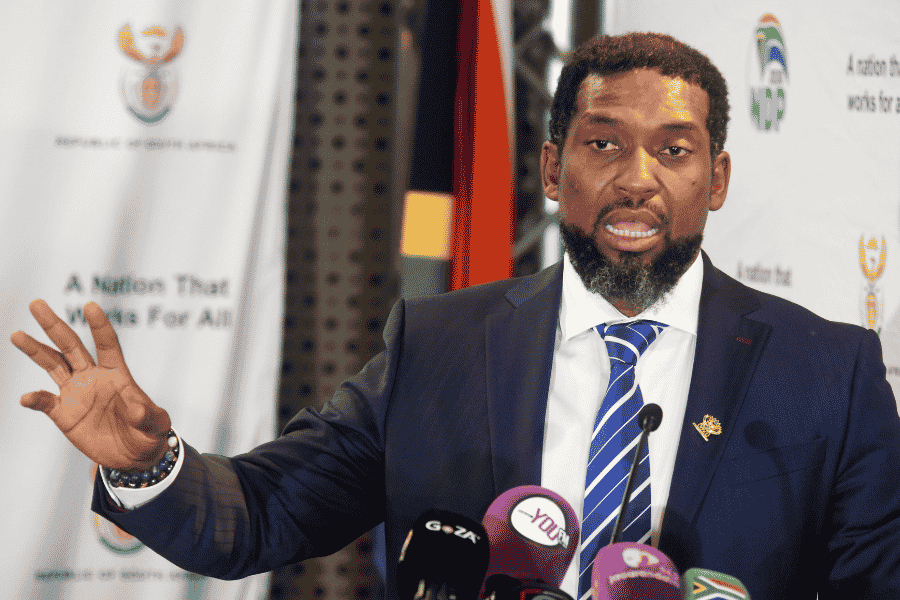
Higher Education Minister Buti Manamela could not say when he would intervene if the National Student Financial Aid Scheme (NSFAS) fails to meet its readiness milestones for the 2027 academic year.
Manamela was directly asked to identify the point at which he would step in if the troubled funding agency failed to get itself ready for 2027.
He did not answer.
The question was put to him by DA MP Dr Delmaine Christians during a Portfolio Committee on Higher Education meeting on Friday.
Christians said NSFAS remained a major concern, given the minister’s repeated assurances that it would be ready for the 2027 academic year.
“My concern remains obviously with NSFAS for 2027, because that is one of our important entities. You’ve given assurance that come 2027 NSFAS will be ready to start the new academic year, that students will be funded,” she said.
She said the committee needed assurance that institutions would be paid on time, allowances would reach students and accommodation problems would not again plunge students into crisis.
Christians then asked Manamela to identify the red flags he was personally monitoring between now and January 2027.
“And at what point do you think you will intervene if NSFAS is not meeting those readiness milestones for 2027?” she asked.
Manamela answered the first question but did not provide the intervention threshold.
He identified three areas he said were priorities for ensuring NSFAS was ready for 2027: governance and senior management, funding guidelines, and student accommodation.
On governance, he said the department was working to strengthen the NSFAS board and said the issue of senior management had become “even much more urgent”.
The agency currently faces a leadership vacuum, with no permanent CEO, CFO or COO.
Christians had earlier described the situation as “leadership without leadership”.
“Considering where we are with NSFAS at the moment, and that it is spiralling, basically, the acting CEO that has subsequently left, and NSFAS subsequently does not have a CEO, a CFO or a COO,” she said.
“So essentially NSFAS is almost leadership without leadership.”
Manamela said he wanted a briefing from the NSFAS board following the departure of the acting CEO.
“We collectively share the concerns with regard to the departure of the acting CEO and some of the challenges that have been there,” he said.
“We actually want to have a discussion with the interim chairperson to get a briefing on what the board’s response is to that.”
He said he expected the board to make decisions aimed at stabilising the institution ahead of 2027.
“We’re quite confident that whatever decisions are taken moving forward will be in the interest of the stabilisation of the institution, especially in our preparations for the academic year 2027,” Manamela said.
He added that the department had already engaged the board about filling other senior management vacancies.
Manamela’s second priority was the 2027 funding guidelines.
He told the committee that universities, students, TVET colleges and accommodation providers should know the guidelines by the end of October.
The guidelines, he said, would take into account government policy, fiscal constraints and the need to expand access to higher education.
He also raised concerns about the uptake of the student loan scheme.
“I must frankly say that the number that has been reported not only did it come as a surprise, but it’s quite concerning, and it also means that we’ll have to do much more than we have,” he said.
Student accommodation was his third priority.
Manamela said the department would work to ensure it was prepared in terms of both policy and protocols.
But none of the three priorities answered Christians’ central question: when will the minister intervene if NSFAS fails to deliver?
After Manamela finished his response, the committee chairperson moved on to the next item on the agenda.
Deputy director-general Thandi Lewin defended the functioning of NSFAS despite the leadership instability.
“It is very unfortunate, Chair and members, that we have lost the acting CEO. But we do have an entire organisation that is operating, and we hope that the board will immediately be able to stabilise at the management level,” she said.
Lewin said some of the instability had been beyond the department’s control because of court proceedings.
NSFAS also remains the only entity in the higher education portfolio whose audit is outstanding.
The Auditor-General told the committee that NSFAS could not be included in its report because the entity submitted its financial statements late.
The developments leave NSFAS facing unresolved leadership, an outstanding audit and preparations for a new academic year, while the minister responsible for the portfolio has not publicly identified the point at which he will intervene if the agency fails to meet its own readiness commitments.