Advocate Luzelle Adams, a paramour of late former Cope President Mosiuoa Lekota, has scored a major victory after Supreme Court of Appeal ruled in her favour in her protracted legal battle with the politician’s wife Cynthia Lekota.
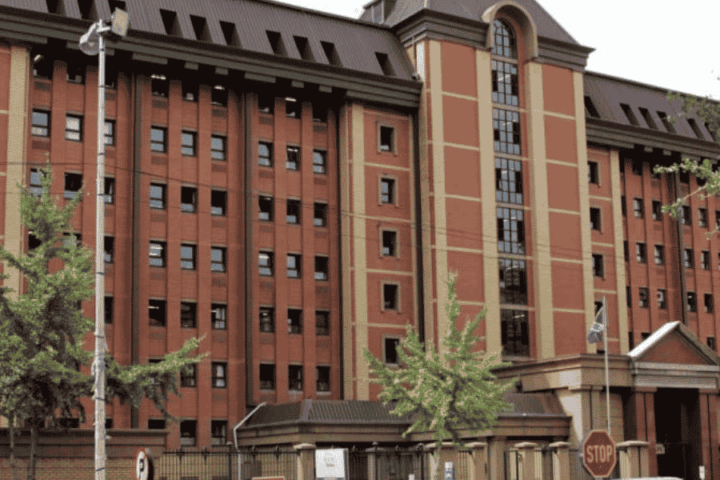
Africa Daily can exclusively reveal that the Supreme Court of Appeal has granted Adams leave to appeal the Pretoria High Court judgment delivered by Judge Anthony Miller.
“Condonation as applied for is granted. The applicant for condonation is to pay the costs of the application. Leave to appeal is granted to the Full Court of the High Court of Gauteng Division, Pretoria. The costs order of the court a quo in dismissing the application for leave to appeal is set aside and the costs of the application for leave in this court and the court a quo are costs in the appeal. If the applicant does not proceed with the appeal, the applicant is to pay these costs,” reads the order, dated 3 September 2026.
Adams’s lawyer Lutendo Siphuma of SL Attorneys confirmed that Adams has been granted leave to appeal Miller’s judgment.
“We are happy to receive such an outcome and this wasn’t a surprise as we knew all along that Judge Miller’s ruling was wrong and that he had misdirected himself and gave an order he ought not to have granted from the first instance. Appeal papers are already underway and we are very much confident that we will succeed in the appeal as we have always maintained,” he said.
Adams filed papers in the Supreme Court of Appeal in Bloemfontein a few months ago to challenge Miller’s decision to dismiss her leave to appeal his previous judgment.
In May 2026, Miller denied Adams leave to appeal his earlier judgment, which he granted in favour of Cynthia on 23 March 2026.
In his earlier judgment, Miller ruled that Lekota, who died in March 2026 at the age of 77, had been mentally incapable of managing his affairs during the final months of his life. This was after Cynthia approached the court over concerns that more than R2 million had been withdrawn from his accounts by Adams. In court papers, Cynthia said that when she visited her husband in January, he could no longer explain the state of their finances, medical aid, or investments.
She said he was unable to explain why monthly payments of R5000 to her had stopped and could not remember details of his bank accounts, financial advisers, usernames, or passwords.
The court also heard that Adams received payments of R1,084,725 and R600,000 at a time when Lekota was no longer fully capable of managing his affairs. The court also found that after Lekota’s son, Kotane Lekota, was appointed interim curator of the estate, Adams transferred R150,000 to herself and paid R250,000 from the estate to her lawyers.
Miller ruled that Adams lived with Lekota and accompanied him to medical appointments and, as such, she was fully aware of medical findings regarding his deteriorating condition.
He further said medical reports later obtained by the court-appointed curator, Mr Du Preez, showed that Lekota had suffered severe cognitive decline after a stroke in April 2025. Another specialist later concluded that Lekota had been unable to manage his legal and financial affairs since May 2025 and required protective measures.
Miller further said Lekota was married in community of property to Cynthia and therefore their assets formed part of a joint estate. However, he said Adams continued to transact on accounts linked to that estate.
He added that Adams did not deny that Lekota lacked mental capacity from May 2025 onwards, nor had she challenged the medical findings relating to his condition.
Adams had approached the court seeking leave to appeal the previous ruling that granted a declaratory order regarding Lekota’s mental state and also ordered her to pay costs. One of her arguments was that the application should not have been brought by the curator and that the court had misunderstood the nature of the proceedings. However, Miller dismissed that argument, saying Adams appeared unwilling to accept that she had no claim over the joint estate.
The court acknowledged Adams may potentially pursue a maintenance claim on behalf of her minor child against Lekota’s portion of the estate. However, Miller said that issue could only be determined after the estate itself had been wound up.
Dismissing Adams’s application for leave to appeal, Miller said he was not convinced another court would reach a different conclusion. Miller ordered Adams to pay Cynthia Lekota’s legal costs.
In the appeal papers, Siphuma said his client was served with more than 700 pages of court papers less than 24 hours before the hearing, making it impossible to properly prepare a response.
He said the application was heard just two days after Lekota’s death, while Adams was grieving and emotionally distressed. He said Adams’s request for a postponement was refused, despite her needing more time to study the allegations and medical reports.
Siphuma also said Miller failed to consider new evidence Adams wanted to present, which he said could have changed the outcome of the case.
He said she believed the matter was wrongly treated as an “extremely urgent” application when there was no real emergency.
Siphuma said Adams further argued that the curators no longer had the legal authority to continue with the case after Lekota died, because no executor of his estate had yet been appointed.
He said his client disputed the finding that Lekota lacked mental capacity and sayd she was denied the opportunity to challenge the medical evidence and call her own experts.
She contended that the costs order against her was unfair, particularly because she was also acting on behalf of her minor child.
Siphuma maintained that refusing Adams leave to appeal would amount to a miscarriage of justice and deny her constitutional right to a fair hearing. And the Supreme Court of Appeal agreed with him.