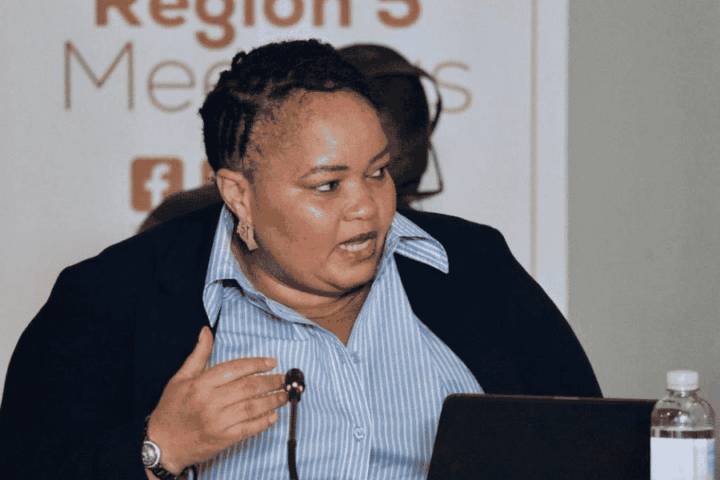
For Fran Hilton-Smith, football was never simply about playing the game.
It was about creating opportunities, developing people and ensuring that the next generation of women would have a better chance to succeed than those who came before them.
The Germiston-born football pioneer, now in her early 70s, has devoted much of her life to the development of women’s football in South Africa and across the continent.
Her remarkable journey has taken her from player to coach, Banyana Banyana mentor, technical director, coaching instructor and administrator — making her one of the most influential figures in the history of South African women’s football.
Hilton-Smith began her football journey as a player before moving into coaching and technical development. She later occupied senior positions within the South African Football Association (SAFA), including Head of Women’s Football and technical-director roles.
But it was her commitment to developing women beyond the playing field that arguably became the defining feature of her career.
“Developing coaches for me is a big priority,” Hilton-Smith once said, underlining her belief that the future of women’s football depends not only on finding talented players, but also on producing properly qualified coaches who can nurture that talent.
Her influence has stretched well beyond South Africa.
As a qualified CAF and FIFA coaching instructor, Hilton-Smith has been involved in educating and mentoring coaches, particularly women who have sought to establish themselves in a traditionally male-dominated football environment.
Her philosophy was simple: create opportunities and keep the door open for those with the determination to succeed.
“The door is always open and every girl out there that is good, practises her skills and looks after herself will get my attention,” she said in an interview reflecting on her scouting and development work.
That approach has helped influence a new generation of female footballers and coaches.
Hilton-Smith has also been credited with developing a significant number of women coaches holding CAF qualifications, while continuing to promote grassroots development and talent identification.
Her work has extended into rural and school football, where she has encouraged young girls to take up the sport and pursue opportunities that were not readily available to previous generations.
Her contribution has also been recognised internationally.
FIFA has documented her involvement in women’s football structures, while CAF and COSAFA have drawn on her expertise in technical development and coach education.
COSAFA recognised her contribution in 2024 when she received a Lifetime Achievement Award for Services to Women’s Football.
For Hilton-Smith, however, the journey has never been about personal recognition alone.
It has been about leaving the game in a better position than she found it.
Her story has also been preserved in print.
Hilton-Smith co-authored FRAN: A Song for Banyana, a book that chronicles her remarkable journey through football and also touches on other parts of her life. The book provides an insight into her experiences as a player, coach and football administrator, as well as her contribution to the rise of Banyana Banyana.
The memoir also reflects on the difficult years when women’s football struggled for recognition, resources and opportunities.
For a woman who witnessed the evolution of Banyana Banyana from its early days to becoming one of Africa’s leading women’s national teams, the transformation has been significant.
Hilton-Smith has seen players she helped develop go on to become coaches and leaders themselves.
Among those who have passed through the Banyana Banyana system are figures who later made their own mark in coaching and football development, including current Banyana coach Desiree Ellis.
This is perhaps where Hilton-Smith’s greatest legacy lies.
A football coach can influence a team.
A coach educator can influence generations.
By helping to develop coaches, administrators and young players, Hilton-Smith created an impact that extended far beyond the teams she personally worked with.
Her journey has not always been easy.
She came through an era when women’s football had limited resources and opportunities, yet she remained committed to the belief that women deserved a place at every level of the sport.
Today, South African women’s football has a stronger presence, with professional competitions, national youth structures, university programmes and increasing numbers of women entering coaching and technical positions.
Those opportunities did not appear overnight.
They were built over decades by pioneers who continued to push the boundaries.
Fran Hilton-Smith is one of those pioneers.
Her legacy is therefore not simply about the matches she played, the teams she coached or the positions she held.
It is about the doors she helped open.
It is about the coaches she helped develop.
It is about the young girls who were given an opportunity to dream.
And it is about a football journey important enough for her to put on paper so future generations can understand where the women’s game came from.
From the football fields of Germiston to the international technical structures of African football, Fran Hilton-Smith’s story is ultimately a story of perseverance, leadership and service.
She did not merely play her part in South African women’s football — she helped build the pathway on which generations of women continue to walk.