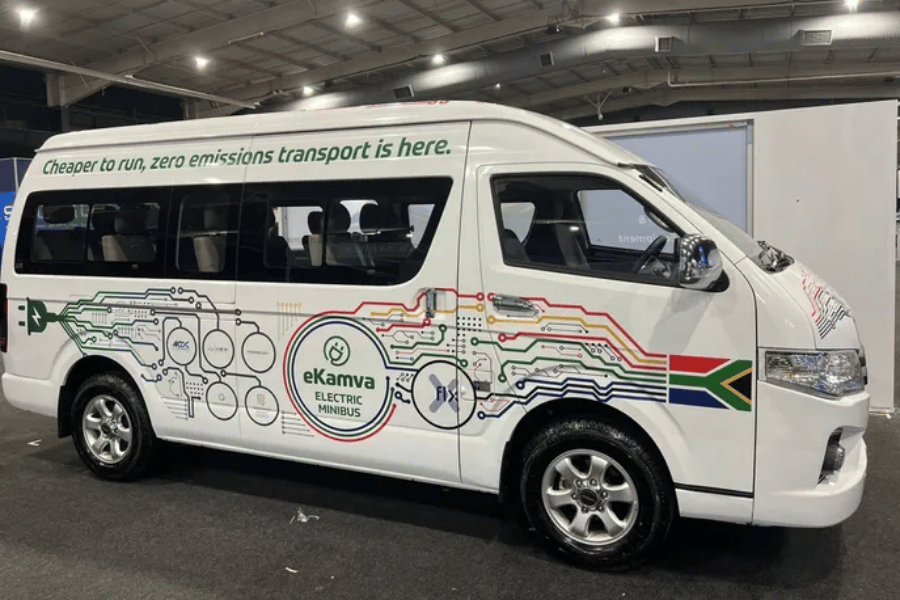
Limpopo’s taxi industry has taken its first ride into the future with the introduction of the province’s first electric minibus taxi in Polokwane.
The 15-seater eKamva electric minibus taxi was introduced to taxi operators affiliated with the South African National Taxi Council (SANTACO) in the Capricorn District on Tuesday, giving drivers an opportunity to test the vehicle and assess whether electric mobility can work in the demanding taxi industry.
The demonstration comes as South Africa’s taxi industry begins looking beyond traditional petrol and diesel-powered vehicles amid growing pressure to reduce emissions, lower operating costs and embrace new technology.
Taxi operators were given an opportunity to drive the electric vehicle and provide feedback on its performance, comfort and practicality.
For an industry where vehicles can spend most of the day on the road, questions around battery range, charging infrastructure, charging time and operating costs will be crucial in determining whether electric taxis can become a common sight on Limpopo’s roads.
SANTACO ready to embrace change
SANTACO has previously made it clear that it does not want the taxi industry to be left behind as the transport sector moves towards cleaner technology.
SANTACO national spokesperson Mmatshikhidi Rebecca Phala said the organisation had resolved to embrace green energy and reduce the industry’s carbon footprint.
Phala said SANTACO had also engaged with countries such as China and international organisations to understand developments in electric mobility, clean energy and electric vehicles.
“We are not afraid to lead and evolve,” Phala said, highlighting the important role that mobility plays in connecting South Africans with economic opportunities.
The introduction of the eKamva in Limpopo puts that commitment to the test, allowing taxi operators to experience the technology themselves rather than simply discussing its potential.
Built for the taxi industry
The eKamva was developed through a consortium led by GoMetro and was specifically designed with South Africa’s minibus taxi industry in mind.
The vehicle has a seating capacity of 15 passengers and a reported range of about 200 kilometres on a 70kWh battery.
Its fast-charging capability is another feature that could be important for taxi operators, with the battery reportedly able to charge from zero to about 85% in approximately 45 minutes.
However, operators will need to determine whether that range and charging capability are sufficient for the realities of daily taxi routes in Limpopo.
Can electric taxis work in Limpopo?
The introduction has also raised important questions about the infrastructure that would be required if electric taxis are eventually rolled out on a larger scale.
Charging stations would need to be strategically located at taxi ranks and other high-use areas, while operators would need reliable access to electricity.
The cost of purchasing electric vehicles will also be a major consideration for taxi owners, particularly when compared with conventional minibus taxis.
Despite these challenges, electric taxis could offer long-term benefits, including lower fuel consumption, reduced tailpipe emissions and potentially lower maintenance costs because electric vehicles have fewer moving mechanical components than conventional vehicles.
For taxi operators, however, the ultimate test will be simple: Can the vehicle make money while reliably carrying passengers every day?
The Polokwane demonstration gives operators the opportunity to begin answering that question.
A new chapter for Limpopo transport
The arrival of the eKamva marks an important moment for Limpopo’s public transport sector.
Although it is still too early to tell when electric minibus taxis could become widely available in the province, the demonstration shows that the conversation has moved from whether electric taxis are possible to whether they are practical for South African conditions.
For SANTACO and the taxi industry, the feedback from drivers will be critical.
And for Limpopo commuters, the prospect of quieter, cleaner electric taxis operating alongside conventional vehicles could eventually signal the beginning of a new era in public transport.