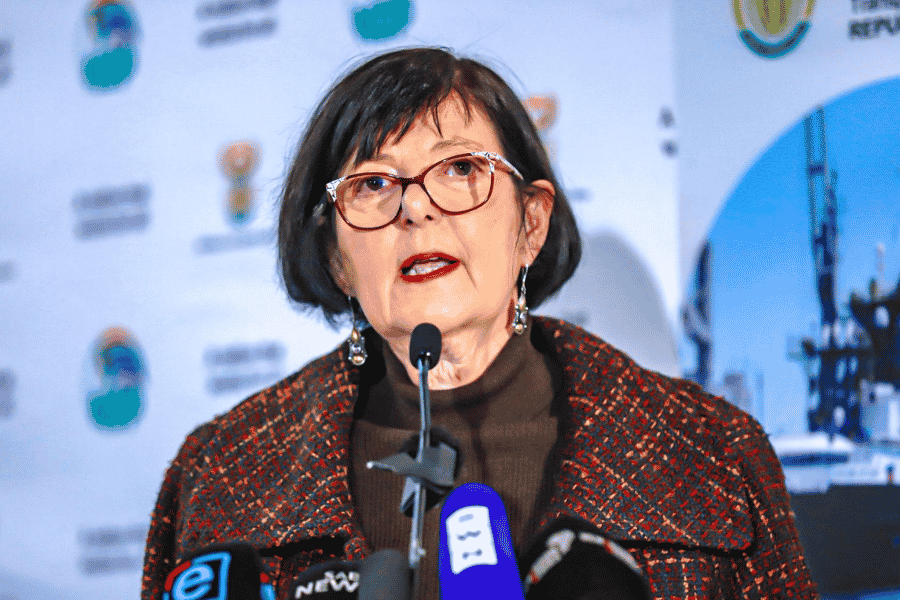
Transport Minister Barbara Creecy has outlined an R8.9 billion restoration programme aimed at improving the reliability and capacity of South Africa’s iron ore rail corridor as government steps up efforts to revive the country’s freight rail network.
Speaking during a media engagement at the Iron Ore Line’s annual maintenance shutdown in Upington, Northern Cape, on Monday 12 October, Creecy said the long-term programme would run until 2030 and support economic growth through a safer and more efficient rail network.
The 861km heavy-haul railway line stretches from Sishen in the Northern Cape to the Port of Saldanha in the Western Cape. It transports iron ore, manganese and other commodities to international markets.
Creecy said the corridor was a critical economic artery that supported export earnings, employment and industrial growth.
The annual maintenance shutdown, which runs from October 6 to 16, has allowed Transnet Rail Infrastructure Manager (TRIM) to carry out intensive maintenance work that would be difficult to undertake while normal rail operations continue.
The work includes rail replacement, sleeper and turnout replacement, track maintenance, formation rehabilitation, culvert installation, as well as electrical and signalling maintenance.
Government has allocated R3.4 billion through the Budget Facility for Infrastructure over the current and next financial year to support the restoration programme.
TRIM will invest approximately R2.2 billion in restorative maintenance on the ore corridor this financial year, with R1.5 billion of the amount funded through the infrastructure allocation.
Transnet is also investing R1.47 billion in rolling stock maintenance, comprising R752.3 million for wagon maintenance and R721.9 million for locomotive maintenance.
According to Creecy, similar amounts will be spent on rolling stock maintenance in the next financial year.
The investments will support locomotive overhaul programmes, address longstanding maintenance backlogs and improve fleet availability and operational reliability.
Efforts to restore the corridor’s export capacity are also being extended to the Port of Saldanha, where the Transnet National Ports Authority is commissioning a R750 million Bulk Power Upgrade Project.
The project will increase the port’s power capacity, enabling the operation of Transnet Port Terminals’ third tippler and supporting higher export volumes.
Creecy said the maintenance programme was also creating employment and business opportunities in communities along the railway line.
Approximately 1,300 fixed-term contract opportunities have been created for the October intervention, while more than 600 indirect opportunities are expected through associated economic activity.
Small, medium and micro enterprises are also expected to benefit from opportunities in civil works, track-related services, logistics, transportation, equipment support, material supply and accommodation.
The minister said the maintenance programme formed part of government’s broader rail reform agenda, which seeks to restore rail as the backbone of the country’s freight logistics system.
A central part of the reform is opening the freight rail network to private train operating companies while retaining state ownership of the infrastructure.
The establishment of TRIM has created a dedicated entity responsible for managing, maintaining and providing access to the national rail network.
Creecy said opening the network to private operators would require reliable infrastructure to give companies confidence to invest in locomotives, wagons, staff and operations.
“We cannot invite greater volumes onto the railway without investing in the infrastructure that must carry those volumes,” she said.
She added that restoring confidence in the rail sector would require delivery rather than announcements, as government, Transnet, private operators, customers, regulators and organised labour worked together to improve the logistics system.
Government has set a target of increasing freight transported by rail to 250 million tonnes a year by 2029, with network access reform forming part of efforts to achieve the goal.
Creecy acknowledged that significant work remained but said the progress made during the maintenance shutdown demonstrated that the restoration process was underway.