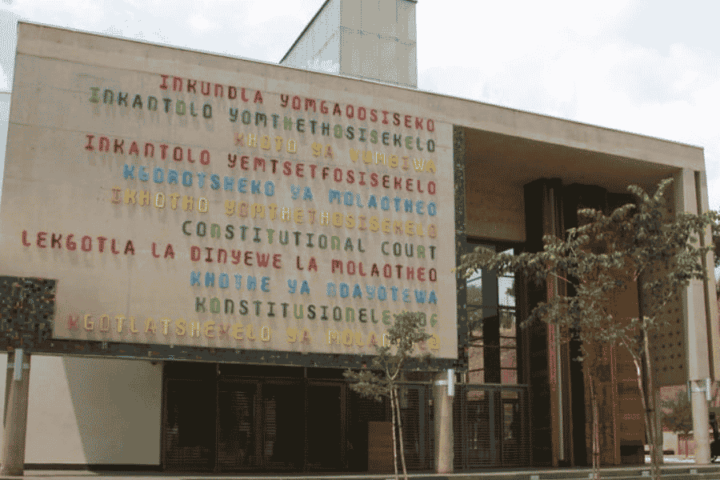
A visibly emotional ANC Secretary-General Fikile Mbalula broke down after the Constitutional Court handed the ANC a lifeline on Thursday morning, declaring that the Constitution had spoken for the people and launching a blistering attack on the party’s partners in the Government of National Unity (GNU).
The apex court overturned the Electoral Court ruling that had upheld the IEC’s exclusion of the ANC’s 181 candidates in six municipalities over the failure to press the “submit as final” button.
In a decisive order, the justices directed that leave to appeal be granted, the earlier ruling be set aside, and that the Electoral Commission must do “everything possible” to include the ANC on the ballot paper for next month’s local government elections.
Before collapsing during his media briefing, an emotional Mbalula – his voice cracking and eyes filled with tears at the Constitutional Court in Braamfontein – said the judgment was about the voters, not the ANC.
“The right to vote is not a privilege handed down by an institution. It is not a setting in a computer program, and it is not a button on a screen. It is a fundamental right, and it belongs to the people,” Mbalula said.
“The constitution has spoken and has spoken for the people of this country.”
The ANC and the IEC had presented their arguments at the same court on Monday.
But it was Mbalula’s political broadside that immediately shifted the focus from the courtroom to the Union Buildings.
In a carefully worded but unmistakable attack on the DA, Mbalula said the party’s intervention in the case had forced the ANC to reconsider the GNU.
“I want to say something about those who stood against us, and I will say it carefully. They are known. They came to this court openly, and they argued in front of the whole country. Hundreds of thousands of our people should be handed a ballot paper that has not carried the party they chose. That was their position,” he said.
“They are entitled to it, and we do not question their right to argue. But we are entitled to ask a question, and we ask it today. The founding statement of intent of government of national unity binds every partner in it to promote the constitutional framework of this republic. To come to the Constitutional Court to argue against enfranchisement of hundreds of thousands of South Africans does not sit easily beside that understanding.”
Mbalula then went further:
“There are matters, comrades, that this movement will now have to sit down and discuss. And one of those matters is our partners in the government of national unity, and that is the DA. We must review the DA in the government of national unity.”
The statement is the strongest signal yet that the ANC’s top leadership is prepared to re-evaluate the power-sharing deal struck after the 2024 general elections.
The DA, which has positioned itself as a defender of strict electoral compliance, had argued that rules must apply equally to all parties.
Mbalula framed the ANC’s fight as a moral one.
“They call this place a hill, and it is well named. We walked it upwards. Along that line, we learned something about leadership, and about tenacity, and about what these times ask of us if we are to carry our people to the destiny we promised them – a country where no one is without shelter, without water, without food on the table, where each of us may pursue our dreams according to our abilities and be met according to our needs.”
He thanked President Cyril Ramaphosa for his leadership “through a hard month,” and paid tribute to ANC Chairperson Gwede Mantashe, the ANC Women’s League and the ANC Youth League for holding the line.
In response on Thursday morning, the DA through its Federal Council Chairperson Ashor Sarupen said the ruling raises “serious concerns about the precedent it sets for complying with the IEC’s deadlines and requirements.”
He further said he noted the “threats” Mbalula made regarding the GNU.
“We note Fikile Mbalula’s threats about the GNU. The reality is that the DA is not in the GNU to go along to get along, and we will vigorously defend the rule of law and the equal application of the law,” Sarupen said.