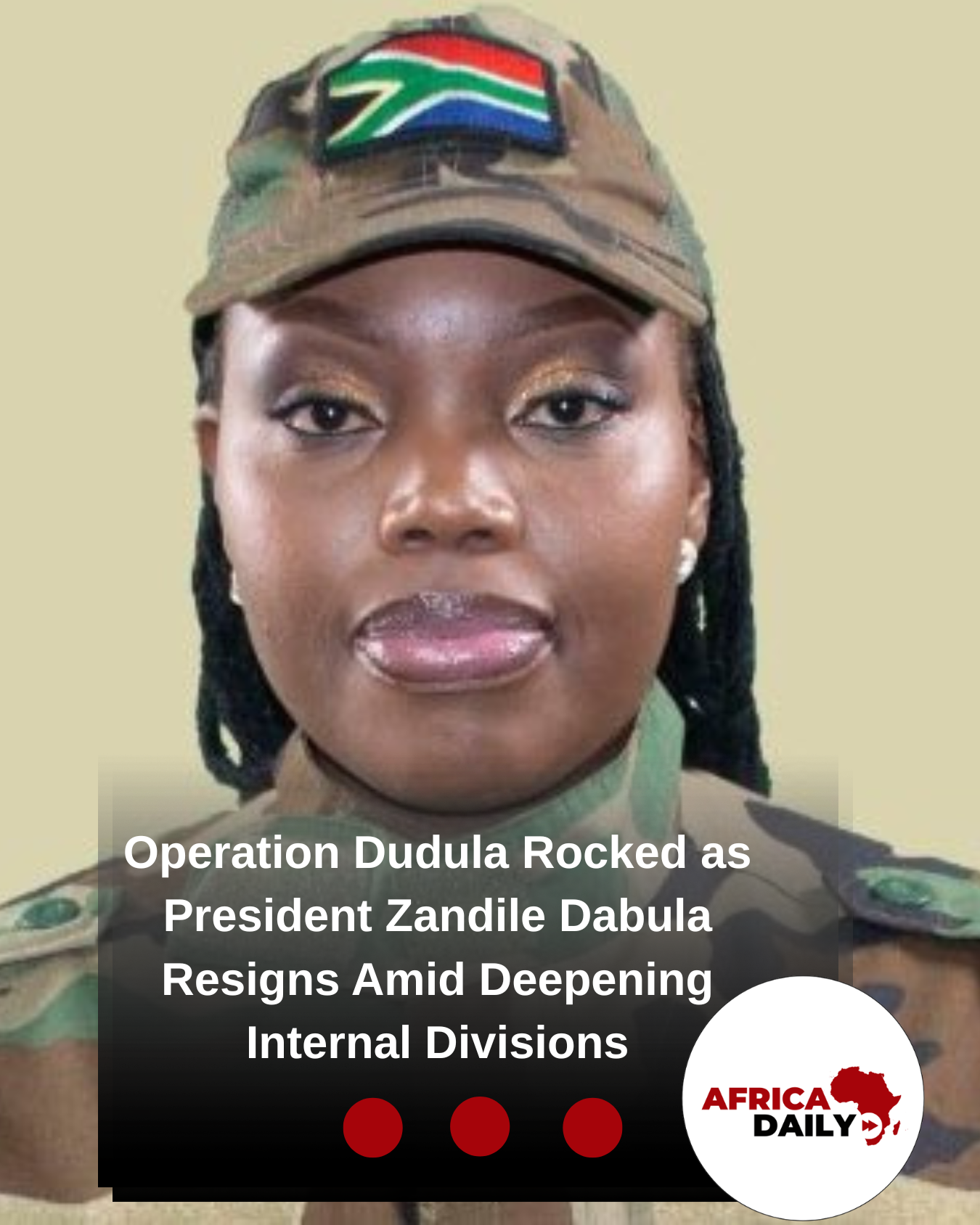
Operation Dudula president Zandile Dabula has dramatically resigned from both her leadership position and membership of the controversial political movement, citing growing concerns over its political direction and internal leadership tensions.
In a statement released on Thursday, 14 May 2026, Dabula announced that she was stepping down with immediate effect after what she described as a long and difficult period of reflection about the future of the organisation and her role within it.
“It is with a heavy heart and deep reflection that I, Zandile Dabula, formally resign from my position as president, as well as a member, of the Operation Dudula Political Party effective from Thursday, 14 May 2026,” she said.
Dabula stressed that her decision was not made lightly and followed months of introspection about the movement’s trajectory and responsibilities towards its supporters.
“This decision has not been taken lightly. It follows a long period of introspection regarding the future direction of the organisation, my own role within it, and the broader responsibility we carry towards the people who’ve supported this movement from the beginning,” she said.
Her resignation has exposed growing cracks within the leadership of Operation Dudula, a movement that rose to prominence through anti-illegal immigration campaigns and community activism before transitioning into a political party.
Dabula revealed that some leaders had become increasingly uncomfortable with the organisation’s shift into formal politics, arguing that the move may have happened prematurely.
“During the course of our journey, there were moments when some among the national leadership reflected on whether the transition of Operation Dudula into a political party may have happened earlier than necessary,” she said.
“There was a growing appreciation amongst some of us that the organisation had built strong influence and impact as a civic movement rooted in activism, advocacy and community mobilisation.”
Although Dabula said she respected the collective decisions taken by the organisation, she admitted that her own vision for the future no longer aligned with the path being pursued by the current leadership.
“While I respected and supported the collective decisions taken by the organisation at the time, I’ve come to accept that my own vision for the future of the movement differs from the current political direction being pursued,” she said.
She also acknowledged the emergence of internal disputes over leadership, structure and strategy.
“I’ve also observed that, like many organisations undergoing growth and transition, differing views on leadership, structure and strategy have naturally emerged over time,” Dabula said.
“While such differences are part of any evolving organisation, I believe it is in the best interest of both myself and the movement that I step aside and allow the organisation to continue on another path chosen by its leadership.”
Dabula added that she could no longer continue asking supporters to make sacrifices while believing she could contribute more effectively outside the political structure.