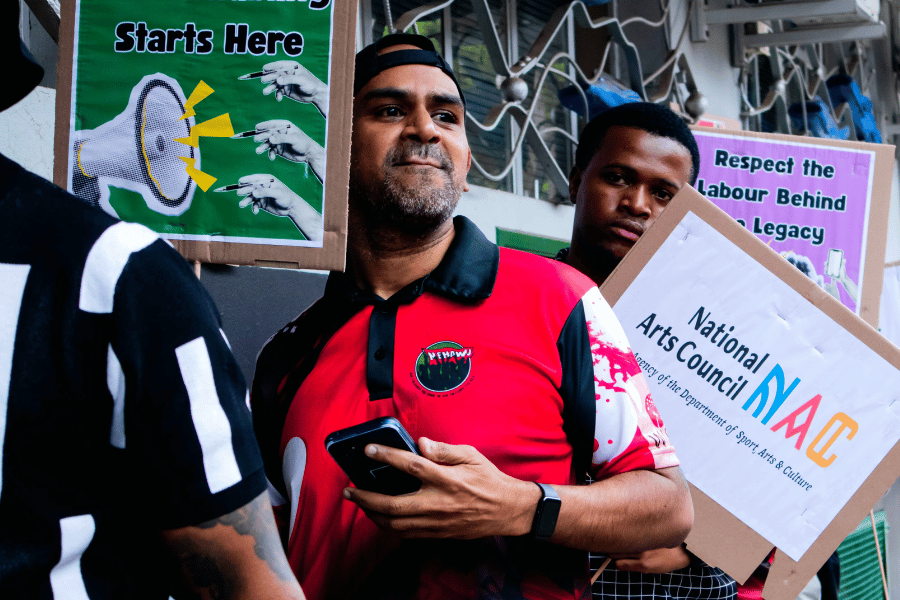
More than R1.5 billion has allegedly flowed through the National Arts Council (NAC) over five years.
This is according to the National Education, Health and Allied Workers’ Union (NEHAWU).
Now the union is calling for a forensic investigation into the NAC, including an investigation by the Special Investigating Unit (SIU), as it rejects the return of the council following a Gauteng High Court judgment that temporarily reinstated the body.
Damien Naidu from NEHAWU told Africa Daily that staff and artists have lost confidence in the current council and that restoring it has not resolved the governance crisis at the public arts funding institution.
NEHAWU’s demand for an investigation is not new.
In May 2026, two weeks before Sport, Arts and Culture Minister Gayton McKenzie dissolved the council, NEHAWU submitted a petition to the National Assembly.
The union called for the NAC board to be dissolved and for the Special Investigating Unit (SIU) to investigate the council.
Africa Daily has seen the petition. It alleges that the NAC had disbursed more than R1.5 billion over five years.
It also argues that a forensic investigation is necessary to establish objective evidence and either substantiate or refute allegations raised in a Public Protector complaint.
Speaking to Africa Daily following the court judgment, Naidu said that they do not welcome the reinstatement of the council.
“We believe in the rule of law but we do not welcome the decision of the court to reinstate the council. We are hopeful that the Minister will take the matter on review,” said Naidu.
“Prior to the Minister dissolving the board, staff and artists have previously submitted a petition to the National Assembly to dissolve the boar,” he said.
But NEHAWU’s most significant demand is for investigators to follow the money.
Naidu said that they want a forensic investigation that traces funds from NAC accounts to beneficiaries and identifies any officials, council members or employees who may have been involved in wrongdoing.
He said that the investigation should establish what happened to public funds rather than relying on internal processes or reviews.
The timing of NEHAWU’s petition is significant.
It was submitted to Parliament on 8 May 2026, two weeks before McKenzie dissolved the council.
The petition describes the NAC as a Schedule 3A entity that had been plagued by allegations of fraud, maladministration, corruption & abuse of power.
It also says the labour dispute had exposed what the petitioners regarded as a broader governance crisis.
The petition called for Parliament to engage the President regarding an SIU proclamation, suspend specified council members and senior managers during an investigation, dissolve the board and place the NAC under administration, and allow the council to be reconstituted.
The petition also called for the council to be downsized.
It points out that the NAC had 29 permanent employees but 22 council members and raises concerns about expenditure on council honorariums, travel, accommodation, cellphone devices and data.
NEHAWU says those costs should instead be redirected towards the arts sector.
The current dispute follows McKenzie’s decision to dissolve the NAC council in May.
The Minister’s decision was challenged by former council members.
On 31 July 2026, Gauteng High Court Judge A. Millar granted interim relief to 11 former council members led by Twain Siboniso Ngwenya.
The court suspended McKenzie’s dissolution of the council and reinstated the former members pending the final determination of the review.
The Minister was also prohibited from taking further steps arising from the dissolution or appointing a replacement council while the interim order remains in force.
The ruling, however, was not a final finding that McKenzie acted unlawfully.
The court made clear that the question of whether the Minister had reasonable grounds to dissolve the council would be determined in the next stage of the litigation.
Judge Millar nevertheless found that the Minister’s decision did not, at this stage, withstand scrutiny and that allowing the NAC to remain without its statutory governing structure created a risk of harm.
The judgment also created uncertainty over the role of Lebogang Magoera, who was appointed acting CEO and designated accounting authority after the council was dissolved.
The court rejected the argument that the CEO could simply become the council following its dissolution.
The judgment emphasised that the CEO’s role as accounting officer does not replace the statutory governance role of the council.
NEHAWU nevertheless says the NAC’s operations continued smoothly while Magoera was acting as accounting authority.
The union believes the CEO should continue managing the institution’s operations while the council should focus on oversight rather than interfere in day-to-day management.
That creates an important question for the reinstated council, how will executive management and council oversight now operate without reproducing the governance tensions that existed before the dissolution?
The court has temporarily restored the NAC council.
However, it has not answered the questions that NEHAWU and the petitioners were already asking Parliament before the dissolution.
For now, the court’s order means the reinstated council must resume its statutory role while the Minister’s decision to dissolve it is tested in the next stage of the litigation.
For thousands of artists waiting for PESP 7 outcomes, there is an additional concern, whether the NAC can provide a stable and credible governance structure while these disputes continue.
But the questions surrounding the billions that have allegedly passed through the institution and the demand for an independent investigation remain.