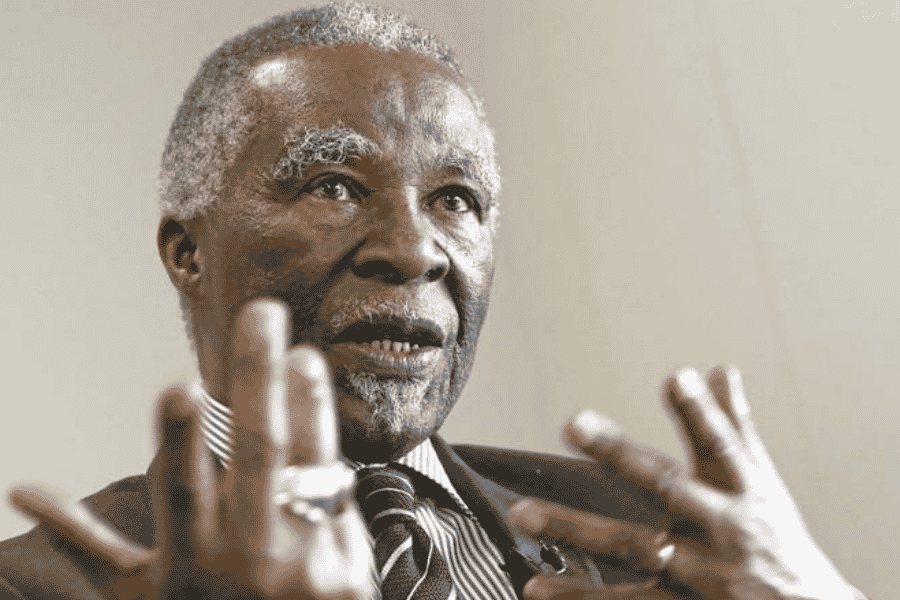
Former President Thabo Mbeki has vehemently denied that his administration ever convened secret meetings with apartheid generals and former president FW de Klerk to craft a political deal to shield perpetrators of apartheid-era crimes from prosecution.
Testifying on Monday before the Khampepe Commission of Inquiry into alleged political interference in Truth and Reconciliation Commission (TRC) cases, Mbeki dismissed as lies testimony that his government devised a mechanism to protect old-order security force members.
“It’s a complete fabrication. No such meetings took place in order to secure amnesty for them,” Mbeki told the commission.
Mbeki is testifying before retired Constitutional Court Justice Sisi Khampepe after his application for her recusal – based on her previous work for the TRC and the NPA – was dismissed on a technicality by Judge President Selby Baqwa for failing to get Chief Justice Mandisa Maya’s approval.
The inquiry is probing whether there were deliberate attempts to delay, hinder or stop the investigation and prosecution of more than 300 cases referred by the TRC for further action, and whether senior officials or institutions were complicit.
At the centre of Mbeki’s testimony on Monday was an allegation by former NPA senior prosecutor Advocate Anton Ackermann, who previously told the commission that a lawyer representing apartheid-era generals, Jan Wagener, had informed him of high-level discussions involving the South African National Defence Force (SANDF), South African Police Service (SAPS), African National Congress (ANC) leaders and former presidents Mbeki and FW de Klerk.
According to Ackermann, that is where a plan was orchestrated to effectively shield apartheid-era perpetrators from prosecution.
Mbeki flatly rejected the claim.
“It’s a complete fabrication. There’s no such thing. There are no such meetings that took place in order to secure amnesty for them,” he said.
He conceded that a meeting did take place with generals of the former security forces, but said its purpose was misrepresented.
“There was one particular meeting where they said what they think needs to happen is that their political principals ought to come to the amnesty committee to tell the truth about what they did,” Mbeki said.
“There was one particular meeting where both generals of the SANDF and SAP raised the problem they faced. They said to us what they think needs to happen is that their political principal, deputy president FW de Klerk, ought to come to the amnesty committee and tell the truth about what they did on these matters.”
Mbeki argued that the generals’ concern was procedural: that political leaders should first take responsibility before the Amnesty Committee, after which foot soldiers could testify about how they carried out orders. At no point, he insisted, was amnesty or immunity from prosecution discussed as a backroom deal.
The Calata Group, which represents families of apartheid victims including the Cradock Four, has accused successive democratic governments – including Mbeki’s – of failing TRC victims. The group says the administrations failed to direct Ministers of Justice, National Directors of Public Prosecutions and Police Commissioners to implement the recommendations in the TRC’s final report.
That final report, which was handed to Mbeki’s government, recommended that prosecutions should proceed where amnesty had not been granted. Little action followed.
Mbeki was also confronted with claims that he authorised, or was behind the authorisation of, the suspension of planned arrests in the Reverend Frank Chikane case in 2006.
Chikane, who later served as Director-General in the Presidency, was poisoned in 1989 after apartheid security branch operatives laced his clothes with an organophosphate nerve agent. Former Law and Order Minister Adriaan Vlok and several senior officers later pleaded guilty to attempted murder and were given suspended sentences in 2007.
Mbeki denied interfering.
The commission further questioned him about presidential pardons granted during his time in office. He told evidence leader Advocate Ishmael Semenya that he approved 33 pardons, including for ANC and PAC members convicted of serious offences.
Critics contend that some of those pardons circumvented the TRC amnesty process and created a parallel, non-transparent route to freedom.
Mbeki defended the decisions, saying his office received a flood of applications after the TRC concluded its work from people who had not participated in the TRC process.
“After the TRC completed its work, my office received numerous requests for pardons,” Mbeki said.
“Persons who applied had not appeared before the TRC. The argument that was advanced was that the process lacked transparency. Should people who committed offences for political reasons be given pardons at all?”
He argued that pardons are separate from amnesty and fall within the President’s constitutional prerogative.
In his written submission, Mbeki had already sought to shift responsibility for the lack of prosecutions onto prosecutors inherited from the apartheid era, accusing them of fabricating claims of executive interference to “hide the truth” and to “protect their criminal offence from discovery by surrounding it with the bodyguard of lies.”
On Monday he maintained that position, insisting no political instruction was ever issued to stop TRC-related prosecutions.
Mbeki’s testimony is set to continue on Tuesday. His successor, former President Jacob Zuma, who also failed in his bid to have Justice Khampepe recuse herself, was due to appear after Mbeki, but his attendance remains uncertain after he was discharged from St Anne’s Hospital in Pietermaritzburg on Saturday.