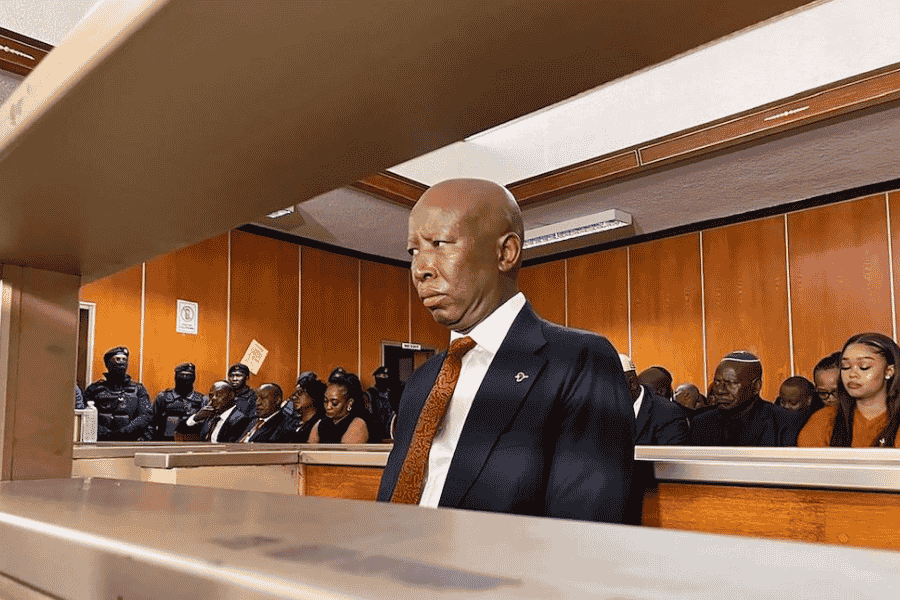
EFF President Julius Malema has been handed a crucial lifeline in his fight to stay out of prison after the Makhanda High Court granted him leave to appeal his firearm convictions and five-year jail sentence.
The decision means Malema’s fate – and his political future – will now be determined by a higher court, months after he was found guilty of firing an assault rifle at the EFF’s fifth anniversary celebrations in Mdantsane.
Malema was convicted in the East London Regional Court on five firearm-related offences stemming from the July 2018 incident, where video footage showed him discharging what the State proved was a .223 Norinco assault rifle into the air at the Sisa Dukashe Stadium.
He was found guilty on five counts: unlawful possession of a firearm, unlawful possession of ammunition, unlawful discharge of a firearm in a built-up area, failure to take reasonable precautions to avoid danger, and reckless endangerment to persons or property.
He was sentenced to five years direct imprisonment.
In a dramatic twist, the Kugompo Regional Court had initially granted him leave to appeal only the sentence, but refused leave to appeal the convictions themselves.
Malema then petitioned the Makhanda High Court to challenge both.
Now, that petition has been granted.
At the heart of Malema’s appeal is his argument that the trial court got it wrong on the law.
In court papers, the EFF leader argues that Magistrate Twanet Olivier erred in her application of the rules governing circumstantial evidence and misdirected herself on the definition of possession under the Firearms Control Act.
Malema has consistently denied that he fired a real gun. His defence throughout the trial was that the rifle was a toy gun loaded with blanks and that no one was ever in danger.
He also accused Magistrate Olivier of being racist after his conviction.
In his appeal papers, Malema contends that the State failed to present direct evidence linking him to the firearm.
He argues that no witness testified to seeing him fire a live weapon, no fingerprint or DNA evidence connected him to the rifle or the spent cartridge, and that the video evidence relied upon by the State was not properly authenticated or handled.
“The State failed to present direct evidence linking him to the firearm or ammunition,” Malema argues in his papers, insisting that the court placed “undue reliance on the evidence of State witnesses while rejecting his version of events.”
But the State were pushing back hard. In opposing the application, prosecutors argued that Malema has no reasonable prospects of success and that the trial court’s findings were supported by overwhelming evidence.
Prosecutors contend that the video, ballistic and expert evidence, taken together, established Malema’s guilt beyond a reasonable doubt.
The footage, which went viral at the time, clearly shows Malema firing the rifle while on stage, with former bodyguard Adriaan Snyman beside him.
The stakes for Malema could not be higher. While he faces five counts, it is the unlawful possession of a firearm conviction that carries a mandatory five-year direct imprisonment without the option of a fine. If that conviction stands, Malema will go to prison.
If it is overturned, the entire sentence could collapse.
For the EFF, the case has always been political. The party has framed the prosecution as a political witch-hunt aimed at silencing its Commander-in-Chief. For the State, it is about the principle that no one, not even a political leader, can fire a military-grade weapon in a crowded stadium and claim it was a toy.
Malema remains out on warning pending the outcome of the appeal in Makhanda.