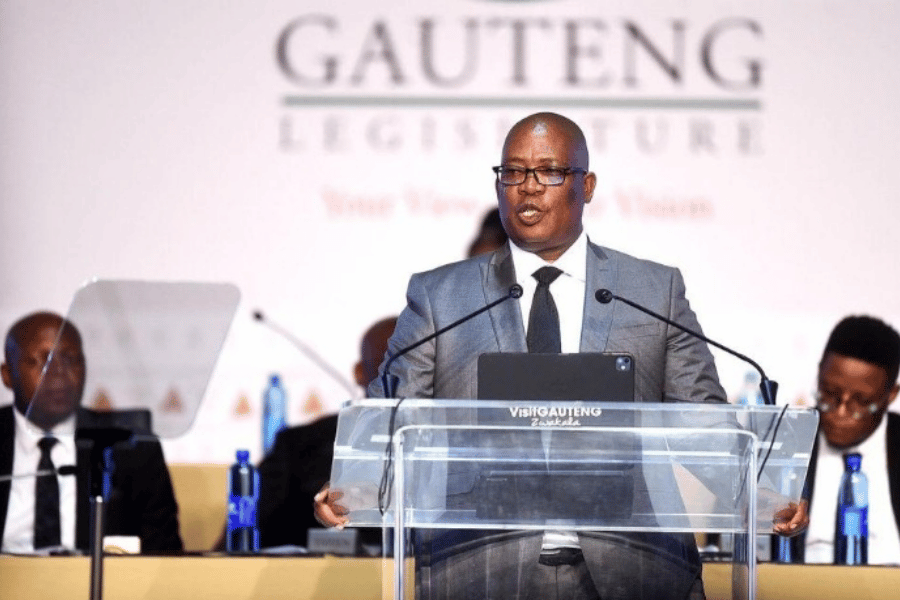
Gauteng Premier Panyaza Lesufi has launched a blistering counter-attack against the Democratic Alliance after the party lodged a formal challenge in the Gauteng Provincial Legislature accusing his government of choosing e-toll debt over children’s education.
Lesufi, who built his political identity as the “education premier,” is now at the centre of a funding scandal that has left public schools across the province with only a quarter of their operating budget while his administration ring-fences more than R9 billion for the defunct e-toll system.
The row erupted this week when DA Gauteng Spokesperson for Education Michael Waters confronted Finance MEC Nkululeko Dunga over the non-payment of Norms and Standards funding – the money schools use to keep the lights on, pay water and municipal bills, maintain classrooms and pay service providers.
According to the DA, Gauteng schools were supposed to receive their first tranche for 2026 on or before 15 May. They received just 25%, leaving a R1.87 billion shortfall. Principals have been forced to negotiate with municipalities to avoid disconnections and plead with suppliers.
In the Legislature, Dunga was asked three direct questions: When will the outstanding first tranche be paid? When will the second tranche be available? And can he guarantee the second tranche will be paid in full and on time?
He could answer none of them.
Yet when pressed on why the provincial government had managed to find R9.282 billion in two years to settle e-toll debt, Dunga was unequivocal: the province has a “contractual obligation” to pay.
It was that admission that triggered the DA’s formal lodge in the Legislature – a complaint that Lesufi’s executive has prioritized honouring SANRAL creditors over honouring its constitutional obligation to provide basic education.
“Gauteng can commit billions to e-toll debt but cannot say when schools will receive the money owed to them,” Waters said during the sitting.
“No dates. No guarantees. No certainty. And, most importantly, no money for our schools.”
Lesufi, responding after the DA lodge, did not take the attack lying down.
The premier accused the DA of playing “political games” with school funding and of weaponizing a temporary cash-flow problem to score points ahead of the November 4 local government elections.
Sources close to the premier said Lesufi told his caucus that the DA was being disingenuous, given that the e-toll debt settlement was itself a decision taken to rescue Gauteng’s finances after years of fiscal pressure caused in part by the very e-toll system the DA had opposed without offering a funding alternative.
Lesufi’s argument, articulated by Dunga in the House, is that settling the e-toll debt was non-negotiable. Failure to pay would have triggered a full fiscal crisis, triggered credit downgrades for the province and ultimately hurt schools even more. The payment, government argues, was necessary to “honour their contractual obligation” and clean the books.
“The e-toll debt had to be settled to protect Gauteng’s future. We cannot be held ransom by a legacy contract that was strangling the province,” a senior official in Lesufi’s office said, echoing the premier’s line.
But the defence has only inflamed the DA further.
“This exposes this provincial government’s misplaced priorities. When it comes to the failed e-toll system, its financial obligations are apparently non-negotiable. But when it comes to funding public schools, the same government offers excuses, delays, and no certainty,” Waters charged.
The party says Lesufi cannot have it both ways – claiming to be the champion of quality education while his treasury tells schools to wait.
“Nothing is amusing about schools not knowing when they will receive the money they need to function, and principals having to worry about municipal accounts, service providers, and keeping their schools operational,” Waters said.
For Lesufi, the political stakes are high. Since his time as Education MEC, he has positioned Gauteng’s education system as his flagship – from online admissions to school infrastructure upgrades. The image of schools unable to pay electricity bills while e-toll gantries are paid off cuts directly against that brand.
The DA is now demanding two immediate actions from Lesufi: that his government urgently pay the outstanding first tranche in full, and that he provides a public, provincial guarantee that the second tranche will be paid in full and on time, ring-fenced from any further cash-flow maneuvers.
The party says if Lesufi can guarantee R9.2 billion for e-tolls, he can guarantee R1.87 billion for schools.
Lesufi’s office has so far refused to give that guarantee, insisting that cash-flow planning is being “strengthened” and that schools will be paid as funds become available – the same line that Dunga gave in the Legislature and which the DA says is no guarantee at all.
Opposition parties say the controversy reveals a deeper crisis in Lesufi’s Gauteng – a government that is administratively overextended, politically defensive, and prioritizing debt optics over service delivery.
“A DA-led Gauteng Provincial Government would put schools first. We would ensure Norms and Standards allocations are paid on time, strengthen provincial cash-flow planning so schools are not used to plug Treasury shortfalls, and ring-fence funding for essential services such as electricity, water, maintenance, and learning materials,” Waters said.