The Special Tribunal has ordered former project architect of Nkandla Minenhle Makhanya to personally repay R147.2 million to the National Treasury.
The judgment, delivered on Wednesday, August 26, is among the largest civil recovery orders obtained by the Special Investigating Unit (SIU) against an individual contractor linked to state-funded infrastructure projects.
The Tribunal found that Makhanya, who served as the principal agent and lead architect for the upgrades at former president Jacob Zuma’s private residence in Nkandla, KwaZulu-Natal, was unlawfully appointed and committed serious breaches of his professional and statutory obligations.
According to the Tribunal, those breaches contributed to substantial financial losses for the state.
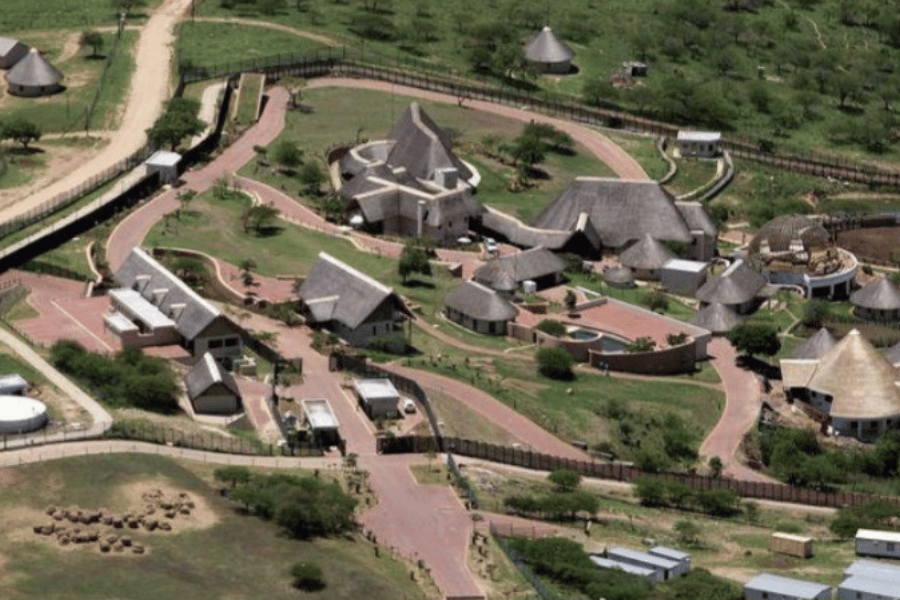
The Nkandla controversy dates back to May 2009, when plans were put in motion to upgrade Zuma’s private residence.
The work was presented as part of security-related improvements at the former president’s private residences.
Following security assessments by the South African Police Service (SAPS) and the South African National Defence Force (SANDF), the National Department of Public Works (DPW) assessed the baseline requirements needed to safeguard the President and his family.
On August 11, 2009, the DPW’s Planned Maintenance Budget Committee approved an initial security budget of R27,893,067.46.
However, the procurement process soon departed from the required procedures.
On August 27, 2009, DPW project manager DJ Rindel appointed Makhanya as the project’s principal agent.
The Special Tribunal found that the appointment contravened Section 217 of the Constitution and the Public Finance Management Act because it was not subjected to a competitive bidding process.
The Tribunal also found that Makhanya was not registered on the DPW vendor database and that there were no emergency circumstances that could have justified avoiding competitive tender procedures.
After taking up his role, Makhanya approved extensive additions that went beyond the security requirements identified by SAPS and SANDF.
As a result, the total cost of the project increased dramatically, rising from the initial R27.89 million approval to R216,010,478.24.
The SIU’s investigation found that Makhanya approved and certified non-security improvements and over-designed structures worth R68,506,106.
The additional works included underground tunnels equipped with three lifts, 20 extra accommodation units for security personnel, a commercial-style laundry, a visitors’ lounge, VIP and clinic basement parking, extensive landscaping and internal road networks.
The project also included the now-infamous fire pool.
Costs were further incurred to relocate 4.5 neighbouring households.
The Special Tribunal found that Makhanya certified payments above prevailing market rates and approved claims for work that had either not been performed or was not properly documented.
He also failed to secure the required written approval for project variations.
In addition, Makhanya authorised payments amounting to R54,825,513 to two other contractors, contrary to the terms of the applicable building contract.
The Tribunal found that Makhanya had breached various statutory and professional requirements contained in the Architectural Profession Act, the Code of Professional Conduct, the DPW’s Manual for Architects and the Joint Building Contracts Committee (JBCC) agreement.
In delivering the judgment, Judge K. Pillay J highlighted the wider accountability issues surrounding the Nkandla project.
“It is regrettable that the first defendant stands alone as the person against whom the Special Investigating Unit has launched action, as he clearly did not act alone in allowing the costs of the upgrade at Nkandla to balloon,” the judge said.
“However, as architect and principal agent, he bore the responsibility to ensure that the second defendant did not incur fruitless and wasteful expenditure.”
The Tribunal subsequently declared Makhanya’s original appointment contract null and void.
It ordered him to repay R147,269,444.06 to the National Treasury.
The amount takes into account the R7.8 million previously repaid by former president Zuma in connection with non-security upgrades, as well as interest calculated at 11.25% per annum and legal costs for two counsel.
The SIU said evidence pointing to possible criminal conduct would be referred to the National Prosecuting Authority (NPA) for further assessment in accordance with the Special Investigating Units and Special Tribunals Act 74 of 1996.