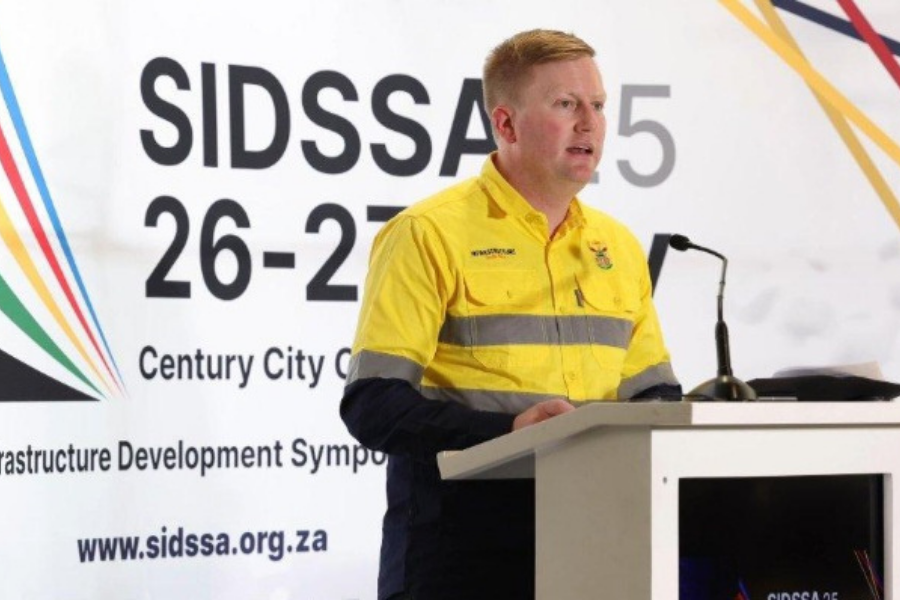
Public Works and Infrastructure Minister Dean Macpherson has called for faster implementation of infrastructure projects, warning that South Africa’s infrastructure ambitions must ultimately be measured by what gets built and delivered to communities.
Speaking at the opening plenary of the Sustainable Infrastructure Development Symposium South Africa (SIDSSA) 2026 in Cape Town on Tuesday, Macpherson said the country had made significant progress in strengthening its infrastructure pipeline but now needed to move decisively from preparation to construction and delivery.
His remarks came as government, investors, financiers, project sponsors and technical experts gathered for the annual infrastructure summit, which this year places a particular focus on local infrastructure delivery.
Macpherson said infrastructure was ultimately experienced most directly at local level, through services such as water, roads, electricity and sanitation.
“If infrastructure delivery does not succeed locally, our national plans cannot succeed,” he said.
The minister said he had set out to transform the public works and infrastructure portfolio into an “economic delivery unit” when he became minister just over two years ago, with the broader objective of helping turn South Africa into a construction site.
He said progress could now be measured through the country’s Strategic Integrated Projects pipeline.
South Africa currently has 81 Strategic Integrated Projects comprising 263 individual projects, with an estimated value of close to R2 trillion, according to Macpherson.
Over the past 18 months, 37 projects worth approximately R69 billion have been completed, while another 82 projects worth R502.7 billion are currently under construction.
A further 54 projects, valued at about R206 billion, are in documentation and procurement.
Macpherson also highlighted the work of Infrastructure South Africa in clearing regulatory obstacles, saying it had processed more than 500 regulatory facilitation cases, resolving about 87% of them.
But despite the progress, the minister said government had learnt that South Africa’s problem was not a shortage of infrastructure ideas.
“Too many projects fail because they are not adequately prepared,” he said.
This included incomplete feasibility studies, uncertain funding models, delayed regulatory approvals and projects that were not sufficiently packaged to attract investors and financiers.
It was against this backdrop that government introduced a project-preparation programme aimed at turning infrastructure concepts into bankable projects.
Macpherson said Infrastructure South Africa had committed R600 million towards project-delivery support.
The first bid window attracted 277 submissions with a combined estimated capital value of about R322 billion.
Infrastructure South Africa is now providing preparation support to more than 26 projects with an estimated capital value of approximately R148 billion, with 15 of those projects having already completed their preparation.
Projects selected through the second bid window represent a potential capital investment value of about R57.8 billion, while the third bid window opened in July.
The minister said the support could include technical feasibility studies, financial modelling, legal and commercial structuring, environmental and regulatory assessments, governance support and transaction advice.
Once projects have been properly prepared, they can then be presented to potential funders.
Macpherson said Infrastructure South Africa’s Development Partners Forum had earlier this month presented four opportunities in housing, aviation, bulk water and energy to local and international development finance institutions and multilateral development banks.
Those four projects collectively require more than R53 billion in debt finance.
He also pointed to a pledge of approximately $1 billion, or R17 billion, secured at the South African Investment Conference for a large-scale bioethanol production facility.
“This is exactly the model we are building: prepare projects properly, take them to the market and support them towards financial close and construction,” Macpherson said.
The minister is expected to announce the priority infrastructure projects selected through Bid Window II later on Tuesday, alongside Infrastructure South Africa head Mameetse Masemola.
He is also expected to release the latest edition of the Infrastructure South Africa Construction Book, which identifies projects expected to enter procurement over the next 12 to 18 months.
Macpherson said the proportion of planned tenders that were subsequently advertised had improved from about 42% to 58%.
But he cautioned that this remained insufficient.
“While that is progress, it is simply not yet good enough,” he said.
He said quarterly performance reporting would now be used to identify projects that were advancing, those falling behind and areas where intervention was required.
*Focus shifts to municipalities*
Macpherson said the same approach was increasingly being applied to municipal infrastructure, where failures in project preparation and implementation can have a direct impact on residents.
Over the past 18 months, Infrastructure South Africa has committed R131 million to supporting local government infrastructure.
This includes R9.39 million to package strategic water projects in Gauteng and the Eastern Cape, with a combined estimated investment value of approximately R7.3 billion.
One example he highlighted was Matjhabeng Local Municipality, where approximately R1.8 million invested in preparing a non-revenue water programme helped unlock an R800 million debt-financing facility from the Development Bank of Southern Africa.
Through the Presidential Adopt-a-Municipality pilot programme, Infrastructure South Africa is also supporting four municipalities across four provinces.
The programme is preparing projects intended to unlock approximately R7 billion in investment in water, sanitation, energy and waste management.
Macpherson said these examples demonstrated the multiplier effect that could come from proper project preparation.
“A relatively small investment in technical preparation can unlock hundreds of millions, and sometimes billions, of rand in infrastructure investment,” he said.
The minister also highlighted changes within the construction sector, particularly efforts to deal with fraudulent conduct.
He said that during the first 22 years of the Construction Industry Development Board, only two contractors had been removed from its register for fraudulent conduct.
“In the last 22 months, 52 contractors have been removed with more on the way,” he said.
According to Macpherson, the move was part of a broader effort to strengthen institutions, improve project preparation and increase accountability.
Another key development is the approval to formalise Infrastructure South Africa as a public entity.
Macpherson said this would be central to the next phase of the country’s infrastructure programme, creating a permanent institution capable of acting as a central point for major infrastructure projects, maintaining a credible national pipeline, coordinating approvals, mobilising finance and supporting implementation.
South Africa has committed more than R1 trillion to public infrastructure over the next three years, according to the minister.
But Macpherson said the focus must now shift from the size of the commitment to its tangible outcomes.
“Our responsibility is now to translate that commitment into properly prepared projects, credible procurement processes, active construction sites and functioning infrastructure,” he said.
He warned that the infrastructure programme should not be judged by the value of announcements alone.
Instead, he said, it should be measured by what is financed, constructed and ultimately delivered to communities.
“SIDSSA 2026 must take us from stronger preparation to faster implementation; from national ambition to visible local delivery,” Macpherson said.
“We must now convert that progress into financial close, procurement, construction and finally, functioning infrastructure.”