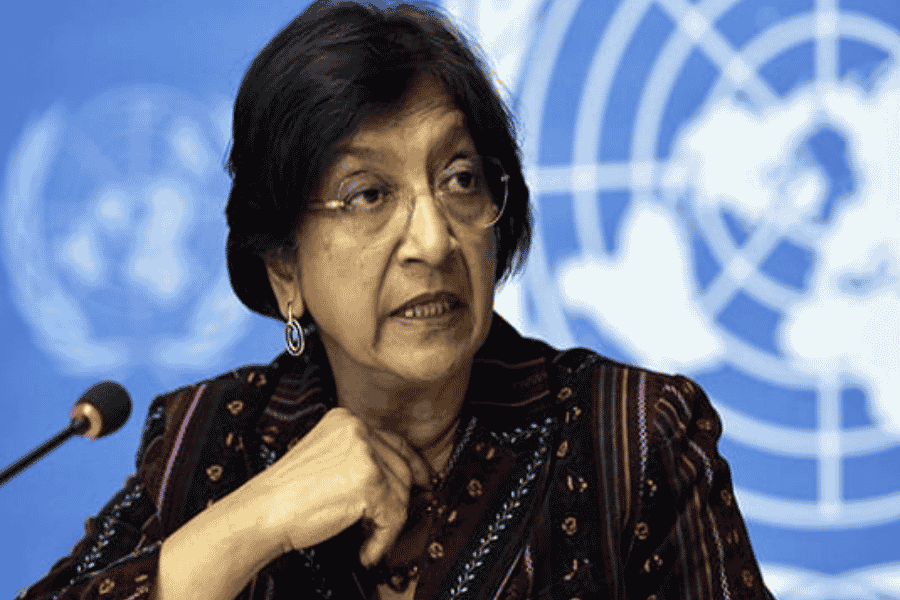
South Africa has done it again. At 85 years old, Durban-born jurist Navanethem “Navi” Pillay has been awarded the 2026 Nobel Peace Prize, becoming the fifth South African and the first South African woman to claim the world’s most prestigious prize for peace.
The Norwegian Nobel Committee announced on Friday, 9 October, in Oslo that the prize goes to Pillay for her lifelong “efforts to promote peace and international law” and her instrumental role in ensuring that war crimes, crimes against humanity and genocide are prosecuted globally.
For a country that has produced Albert Luthuli, Desmond Tutu, Nelson Mandela and FW de Klerk, Pillay’s win is not just another name on the list. It is a vindication of a life lived against the grain of power.
“Navi Pillay’s commitment to universal legal principles and her firm moral compass are constants in a long career,” the Committee said in its citation. “Born into a family of Indian Tamil origin under apartheid in Durban, South Africa, Pillay became a lawyer and legal pioneer, confronting deep structural discrimination, segregation and exclusion.”
Committee Chair Jorgen Watne Frydnes said the award comes at a time when the very system of international law is under attack.
“At a time when the number of wars and conflicts is rising, and when judges and institutions of international law are under political attack, the Nobel Committee wishes to issue a reminder that the ability to resolve conflicts without force or violence is dependent on the international rule of law,” Frydnes said. “It is judges who guard the thin red line between order and chaos.”
Pillay, who was in the historic Courtroom 600 in Nuremberg – where Nazi leaders were tried after World War II – when the announcement was made, said she would dedicate the award to survivors.
“I will dedicate this award to all of the survivors of international crimes,” she said. “Perhaps it was meant to be that I was in this historic courtroom when the announcement was made.”
In a statement that will reverberate through South Africa’s corridors of power, the Chief Justice Mandisa Maya on behalf of the Judiciary congratulated Pillay, calling her achievement a source of immense pride.
“Justice Pillay’s distinguished career reflects an enduring commitment to justice, human dignity, human rights and the rule of law,” Maya said. “Her service in the South African judiciary, followed by her influential work in international justice, has contributed significantly to strengthening accountability and advancing the protection of fundamental rights.”
Maya added: “Her achievement is a source of pride for South Africa and underscores the important contribution that jurists can make to justice beyond national borders. Her career offers an enduring example to current and future generations of judges of the importance of independence, integrity, courage and fidelity to the law.”
Pillay’s journey is extraordinary. In 1967 she became the first woman to start a law practice in Natal Province and defended anti-apartheid activists, including those caught up in Mandela’s circle, when few dared to. She later became the first non-white woman to serve as a judge of the High Court in South Africa.
After democracy, the world called. She served as a judge of the International Criminal Tribunal for Rwanda, where she helped establish rape as an act of genocide under international law – a landmark precedent that changed international humanitarian law forever. She then served as a judge of the International Criminal Court and as UN High Commissioner for Human Rights from 2008 to 2014.
Most recently, she chaired the UN Independent International Commission of Inquiry on the Occupied Palestinian Territory, which concluded last year that Israel was responsible for genocide in Gaza with a specific intent to destroy Palestinians – a finding Israel dismissed as “scandalous.”
“The last thing I did is the delivery of the report on Gaza, naming what’s happening there as genocide,” Pillay said on Friday. “One of the main reactions to that report is paying tribute to me for my courage. And you can imagine how surprised I was. Why would you need courage to speak the truth?”
That question captures why Oslo chose her in the 125th year of the Nobel Peace Prize. In an era of power politics, of wars in Gaza, Sudan and Ukraine, and of open attacks on the International Court of Justice and International Criminal Court, the Committee made a statement: law still matters.
Pillay becomes the fifth South African laureate, joining Chief Luthuli (1960), Tutu and Mandela and De Klerk (jointly in 1993), but she is the first woman, the first South African of Indian descent, and the first jurist whose entire career has been about holding the powerful to account.