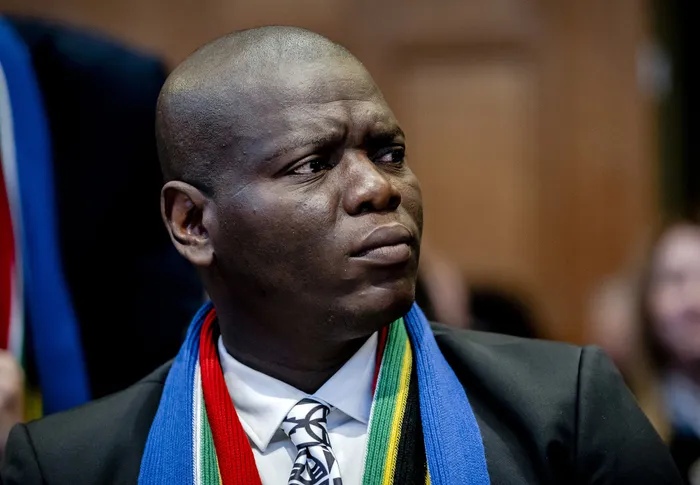
International Relations and Cooperation Minister Ronald Lamola has identified regional peace and security, industrialisation, infrastructure, youth development and orderly migration as South Africa’s key priorities as it takes over the chairpersonship of the Southern African Development Community (SADC).
Lamola accepted the chairpersonship on behalf of South Africa during the SADC Council of Ministers meeting in Durban this week, saying the country would use its tenure to advance regional integration, economic development and shared prosperity.
A major focus will be the region’s critical mineral wealth, with Lamola saying SADC must move away from exporting raw resources and instead prioritise beneficiation and the development of regional value chains.
“We accept this mandate fully conscious that this role does not belong to South Africa alone,” Lamola said.
“This is a collective responsibility that we must discharge in the interests of our Community.”
South Africa’s chairpersonship follows Zimbabwe’s tenure, with Zambia set to become the incoming chair.
Lamola said the first priority under South Africa’s leadership would be strengthening peace, security and stability, arguing that the security of individual member states was inseparable from the stability of the wider region.
He said SADC had a history of responding collectively to threats to peace and security and that regional solidarity remained important as the bloc confronted emerging political and security challenges.
A second priority will be accelerating industrialisation and economic transformation, with a particular focus on agriculture, critical-minerals beneficiation, regional trade and the development of regional value chains.
Lamola said the region had a significant opportunity to benefit from rising global demand for critical minerals, noting that nearly 30% of the world’s proven critical mineral reserves were located in the region.
The region also holds approximately 50% of global cobalt reserves and 20% of graphite reserves, he said.
However, Lamola warned that simply possessing these resources would not guarantee economic development.
“We know from earlier chapters in our unfolding story that our region’s wealth has nourished economies far and wide, while our own economies have remained trapped in old patterns of extractive accumulation,” he said.
He said SADC needed to move towards beneficiation at source, develop regional value chains and increase trade between member states.
Lamola said intra-regional trade currently accounted for only about 20%, which he described as far too low given the potential of the regional market.
South Africa’s chairpersonship will seek to implement objectives agreed at the SADC Skukuza retreat, including a target of achieving 50% intra-SADC trade and increasing beneficiation of critical minerals at source.
Infrastructure development will form another major pillar of the chairpersonship.
Lamola said reliable energy, efficient transport corridors, modern ports, integrated digital networks and dependable water systems were essential to connecting the region and supporting industrialisation.
He warned that without such infrastructure, regional manufacturing would struggle to expand and create jobs on the scale required.
Social and human capital development will also feature prominently, particularly given the continent’s young population.
Lamola said Africa had a median age of 19, with nearly 60% of its population under the age of 25.
By 2030, he said, one in four young people globally would be African.
“This means our economies and level of job creation must be at the same par with population growth,” he said.
He said the region’s development agenda would therefore also have to incorporate gender equality, climate resilience and disaster-risk management.
Lamola also addressed migration and human mobility, an issue that has become increasingly contentious in South Africa amid concerns over irregular migration, border integrity, access to economic opportunities and pressure on public institutions.
While acknowledging the concerns of South African citizens, Lamola rejected vigilantism and human rights violations against migrants.
“Addressing the challenges associated with irregular migration must occur within an orderly and lawful framework,” he said.
He argued that migration in the region could not be viewed solely as a security issue, as the movement of people was also linked to economic opportunities and employment.
Lamola pointed to Durban’s own history of industrial development, saying the city had benefited from labour drawn from the region and beyond.
He called on SADC member states to sign the protocol on the free movement of people, saying this would support regular and orderly migration within the region.
Lamola also welcomed SADC’s emphasis on the principle of subsidiarity during discussions on migration at the African Union Executive Council, arguing that the Southern African region was particularly affected by the issue.
The minister said SADC was operating in an increasingly uncertain global environment, marked by great-power competition, external shocks, climate disasters, the threat of pandemics and a shift towards inward-looking policies among advanced economies.
Against this backdrop, he said the region needed to strengthen its institutions and ensure that existing regional development frameworks translated into tangible improvements in people’s lives.
“The people of our Community yearn for a region where they can thrive, where their countries trade with each other, where advanced infrastructure connects them to their neighbours and where jobs and economic opportunities are plentiful,” Lamola said.
He said the Regional Indicative Strategic Development Plan 2020-2030 already provided the framework for achieving these ambitions, but warned that policy frameworks would only matter if they were translated into practical outcomes.
“As Southern Africa’s most industrialised economy, we recognise the duty and obligation to place our capabilities at the service of regional integration and shared prosperity,” he said.
Lamola said South Africa would approach its chairpersonship with humility and work with all SADC member states to advance the bloc’s priorities.
He added by wishing Zambia peaceful and free elections on Thursday, saying democracy remained central to the region’s development.