
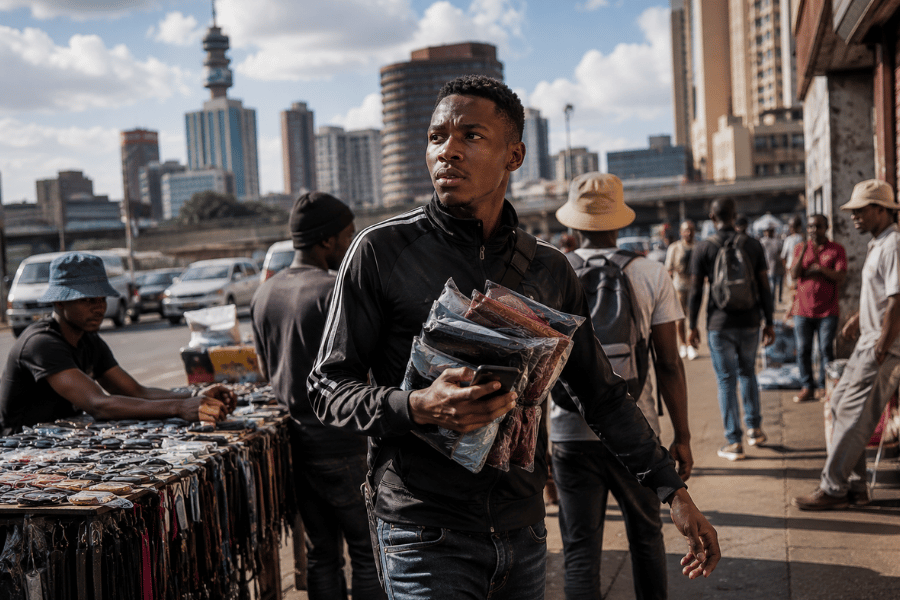
The young men and women who have built livelihoods as runners in Johannesburg’s inner city represent more than another informal business model. They represent resilience in the face of an economy that has failed to create enough jobs. Their experiences highlight both remarkable resilience and the urgent need for an environment where legitimate enterprise can flourish.
Many are graduates. Others have years of work experience but have been unable to find permanent employment. Instead of surrendering to unemployment, they have created businesses that connect customers with manufacturers, wholesalers and retailers.
For years, catalogue-based purchasing connected customers with factories and suppliers. This catalogue-based industry is the foundation of my personal entrepreneurial journey, defying the apartheid brutal race-based legislation that someone who looked like me could not freely operate a business. Today’s runnersin the city of Johannesburg and other cities have adapted that model to the digital age.
Many runners argue that they face unfair competition from traders, mostly illegal immigrants who are now stealing their databases and clientele and also bypass formal business requirements, while counterfeit goods continue to undermine legitimate commerce. These concerns warrant effective law enforcement and consistent application of the law.
Entrepreneurs in the mainly black areas are facing a myriad of challenges, largely including protected illegal foreign businesses, funded by who, only God knows.
The tragedy of Mazwi Kubheka, the young spaza shop owner who was kidnapped after allegedly refusing to surrender his business to criminal interests, is a stark reminder that South Africa is failing honest entrepreneurs. His ordeal exposed the frightening reality that organised criminal syndicates are increasingly dictating who may trade, where they may trade and under what conditions. To date the perpetrators are still not arrested and the justice system is failing Mazwi like many other South Africans.
The same justice system that has failed to dismantle these criminal networks is also failing Johannesburg’s runners, who continue to report intimidation, theft of clients, extortion and unfair competition with little meaningful intervention. When law-abiding South Africans are left to fend for themselves while criminals operate with impunity, the State ceases to be a protector of enterprise and instead becomes an enabler of lawlessness.
The deteriorating condition of Johannesburg’s roads where they operate including Bree Street and surrounding areas, reflects broader governance challenges. Poor infrastructure neglected public spaces and unreliable municipal services discourage investment and make it harder for entrepreneurs to succeed.
South Africans did not fight apartheid and sacrifice for freedom so that political elites could inherit the privileges once reserved for a few while ordinary citizens remained locked out of the economy.
We must ask ourselves a difficult but necessary question: was the struggle against apartheid meant to liberate all South Africans, or merely to create a new political class that enriches itself and illegal immigrants while millions of law abidingSouth Africans remain unemployed, excluded and without opportunity?
Years of corruption, cadre deployment and a complete absence of accountability have hollowed out our institutions, weakened law enforcement and created an environment where honest entrepreneurs are left vulnerable while politically connected individuals and criminal syndicates thrive. Until those responsible for this decline are held accountable, South Africa will continue to betray the very promise of its democracy.
Johannesburg’s runners deserve to be recognised as entrepreneurs whose experiences reveal both the potential of South Africans and the importance of a safe, well-managed and economically vibrant city.