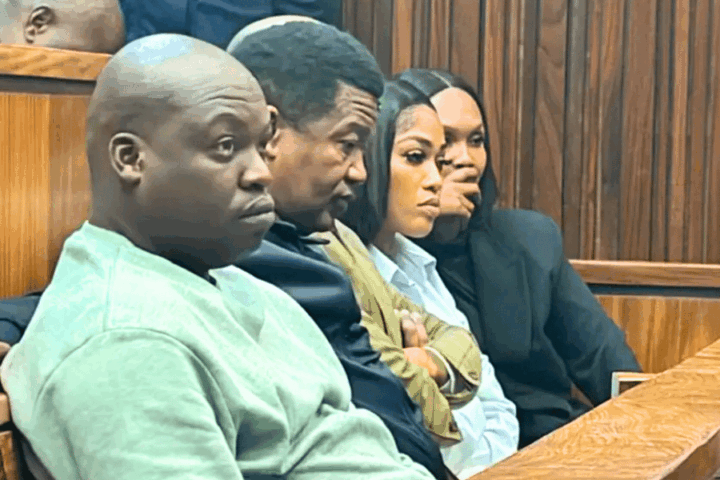
The indictment in the trial of Vusimuzi “Cat” Matlala reveals that the State’s case is built largely on a single legal doctrine: common purpose.
Across 25 charges and three separate shootings, the State’s theory is not that five people each committed their own crimes.
It is that they acted, in the words of the indictment, “in concert with one another” toward a shared end and that the law therefore holds each of them responsible for what the group did.
That idea is the doctrine of common purpose, and it is the thread on which this entire prosecution hangs.
Common purpose is a principle of South African criminal law that allows the State to hold each member of a group liable for a crime committed in pursuit of a shared objective, whether or not each person personally performed every act, or any of the physical acts at all.
If the State proves that individuals associated themselves with a common design and intended its result, the conduct of one can be attributed to all.
It exists for cases where a crime is committed by a group and it is difficult, or impossible, to prove exactly who did what.
A person who planned, who drove, who financed, who provided a vehicle, or who kept watch may be held as liable as the person who pulled the trigger.
How the indictment is built on it:
The structure of the charges shows the doctrine in action.
In each of the attempted murder counts arising from the three incidents, the indictment alleges that accused number 1, Musa Kekana and accused number 2, Tiego Floyd ‘Danny’ Mabusela carried out the shooting with the knowledge and on instruction of accused number 3, Vusimuzi ‘Cat’ Matlala.
Matlala is alleged to have instructed each of the three attacks.
Two other accused, Tsakani Matlala and Nthabiseng Zandile Nzama, are not alleged to have taken part in the shootings themselves. Instead, the State says they were involved in what happened before and after the attacks, the movement of money allegedly paid as compensation to kill and, in one instance, helping an offender after the crime had been committed.
The money laundering counts illustrate how the State intends to connect those who are not alleged to have been at any scene.
The State alleges that portions of what it calls the “compensation to kill” were transferred between the business accounts of three of the accused, ( from Matlala to Nzama and then to her father, Mabusela) in a recurring pattern.
On the State’s version, a bank transfer is capable of linking an accused to a common purpose as effectively as pulling the trigger or standing beside the shooter.
In its summary, the State alleges that the accused “acted in concert with one another, in the furtherance of a prior criminal agreement and/or common purpose” while conceding that it does not know exactly when or where that agreement was formed, or who all the parties to it were.
Why it matters for this trial:
The doctrine of common purpose is not only central to the indictment but is already shaping the course of this trial.
On Monday, 27 July, counsel for the fifth accused asked that her client be excused from hearing evidence said not to concern her.
The court refused, it held that because all five accused face charges based on the doctrine of common purpose, none can be treated as entirely separate from the case against the others.
It also helps explain why so much of the first week was spent arguing over evidence.
The State’s first witness could not identify the men who opened fire, he said it was dark.
It further explains why identification became the central battleground during the trial’s first week and on this week.
This also bears on the identification difficulty that dominated the first week.
Common purpose does not require the State to prove which accused held which weapon, only that they shared and pursued a common design. So the gaps in eyewitness identification, while significant, are not necessarily fatal to the State’s case.
None of this is proved. Each alleged connection, the instruction, the vehicles, the money, the prior agreement must be established in evidence and tested by the defence, and the doctrine itself requires the association and the shared intent to be proved, not assumed.
Common purpose is powerful precisely because it can convict those who never fired a shot, for that reason, courts have been careful to insist it not become a shortcut around proof.
But it explains the shape of everything to come.
The central question in this trial may not be what happened at three crime scenes, but whether the State can establish that all five accused knowingly participated in a single criminal enterprise and whether the evidence is strong enough to prove it.