As the fate of President Cyril Ramaphosa in the long-running Phala Phala controversy now rests in the hands of the Constitutional Court, ordinary South Africans are sharply divided over whether the country’s highest court will rule in his favour or hold him accountable.
The matter stems from the theft of millions of US dollars allegedly hidden inside furniture at Ramaphosa’s Phala Phala game farm in Limpopo in 2020. The scandal exploded into the public domain in 2022 after former State Security Agency boss Arthur Fraser laid criminal charges against the president, accusing him of money laundering, kidnapping and defeating the ends of justice.
An independent panel appointed by former National Assembly Speaker Nosiviwe Mapisa-Nqakula later found that Ramaphosa may have committed serious violations of the Constitution and the law, and recommended that Parliament consider impeachment proceedings against him.
However, an ANC-dominated Parliament voted against adopting the panel’s report, effectively shielding the president from impeachment. The decision prompted the Economic Freedom Fighters and the African Transformation Movement to approach the Constitutional Court, arguing that Parliament failed to exercise proper oversight and unlawfully protected Ramaphosa.
On Thursday,Africa Daily interviewed several Joburg residents who expressed differing views on what the judges should do.
Peter Baloyi from Hillbrow said he believed the court would ultimately side with Ramaphosa because powerful leaders are often protected.
“They always protect him. They delayed this matter because they were trying to come up with convincing reasons to justify why Parliament was right in dismissing that report,” he said.
Rosemary Duma also questioned whether the judiciary would truly act independently in a politically charged matter involving the president.
“Chief Justice Mandisa Maya was appointed by Cyril to the position. Do you honestly expect the court, which she leads, to rule against him? You cannot bite the hand that feeds you,” she said.
Others argued that despite the controversy surrounding the president, Ramaphosa had brought much-needed stability after the turbulent years under former President Jacob Zuma.
Freddy Ndima said South Africa could not afford another period of political instability.
“He may not have been what many of us expected, but he stabilised the country after years of instability and destruction under Zuma. The judges should take that into consideration and protect him because the country needs stability,” he said.
Molatelo Dube said the findings of the independent panel were not enough to prove criminal wrongdoing.
“That panel never said the president was guilty. It simply said he may have a case to answer. There was no conclusive evidence of corruption against him,” she said.
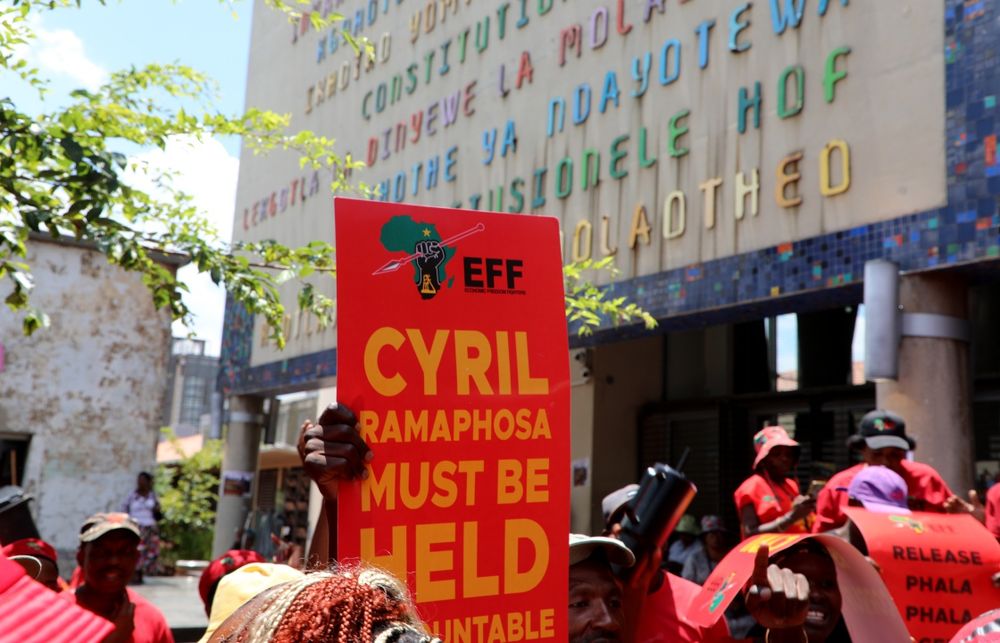
Lilly Ngudle dismissed the EFF and ATM court challenge as political opportunism.
“I think this case is about cheap political scoring. South Africa has far more serious issues like unemployment, crime and poverty. We cannot spend years fighting over money that belonged to the president himself,” she said.
But critics of the president insisted the matter strikes at the heart of accountability and the rule of law.
Thapelo Mosadi accused Parliament of failing the public by protecting Ramaphosa for political reasons.
“We are all equal before the law. You cannot keep millions of dollars hidden under mattresses and sofas and expect ordinary people not to ask questions. Parliament shielded him for political expediency,” he said.
Valley Lerole agreed, saying Ramaphosa should have stepped down when the panel’s findings were released.
“The president should have resigned instead of clinging to power. The Constitutional Court must hold him accountable because no one is above the law,” he said.