President Cyril Ramaphosa has called for deeper economic cooperation between South Africa and Zimbabwe, saying the two countries must address the imbalance in bilateral trade.
He urged for an expanded collaboration in infrastructure, mining, energy, agriculture and water.
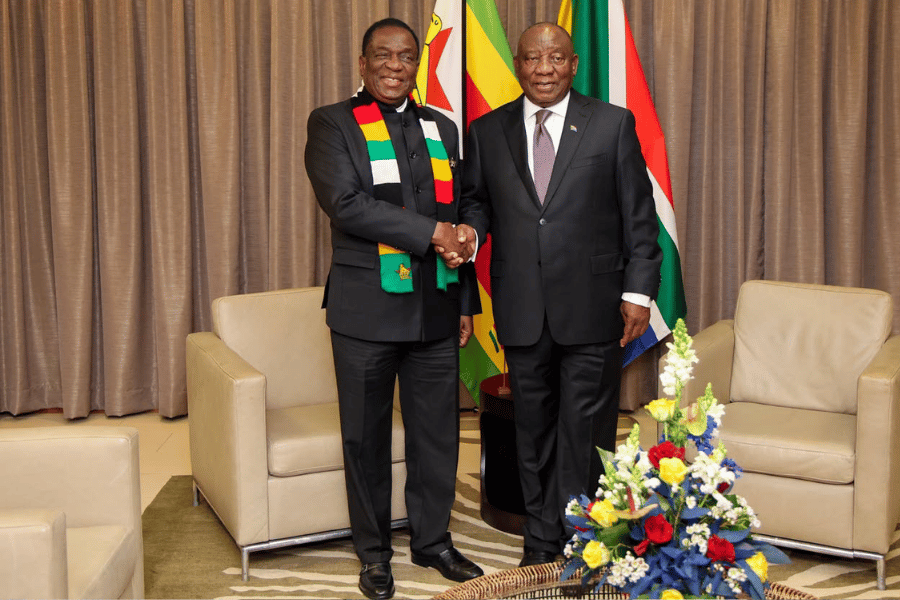
Ramaphosa was speaking on Friday at the opening of the fourth session of the South Africa-Zimbabwe Bi-National Commission (BNC) in Pretoria, where he welcomed Zimbabwean President Emmerson Mnangagwa and his delegation.
The meeting comes as the two countries seek to strengthen economic ties, with Ramaphosa noting that bilateral trade had almost doubled over the past four years.
However, he said the growth in trade had not been balanced, with South Africa exporting significantly more to Zimbabwe than it imports.
“Through instruments like the Memorandum of Understanding on Economic Cooperation, we need to work together to narrow this deficit,” Ramaphosa said.
He called for the two countries to use opportunities presented by the African Continental Free Trade Area to increase trade while expanding the range of goods produced and exported by both countries.
The president said the ministerial report to the BNC would assess progress and identify opportunities for cooperation in mining, energy, agriculture, transport, logistics and water management.
Ramaphosa also placed infrastructure development at the centre of the two countries’ economic ambitions, saying increased investment was necessary to support growth and trade.
He said South Africa’s Development Bank of Southern Africa and Industrial Development Corporation were prepared to invest in high-impact projects in Zimbabwe.
“These are projects that connect factories and farms to markets. Projects that connect power stations to businesses and homes. That connect dams to taps. That connect countries to their neighbours,” he said.
Mining and energy cooperation
Ramaphosa said South Africa and Zimbabwe should work together to ensure that the region’s mineral wealth translates into jobs and economic opportunities.
He highlighted Zimbabwe’s growing mining sector, particularly its production of gold, platinum and critical minerals such as lithium.
He said South Africa was increasing investment in mineral exploration and beneficiation and that both countries needed to move towards processing minerals locally rather than exporting raw resources.
“We have said for many years that our minerals should be processed at home, that we should export finished products. Together, we need to put that aspiration into practice,” he said.
The president also called for deeper cooperation in the energy sector, pointing to the potential of the Southern African Power Pool to help establish the region as a source of clean, affordable and reliable energy.
Water cooperation was another area highlighted by Ramaphosa, who pointed to an agreement to supply water from Zimbabwe’s Beitbridge Water Works to Musina as an example of bilateral cooperation aimed at meeting basic needs and strengthening resilience to climate change.
Food security and agriculture
Ramaphosa said the two countries should also make greater use of their agricultural potential to improve food security.
He called for intensified production and greater support for both communal and commercial farmers.
He referred to his visit to the Zimbabwe Agricultural Show last year, saying he had been impressed by the technology and services available to help industrialise farming.
He said stronger agricultural cooperation was particularly important as climate change and El Niño-related droughts continue to place pressure on water sources and grazing land.
Migration, border management
The president also called for continued cooperation on migration and border management, saying improved infrastructure and systems were needed to facilitate the movement of people and goods between the neighbouring countries.
He said the two countries must also strengthen efforts to combat trans-border crime.
Ramaphosa linked these efforts to the broader need to maintain peace and stability in Southern Africa and on the continent.
He expressed concern about ongoing instability in eastern Democratic Republic of the Congo, Cabo Delgado in Mozambique and Madagascar, while also highlighting the conflict in Sudan, the political impasse in South Sudan and armed insurgency in the Sahel.
“In a geopolitical environment that has become unpredictable and fractured, there is now even a greater need for the peaceful resolution of conflict, mediation and dialogue,” Ramaphosa said.
He also congratulated Zimbabwe on its election to a non-permanent seat on the United Nations Security Council for the 2027-2028 term.
Ramaphosa said he expected Zimbabwe to use its position to draw international attention to conflicts hindering Africa’s development and to mobilise support for African-led efforts to resolve them.
The president concluded emphasised the historic relationship between the two countries, recalling Zimbabwe’s support for South Africa during the struggle against apartheid.
“We are two countries with a common history and a common destiny,” he said.
Ramaphosa said the BNC should produce concrete outcomes for citizens, including more inclusive economies, employment and sustainable livelihoods.