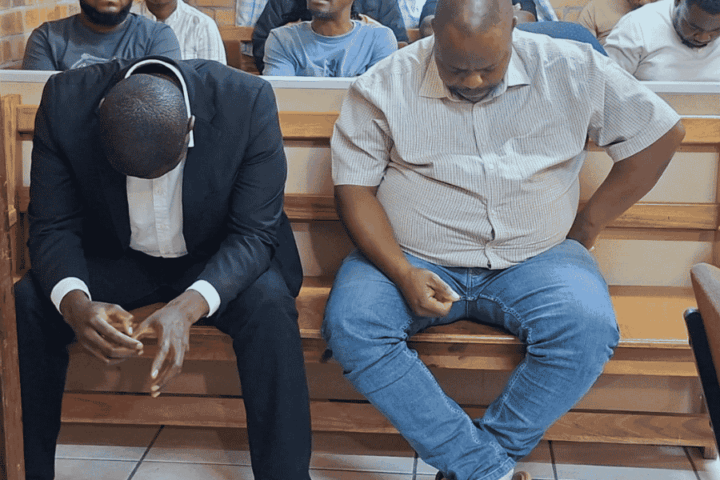
A doctor who examined Matlala co-accused Musa Kekana has conceded that she could not rule out suffocation as a possible cause of the blood he reported coughing up, while insisting that she could not conclude that the alleged assault caused it.
Dr Panicker Pooja told the Gauteng High Court in Johannesburg that her examination of Kekana revealed bilateral opacifications on his chest X-ray.
She explained that the finding was non-specific and could have several causes.
Asked whether the white areas on the X-ray could represent blood in the lungs, Panicker said:
“It could be blood in the lungs.”
Counsel for accused number 1, Riaan Gissing then put a much more direct proposition to her, could severe suffocation cause bleeding in the lungs?
She answered: “Yes, it can.”
But when counsel sought to establish whether this supported Kekana’s allegation that he had been suffocated, Panicker resisted the conclusion. “The X-ray findings are nonspecific,” she said.
She said the blood could have been caused by an infection. Her evidence was that her principal differential diagnosis at the time was an effective process, based largely on Kekana’s reported two-week cough, night sweats, weight loss and yellow sputum.
She therefore assessed him as suffering from a lower respiratory tract infection and queried pulmonary tuberculosis.
Yet the doctor conceded that suffocation remained a possibility.
The defence then sought to establish whether the absence of another definitive diagnosis meant suffocation was the only reasonable explanation for the haemoptysis. Panicker rejected that.
“I can’t make that conclusion because we don’t know what the blood results showed. We don’t have the report, if it was done. We don’t have any evidence to make that conclusion,” she said.
The court also heard that the April admission contained no blood-test results, despite Panicker saying that blood tests had been ordered.
She said the hospital’s laboratory did not operate after hours and that the results were still pending when Kekana was transferred.
Another contentious issue was the history of the alleged assault. Panicker’s original notes recorded that Kekana told her he had been suffocated at a police station and had subsequently coughed up red blood with sputum.
But she did not record that a plastic bag had allegedly been used. She rejected the suggestion that this necessarily meant her history was wrong.
She also pointed to another medical note recording a two-week history of coughing, saying this supported her original documentation.
The defence challenged her over another note which recorded only one day of coughing. Panicker acknowledged the discrepancy. “I do see a discrepancy,” she said.
But she said other doctors’ notes should also be considered before concluding that her history was inaccurate. The doctor repeatedly emphasised that the information in the presenting-complaint section came from Kekana himself.
“All the information I have written in this document was given to me by the patient. I do not have any interest in the case, or I did not know there was a case,” she added.
Panicker said her role was to assess and stabilise Kekana medically, not investigate whether he had been assaulted.
She acknowledged that she had not taken a detailed history about the alleged suffocation. Asked whether she could have taken a more detailed history, she said: “I could have taken a more detailed history, yes.”
But she rejected the suggestion that her notes were inadequate. The court also heard that Panicker could not independently remember the patient or the consultation. She said she relied on her notes.
Asked whether she could identify any of the accused in court, she said: “No.”
The defence further challenged her over the lack of a J88 form, the absence of blood-test results and the extent of the physical examination conducted for signs of suffocation.
Panicker maintained that she had examined Kekana’s systems, including his ears, nose and throat, but acknowledged that her notes did not specifically state that she had examined him for signs of suffocation.
The trial continues.