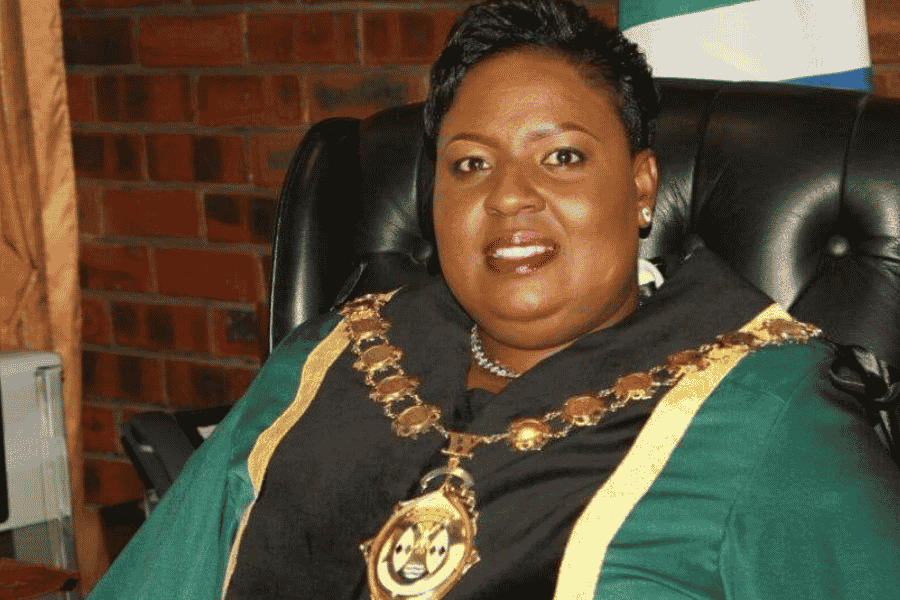
Correctional Services Deputy Minister Lindiwe Ntshalintshali has publicly broken ranks with her boss, Pieter Groenewald.
She accused the department’s leadership of working in silos after its disastrous audit outcome.
She further revealed that her advice to challenge the Auditor-General in court was rejected.
“I remain convinced that the department could have obtained a better audit opinion than a disclaimer. I think this is a matter we should follow up on,” Ntshalintshali told Parliament’s Portfolio Committee on Correctional Services on Tuesday, 13 October.
Her criticism exposed a growing rift at the top of the Department of Correctional Services (DCS), with Groenewald confirming that he personally blocked a proposed court challenge.
“The national commissioner discussed it with me. He wanted to go to court. And I said no,” Groenewald told MPs.
The department received a disclaimer of audit opinion for the 2025/26 financial year, a serious outcome that signals the Auditor-General could not obtain sufficient appropriate audit evidence to support an opinion on the financial statements.
Ntshalintshali said the department had deteriorated under the current leadership.
“We found this department with an unqualified opinion when we came in. And under the leadership of the minister, we found ourselves with this,” she said.
She said she had advised National Commissioner Makgothi Thobakgale to challenge the audit outcome, but the necessary permission was not granted.
“My advice to the national commissioner was: why not challenge this? And that permission was never granted,” she said.
“I think we’ve shot ourselves in the foot,” she said.
Groenewald defended his decision not to litigate, arguing that a court fight between state institutions would waste taxpayers’ money.
“We respect them as a Chapter 9 institution. I said to the national commissioner, let’s live with the disclaimer and it must be a challenge to us,” he said.
Asked later whether he was willing to take the matter to court, he was unequivocal: “I do not. Not at all,” he said.
But Ntshalintshali’s criticism went beyond the decision to abandon litigation.
She accused the department’s leadership of keeping her out of crucial discussions and leaving her to learn about serious problems through the media.
“I’ve gone through the report myself, and it’s so bad that some of the matters, you learn about them in the media,” she said.
“There’s no executive meeting that was set where the deputy minister was part of it,” she continued.
She said that the department would struggle to turn its performance around while its leadership operated separately.
“If we work and continue working in silos, we’re not going to win this, because it is on our table. It is under our leadership,” she said.
Groenewald declined to elaborate on the dispute in the committee meeting.
“I’m not going to elaborate on this platform. I have an open door. The DM is welcome,” he said.
He said the disclaimer had been in the media since 27 September and that Ntshalintshali had not contacted him.
“I was not contacted by the DM,” he said.
Ntshalintshali did not back down. Asked about the minister’s open-door remark, she said: “I will reserve my comments.”
She said the ministry would “explore the open-door approach and ensure that we understand when we are acting as a ministry and when we are operating independently, ”she said.
ANC MP Mogodu Samuel Moela said the lack of teamwork was evident.
“I could sense, Honourable Chairperson, that the teamwork is a bit lacking. We need a team that speaks in one language,” he said.
He said the minister’s open-door policy should extend to his deputy so they could improve their working relationship and, in turn, the department’s performance.
Committee chairperson Kgomotso Ramolobeng challenged the executive over the department’s decline.
“How do we get to a disclaimer two years later under your leadership?” she asked.
Groenewald questioned the process that produced the final audit opinion.
He told MPs that the Auditor-General’s team had reached an unqualified opinion with findings on 21 July, before the outcome changed to a disclaimer about a week later.
“Then an individual who was not part of the team makes a decision that it is a disclaimer,” he said.
Thobakgale acknowledged that the 21 July report was a draft. He said he had followed the dispute process in the department’s engagement letter with the Auditor-General, apart from taking the matter to court.
The commissioner said he signed the management representation letter even though he disagreed with the audit opinion.
The Auditor-General attributed the disclaimer to systemic record-keeping failures and falsified or altered supporting documentation that compromised management integrity, according to a parliamentary statement.
The audit crisis comes amid separate concerns about the department’s procurement controls.
In September, Groenewald announced the suspension of four officials, including the chief financial officer, over alleged irregularities involving a R1.6-billion coal-supply tender. A case was opened with the Hawks.
Groenewald told MPs that the Auditor-General had flagged 54 of the 74 suppliers appointed under the tender, including suppliers whose documents he said had been manipulated or altered after bids closed.
He said “not one single cent” had been paid on the tender.
The coal-tender allegations should not be conflated with the disclaimer, the available evidence does not establish that the tender itself caused the audit outcome.
By the end of the meeting, Ntshalintshali said the department had dealt comprehensively with the issues raised by MPs.
But her public criticism left a question hanging over the department’s leadership.