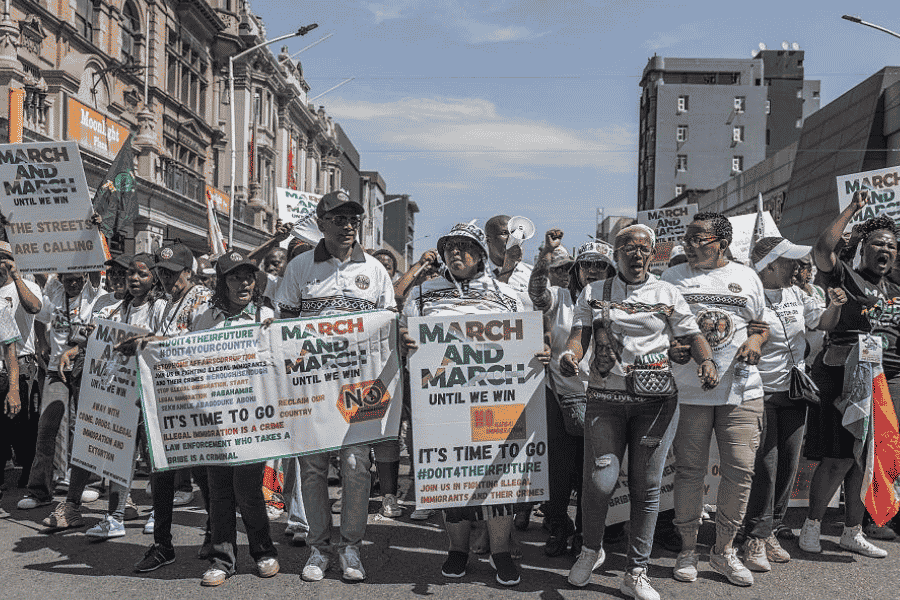
March and March was back on the streets on Wednesday, staging a national day of action that fused two explosive issues — gender-based violence and femicide (GBVF) and illegal immigration.
What was initially billed as a national shutdown against undocumented foreigners became a dual protest, after a wave of femicide cases and public outrage over the killing of women forced the movement to broaden its focus.
But the organisation’s core message has not changed.
“You can not dissociate the March and March movement from illegal immigration. Our primary focus has always been an anti-illegal immigrant stance,” spokesperson Sandile Dube said.
“But equally, you can not be stuck on that stance while there are developments in the country which affect the people of South Africa. In any case, a fight against gender-based violence has always been one of our pillars.”
The movement’s latest mobilisation comes as South Africa faces renewed pressure on both fronts — a GBV crisis that government itself has described as a national disaster, and a fierce, often volatile public debate over undocumented immigration.
March and March demanded that men take centre stage.
“We’ve called men to come out in all of this to say men cannot be silent when women are being murdered,” Dube said.
“I want to show that message very, very clearly to say it cannot happen in our name, on our watch as men.”
While the protest was directed at men, Dube said women were also welcome to join.
In Pretoria, hundreds gathered at Church Square before marching through the city centre and into Sunnyside — a densely populated suburb the movement deliberately targeted — en route to the Union Buildings.
Dube said the route through Sunnyside was chosen to “make as much noise against the killing of women as possible.”
At the Union Buildings, the group was expected to hand over a memorandum to Minister in the Presidency for Women, Youth and Persons with Disabilities, Sindisiwe Chikunga.
Similar demonstrations were planned in Durban, where marchers were set to move from Albert Park to the provincial police headquarters, as well as in Cape Town and other major centres.
The movement insisted its protests would remain peaceful.
“We can’t defend a looter. We can’t defend a person that breaks property,” Dube said.
The action in Gauteng follows a march in Qwaqwa in the Free State on Tuesday, where activist Nkosikhona “Phakelumthakathi” Ndabandaba addressed supporters and vowed that the group would continue demonstrating until government acted on both illegal immigration and GBV.
March and March has become known for its hardline stance on undocumented immigration, staging a series of shutdowns and marches in recent months demanding mass deportations, stricter border enforcement, and audits of spaza shops and businesses employing foreign nationals.
Its critics accuse it of xenophobia — a charge it denies, saying it is targeting illegality, not nationality.
The movement tied the two issues together, arguing that crime, GBV and illegal immigration are interconnected and require a coordinated state response.
Dube was critical of government’s handling of GBV, accusing it of public relations over operations.
“I think the government has done a very good public relations exercise on the issue of gender-based violence, not necessarily operationalising it,” he said.
The comment lands as President Cyril Ramaphosa faces mounting pressure to declare GBV a national disaster and as Gauteng Premier Panyaza Lesufi convenes an emergency safety council with mayors and law enforcement this week.
The group says it will not choose between fighting GBV and fighting illegal immigration — it will do both, at once.
“The latest action, therefore, combines March and March’s continued opposition to undocumented immigration with its call for men to take a stronger stand against GBV,” Dube said.
The movement has indicated it intends to continue demonstrating and putting pressure on government, with more marches expected in the coming weeks.